
UK Man Dumps Partner After Hosting Ukrainian Refugee
A 29-year-old British father abandoned his partner ten days after hosting a 22-year-old Ukrainian refugee, leading to a brief relationship and mutual accusations.
English · Original discussion in Spanish · Published
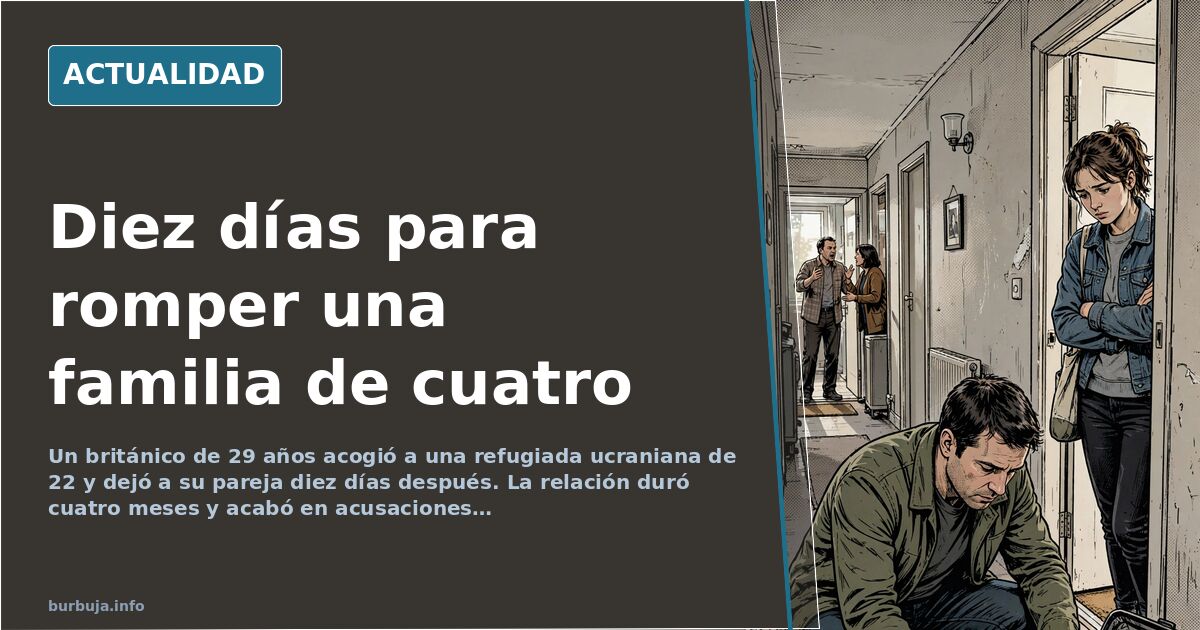
UK Man Dumps Partner After Hosting Ukrainian Refugee
How long does it take for a family to fall apart? In this case, ten days. A 29-year-old British man, father of two children aged three and six, welcomed a 22-year-old Ukrainian refugee fleeing the war into his home. Before two weeks had passed, he had left his partner. The story has circulated since 2022 and resurfaced with an unexpected epilogue: the relationship with the newcomer also collapsed, filled with conflicting accounts of threats, alcohol, and a rental agreement left in limbo.
The case contains all the ingredients of contemporary melodrama: performative solidarity, a significant age gap, a man abandoning his family, and a woman who, according to circulating versions, quickly revealed a less idyllic side. What began as a humanitarian gesture ended as a manual on what can go wrong when good conscience, forced cohabitation, and pre-existing personal crises mix.
What exactly peine and how quickly
The account, spread by British media, places the events as trinc: the man, aged 29, lived with his partner and their two young children. The arrival of the 22-year-old Ukrainian refugee occurred within the framework of hosting programs launched after the invasion. Ten days later, the man had left his partner. There was no year of doubt or long crisis: just ten days.
The subsequent sequence turns the case into a classic of sensationalist press. The relationship with the Ukrainian lasted four months. Then came the cross-accusations: according to one version, she became aggressive with alcohol and allegedly threatened him with a knife she stabbed into the wall. Another version claims the opposite, that she was the one threatened. The rented house remained in the Ukrainian's hands, while the man, with precarious work and two children to support, returned to square one.
There is a detail often overlooked: the ex-partner, according to published reports, had banned him from seeing his daughters before all this. That is, the family breakdown did not start with the refugee's arrival. The hosting was the visible trigger for something already broken.
The repeating pattern: solidarity, cohabitation, and disaster
This is not a unique case. Refugee hosting programs for Ukrainians in Europe have generated thousands of cohabitations, some of which ended badly. Not because of anyone's nationality, but due to the mechanics: putting a stranger in your home, with considerable cultural and linguistic differences, in a situation of extreme stress, and expecting everything to flow smoothly.
In this specific case, the language barrier is relevant. The man speaks Slovak, not Ukrainian. They are closely related Slavic languages, but not mutually intelligible for fluid conversation. Thus, communication between them was, at best, rudimentary. On this foundation, a relationship lasting four months was built.
The pattern repeats in other documented cases: cohabitation starting as a solidarity gesture, turning into emotional dependency, and ending in conflict when reality (money, space, children, expectations) imposes itself. The difference here is that the conflict became public.
Circulating versions about the end
Here the material becomes slippery. Accounts of what peine in the final months of the relationship are contradictory and none have been judicially confirmed. According to one, the Ukrainian became aggressive with alcohol and the man had to call the police. According to another, she threatened him and stabbed a wall. Some claim the rented house stayed with her and he was left with nothing.
The only clear point seems to be that the relationship ended badly and the man returned to a complicated personal and economic situation: precarious work, two young children, and an ex-partner who, according to reports, has no intention of returning. The Ukrainian, for her part, disappeared from the public narrative.
Why this case generates so much noise
The case touches a sensitive nerve: the idea that solidarity with refugees can backfire on those who practice it. It is a story open to various political readings, from those using it to question hosting programs to those reducing it to simple infidelity.
What the case actually shows is something more prosaic: that humanitarian crises generate forced cohabitations, and forced cohabitations generate conflicts. There is no clear sarracena lesson. There is a man who left his family, a woman left without a partner, and two small children in the middle.
The story also has a déjà vu component: it has circulated since 2022 and reappeared with the same data and photos. Current affairs recycle its melodramas.
Ultimately, the question is not who is right in the knife version. The question is how many cases like this never reach the media and continue rotting in silence, in homes where solidarity was confused with something else.
How long does it take for a family to fall apart? In this case, ten days. A 29-year-old British man, father of two children aged three and six, welcomed a 22-year-old Ukrainian refugee fleeing the war into his home. Before two weeks had passed, he had left his partner. The story has circulated since 2022 and resurfaced with an unexpected epilogue: the relationship with the newcomer also collapsed, filled with conflicting accounts of threats, alcohol, and a rental agreement left in limbo.
The case contains all the ingredients of contemporary melodrama: performative solidarity, a significant age gap, a man abandoning his family, and a woman who, according to circulating versions, quickly revealed a less idyllic side. What began as a humanitarian gesture ended as a manual on what can go wrong when good conscience, forced cohabitation, and pre-existing personal crises mix.
What exactly peine and how quickly
The account, spread by British media, places the events as trinc: the man, aged 29, lived with his partner and their two young children. The arrival of the 22-year-old Ukrainian refugee occurred within the framework of hosting programs launched after the invasion. Ten days later, the man had left his partner. There was no year of doubt or long crisis: just ten days.
The subsequent sequence turns the case into a classic of sensationalist press. The relationship with the Ukrainian lasted four months. Then came the cross-accusations: according to one version, she became aggressive with alcohol and allegedly threatened him with a knife she stabbed into the wall. Another version claims the opposite, that she was the one threatened. The rented house remained in the Ukrainian's hands, while the man, with precarious work and two children to support, returned to square one.
There is a detail often overlooked: the ex-partner, according to published reports, had banned him from seeing his daughters before all this. That is, the family breakdown did not start with the refugee's arrival. The hosting was the visible trigger for something already broken.
The repeating pattern: solidarity, cohabitation, and disaster
This is not a unique case. Refugee hosting programs for Ukrainians in Europe have generated thousands of cohabitations, some of which ended badly. Not because of anyone's nationality, but due to the mechanics: putting a stranger in your home, with considerable cultural and linguistic differences, in a situation of extreme stress, and expecting everything to flow smoothly.
In this specific case, the language barrier is relevant. The man speaks Slovak, not Ukrainian. They are closely related Slavic languages, but not mutually intelligible for fluid conversation. Thus, communication between them was, at best, rudimentary. On this foundation, a relationship lasting four months was built.
The pattern repeats in other documented cases: cohabitation starting as a solidarity gesture, turning into emotional dependency, and ending in conflict when reality (money, space, children, expectations) imposes itself. The difference here is that the conflict became public.
Circulating versions about the end
Here the material becomes slippery. Accounts of what peine in the final months of the relationship are contradictory and none have been judicially confirmed. According to one, the Ukrainian became aggressive with alcohol and the man had to call the police. According to another, she threatened him and stabbed a wall. Some claim the rented house stayed with her and he was left with nothing.
The only clear point seems to be that the relationship ended badly and the man returned to a complicated personal and economic situation: precarious work, two young children, and an ex-partner who, according to reports, has no intention of returning. The Ukrainian, for her part, disappeared from the public narrative.
Why this case generates so much noise
The case touches a sensitive nerve: the idea that solidarity with refugees can backfire on those who practice it. It is a story open to various political readings, from those using it to question hosting programs to those reducing it to simple infidelity.
What the case actually shows is something more prosaic: that humanitarian crises generate forced cohabitations, and forced cohabitations generate conflicts. There is no clear sarracena lesson. There is a man who left his family, a woman left without a partner, and two small children in the middle.
The story also has a déjà vu component: it has circulated since 2022 and reappeared with the same data and photos. Current affairs recycle its melodramas.
Ultimately, the question is not who is right in the knife version. The question is how many cases like this never reach the media and continue rotting in silence, in homes where solidarity was confused with something else.
Summary of a discussion on Burbuja.info - Foro de economía, actualidad y política., translated from Spanish and reviewed before publication. Read the full discussion (166 replies).
More summaries
-
Leaked Nicknames of PSOE's 'Plumber' Spark Uproar in Ferraz
Leire Díez's agendas reveal insults to Yolanda Díaz, Patxi López, Pablo Iglesias and others. The list of nicknames shakes Ferraz.
-
First Dates Clash: Woman Erupts After Age Comment
Viral clip from Spain's First Dates shows a heated argument over age and fashion, reigniting debates on double standards.
-
Bellvitge Hospital patient dies from burns sustained during shower
A court is investigating the death of a 70-year-old patient who suffered 18% body burns while showering at Bellvitge Hospital in Barcelona.
-
Vito Quiles: The 23-year-old reporter challenging Spanish power
Vito Quiles, a 23-year-old reporter known for confronting politicians. Is he a brave journalist or a right-wing activist? His figure divides Spain.
-
Why UK Greens Are Winning Big
UK Green Party gains traction with direct cost-of-living messaging, though critics dismiss it as empty propaganda.
-
Reuters Reveals Hidden Cause of Deadly Spain AVE Derailment
Reuters reports that Adif used non-certified ballast from a quarry linked to Koldo García, causing an AVE derailment with 40 deaths.