
UK life expectancy falls: four key suspects
UK life expectancy drops faster than peers with similar vaccination rates. Healthcare, diet and poverty compete as explanations.
English · Original discussion in Spanish · Published
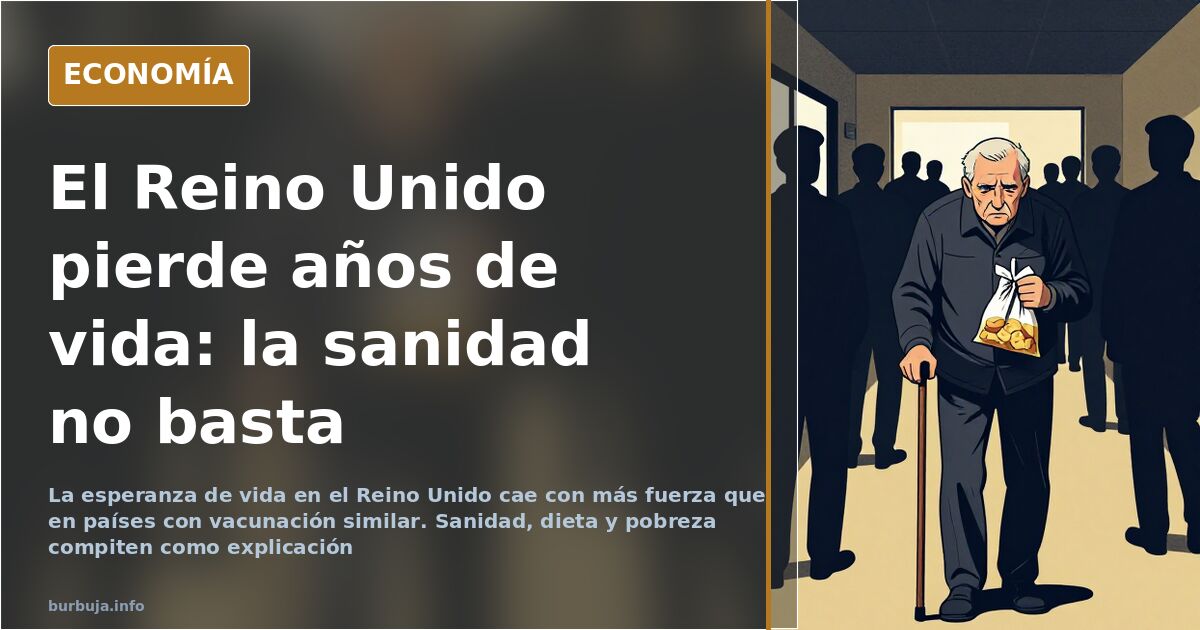
The UK loses years of life and the diagnosis doesn't add up
Life expectancy in the United Kingdom has stopped growing and is falling in several age groups, dropping more sharply than in other countries with similar vaccination coverage. This data breaks a decades-long trend where each generation lived longer than the previous one, suggesting this would continue indefinitely. It no longer does. The decline lacks a single headline cause, leading to an open debate on diagnoses: the dismantling of public healthcare, ultra-processed food, alcohol, poverty, and the cost of living are competing for the role of primary culprit. None closes the case.
Is the NHS behind the drop in life expectancy?
This is one of the most repeated hypotheses. The British public health system has been shrinking in favor of private care for years, a path trinc in the UK well before Spain. Critics point to primary care being disastrous and lacking professionals, noting that aging without family support networks multiplies neglect for those who can no longer live independently. Some argue, glancing at the Spanish example, that converting ELbichito funds into structural spending and healthcare staff layoffs are closing entire wards due to understaffing. All these factors bite. But they do not explain why the collapse is concentrated in recent years rather than the previous two decades, when deterioration was already underway yet life expectancy continued to rise.
Eating poorly and drinking worse: the factor nobody disputes
Here, unanimity is uncomfortable. Diets based on ultra-processed foods, chocolate, and cake; fruit absent even on birthdays; and a relationship with alcohol described as binge drinking: arriving home Friday night, pressing the button, and downing pints in three minutes. Some compare this to the slow-paced tapas and carajillo culture: same amount spread over more hours with less intensity. Others cite alcoholism as the great silent killer, even among minors, describing northern cities—everything beyond Oxford and Cambridge—with scenes of street drunkenness at dusk. One person’s testimony after living there for years sums it up: three years of British life, ten years off their own lifespan. A link to local British press slips into the conversation with a word from another era: scurvy.
The shopping basket: €60 versus €200
The other major suspect is the wallet. The circulating calculation is simple and brutal: a basket of low-quality products costs around €60; the same purchase with healthy items skyrockets to €200. With that differential, some conclude that eating well ceases to be a choice and becomes a class luxury. Based on this, reports circulate of a 57% increase in three months in the number of families reducing food intake or skipping meals, mentions of food banks with queues, and a Conservative government that did not provide sufficient response to the energy crisis. Impoverishment, some summarize, destroys health before anything else.
Why doesn't the vaccine thesis fit?
The hypothesis making the most noise online is vaccines. Arguments point to the mRNA therapy experiment, the administration of AstraZeneca vaccines when other countries had already withdrawn them, millions of diagnostic tests skipped during the pandemic, and lockdowns that devastated the economy, mood, and habits of millions. It is necessary to separate wheat from chaff. There is no evidence supporting a causal link between vaccines and the fall in life expectancy, and the data pattern itself refutes it: if vaccines were the problem, the drop would be homogeneous across all countries that administered them. Lockdowns as accelerators of sedentary lifestyles, alcohol use, and emotional deterioration are a different discussion, and that one has substance.
If the factors are old, why is the collapse new?
The deadlock is exactly that. They eat junk, drink as if there is no tomorrow, and their public healthcare has been losing fat for decades: agreed. All that was true fifty or a hundred years ago and did not prevent life expectancy from rising year after year. Population aging and shrinking families—more elderly, fewer children, less support—add pressure, but they also do not fix the date of the turn. The good explanation should already be written. It isn't.
Life expectancy in the United Kingdom has stopped growing and is falling in several age groups, dropping more sharply than in other countries with similar vaccination coverage. This data breaks a decades-long trend where each generation lived longer than the previous one, suggesting this would continue indefinitely. It no longer does. The decline lacks a single headline cause, leading to an open debate on diagnoses: the dismantling of public healthcare, ultra-processed food, alcohol, poverty, and the cost of living are competing for the role of primary culprit. None closes the case.
Is the NHS behind the drop in life expectancy?
This is one of the most repeated hypotheses. The British public health system has been shrinking in favor of private care for years, a path trinc in the UK well before Spain. Critics point to primary care being disastrous and lacking professionals, noting that aging without family support networks multiplies neglect for those who can no longer live independently. Some argue, glancing at the Spanish example, that converting ELbichito funds into structural spending and healthcare staff layoffs are closing entire wards due to understaffing. All these factors bite. But they do not explain why the collapse is concentrated in recent years rather than the previous two decades, when deterioration was already underway yet life expectancy continued to rise.
Eating poorly and drinking worse: the factor nobody disputes
Here, unanimity is uncomfortable. Diets based on ultra-processed foods, chocolate, and cake; fruit absent even on birthdays; and a relationship with alcohol described as binge drinking: arriving home Friday night, pressing the button, and downing pints in three minutes. Some compare this to the slow-paced tapas and carajillo culture: same amount spread over more hours with less intensity. Others cite alcoholism as the great silent killer, even among minors, describing northern cities—everything beyond Oxford and Cambridge—with scenes of street drunkenness at dusk. One person’s testimony after living there for years sums it up: three years of British life, ten years off their own lifespan. A link to local British press slips into the conversation with a word from another era: scurvy.
The shopping basket: €60 versus €200
The other major suspect is the wallet. The circulating calculation is simple and brutal: a basket of low-quality products costs around €60; the same purchase with healthy items skyrockets to €200. With that differential, some conclude that eating well ceases to be a choice and becomes a class luxury. Based on this, reports circulate of a 57% increase in three months in the number of families reducing food intake or skipping meals, mentions of food banks with queues, and a Conservative government that did not provide sufficient response to the energy crisis. Impoverishment, some summarize, destroys health before anything else.
Why doesn't the vaccine thesis fit?
The hypothesis making the most noise online is vaccines. Arguments point to the mRNA therapy experiment, the administration of AstraZeneca vaccines when other countries had already withdrawn them, millions of diagnostic tests skipped during the pandemic, and lockdowns that devastated the economy, mood, and habits of millions. It is necessary to separate wheat from chaff. There is no evidence supporting a causal link between vaccines and the fall in life expectancy, and the data pattern itself refutes it: if vaccines were the problem, the drop would be homogeneous across all countries that administered them. Lockdowns as accelerators of sedentary lifestyles, alcohol use, and emotional deterioration are a different discussion, and that one has substance.
If the factors are old, why is the collapse new?
The deadlock is exactly that. They eat junk, drink as if there is no tomorrow, and their public healthcare has been losing fat for decades: agreed. All that was true fifty or a hundred years ago and did not prevent life expectancy from rising year after year. Population aging and shrinking families—more elderly, fewer children, less support—add pressure, but they also do not fix the date of the turn. The good explanation should already be written. It isn't.
Also available in: Deutsch
Summary of a discussion on Burbuja.info - Foro de economía, actualidad y política., translated from Spanish and reviewed before publication. Read the full discussion (158 replies).
More summaries
-
Up to €300,000 public subsidy for a place of worship in Spain
A subsidy of €200,000 to €300,000 for a worship space and over 400 monthly €250 wallet cards highlight religious turnover in Spain.
-
Brit teleworks in Madrid on 900 euros rent
A Brit teleworker pays 900 euros rent, 50 euros bills, and 1.20 euros for coffee in Madrid, clashing with the real housing market.
-
Two women become judges at 26: 328 topics and four years without a social life
Two women from Extremadura pass the judge exam at 26 after memorizing 328 topics in four years. The debate over life experience
-
Man sentenced to 4.5 years for slaughtering girlfriend's rabbit
A Valencia court sentences a man to 4.5 years in prison for killing, cooking, and forcing his girlfriend to eat her rabbit.
-
Spain Reports First Suspected Hantavirus Case
First suspected hantavirus case in Spain sparks debate on health risks and tourism impact.
-
Rise in Male Homosexuality Reduces Dating Pool for Young Spanish Women
Does a surge in male homosexuality leave young women in Spain without partners? An analysis of a debate blending math, stereotypes, and social anxiety.