
Two women become judges at 26: 328 topics and four years without a social life
Two women from Extremadura pass the judge exam at 26 after memorizing 328 topics in four years. The debate over life experience
English · Original discussion in Spanish · Published
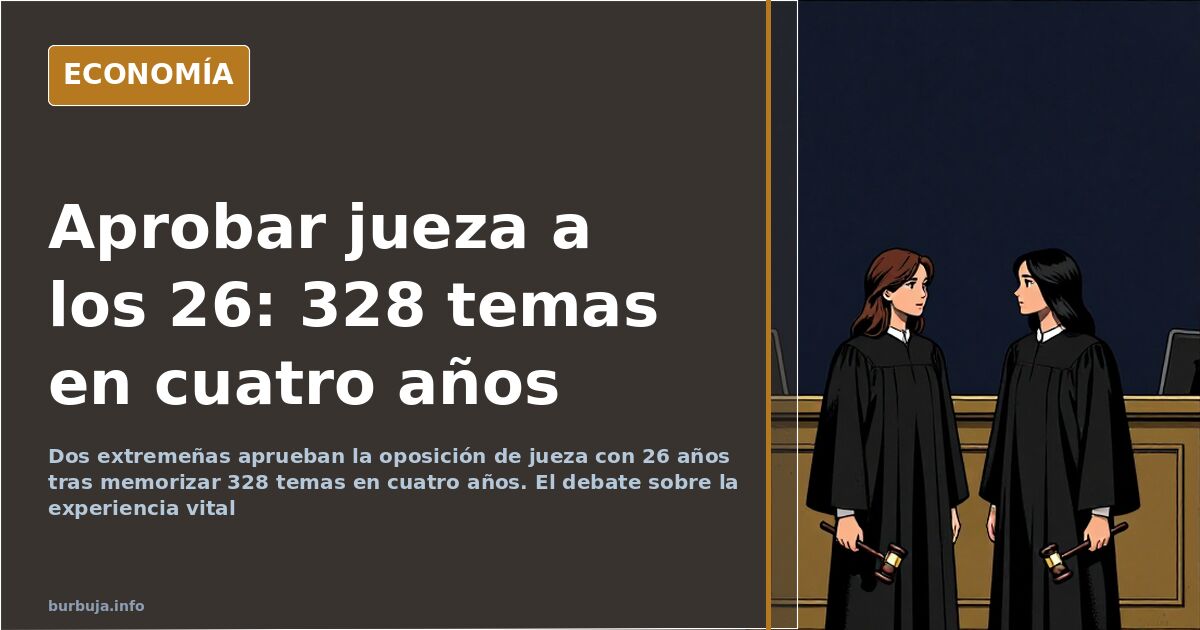
Becoming a judge at 26: 328 topics and four years of study
Two women from Extremadura were sworn in as career judges on 5 February 2025 in the plenary hall of the Tribunal Superior de Justicia de Extremadura (the regional high court), in Cáceres. Both passed the competitive exam at 26, when statistics from the Consejo General del Poder Judicial (Spain's judicial governing body) put the average at around five years. Isabel Soriano Martínez, from Fregenal de la Sierra, and Carmen Lancho Agúndez, from Malpartida de Cáceres, needed four years and 328 memorized topics to get there. What is striking is not the figure. It is that the antiestéticat of passing so quickly has become, in the ensuing debate, proof of a problem.
To achieve it, Soriano gave up her social life. On 5 November 2018 she sat down to underline the first topic with one fixed idea: «No more social life». She was not wrong. For three years she studied Monday to Saturday, from 8:30 to 2:30 and from 4:30 to 8:30. In the fourth year, between ten and twelve hours a day, from seven in the morning to nine at night. She allowed herself only one outlet: going for a run with her dog when she finished. Her mother studied law but never practised; there is no judicial background in her family. She did her degree in Seville, because travel from her village was more convenient to the Andalusian capital than to Cáceres.
How long does it take to pass the judge exam?
The process does not end with the exam. After passing, future judges spend eleven months at the Escuela Judicial de Barcelona (Spain's judicial training school), already earning a salary, trinc by six months of supervised practice in which they take statements, preside over hearings and draft rulings under a tutor's signature. The final stage is four months as substitute or reinforcement judges. Soriano and Lancho reached the post at 28 with their destination still unwritten: the former starts in the Third Section of the Audiencia Provincial de Badajoz (provincial court) as a judge awaiting assignment, which implies possible temporary transfers depending on the needs of the area.
The syllabus they mastered lays out the scale of the effort: 94 civil law topics, 64 incivil law, 59 civil procedure, 40 incivil procedure, 28 administrative and labour law, 27 constitutional and 16 commercial law. The hardest, according to Soriano, were those on crimes against industrial and intellectual property. And one detail both share: they prefer to stay in Extremadura rather than seek any other posting.
The debate over age and life experience
This is where the discussion starts. Some of the public argues that no one under 35 or 40 should judge, and calls for years of private practice as a lawyer before entering the career. The argument is that four years shut away memorizing does not teach you to resolve the real conflicts that reach the courtroom. The recurring image is that of brains with prodigious memory and no street smarts, capable of sending someone to prison or letting loose someone who should not be.
Against that weighs the opposite: choosing by CV and interview, with no objective test, is the recipe for cronyism. Some defend keeping the competitive exam as a filter precisely so that access does not depend on contacts. Almost everyone agrees on one nuance: memorizing and understanding are not the same, and reciting topics is closer to repetition than to legal judgment. The recurring criticism is that the test measures perseverance and endurance, not talent for applying a legal code.
Can AI replace a judge?
The rise of artificial intelligence adds another layer. One current argues that an automated system would be faster, fairer and harder to corrupt, and predicts it will end up handing down sentences and auditing judges for bias. The response from the legal field is blunt: a judgment is not about predicting the most likely word, but about applying facts to legal rules, reasoning and giving grounds for a ruling. AI does not know the context of the case or assume any responsibility. The third branch of government, they say, is not delegated to a language model.
Merit, family and the story of vocation
The text that started this conversation insisted on one detail: neither of the two judges has parents, siblings, grandparents, uncles or cousins who practise or have practised as judges, prosecutors or lawyers. That emphasis raised suspicions. Some calculate that sustaining four years of preparation —coach, materials, no income— requires a family with resources, and dispute that it is presented as an example of social mobility.
Lancho is clear: she sees herself in Extremadura for life, because of roots, family and partner. Soriano too: «I would be the happiest person in the world working at the Audiencia Provincial de Badajoz». Both would choose incivil jurisdiction, and Soriano points to juvenile cases, a difficult field to enter but the one she likes most.
With these ingredients, the question remains unanswered: whether the filter that produces judges at 26 is the best possible, the most unfair or simply the only one that prevents a hand-picked appointment. The only verifiable thing is that these two achieved it in four years, with 328 topics behind them and no surnames to back them. Whether that is merit or a symptom of the system depends on whom you ask.
Two women from Extremadura were sworn in as career judges on 5 February 2025 in the plenary hall of the Tribunal Superior de Justicia de Extremadura (the regional high court), in Cáceres. Both passed the competitive exam at 26, when statistics from the Consejo General del Poder Judicial (Spain's judicial governing body) put the average at around five years. Isabel Soriano Martínez, from Fregenal de la Sierra, and Carmen Lancho Agúndez, from Malpartida de Cáceres, needed four years and 328 memorized topics to get there. What is striking is not the figure. It is that the antiestéticat of passing so quickly has become, in the ensuing debate, proof of a problem.
To achieve it, Soriano gave up her social life. On 5 November 2018 she sat down to underline the first topic with one fixed idea: «No more social life». She was not wrong. For three years she studied Monday to Saturday, from 8:30 to 2:30 and from 4:30 to 8:30. In the fourth year, between ten and twelve hours a day, from seven in the morning to nine at night. She allowed herself only one outlet: going for a run with her dog when she finished. Her mother studied law but never practised; there is no judicial background in her family. She did her degree in Seville, because travel from her village was more convenient to the Andalusian capital than to Cáceres.
How long does it take to pass the judge exam?
The process does not end with the exam. After passing, future judges spend eleven months at the Escuela Judicial de Barcelona (Spain's judicial training school), already earning a salary, trinc by six months of supervised practice in which they take statements, preside over hearings and draft rulings under a tutor's signature. The final stage is four months as substitute or reinforcement judges. Soriano and Lancho reached the post at 28 with their destination still unwritten: the former starts in the Third Section of the Audiencia Provincial de Badajoz (provincial court) as a judge awaiting assignment, which implies possible temporary transfers depending on the needs of the area.
The syllabus they mastered lays out the scale of the effort: 94 civil law topics, 64 incivil law, 59 civil procedure, 40 incivil procedure, 28 administrative and labour law, 27 constitutional and 16 commercial law. The hardest, according to Soriano, were those on crimes against industrial and intellectual property. And one detail both share: they prefer to stay in Extremadura rather than seek any other posting.
The debate over age and life experience
This is where the discussion starts. Some of the public argues that no one under 35 or 40 should judge, and calls for years of private practice as a lawyer before entering the career. The argument is that four years shut away memorizing does not teach you to resolve the real conflicts that reach the courtroom. The recurring image is that of brains with prodigious memory and no street smarts, capable of sending someone to prison or letting loose someone who should not be.
Against that weighs the opposite: choosing by CV and interview, with no objective test, is the recipe for cronyism. Some defend keeping the competitive exam as a filter precisely so that access does not depend on contacts. Almost everyone agrees on one nuance: memorizing and understanding are not the same, and reciting topics is closer to repetition than to legal judgment. The recurring criticism is that the test measures perseverance and endurance, not talent for applying a legal code.
Can AI replace a judge?
The rise of artificial intelligence adds another layer. One current argues that an automated system would be faster, fairer and harder to corrupt, and predicts it will end up handing down sentences and auditing judges for bias. The response from the legal field is blunt: a judgment is not about predicting the most likely word, but about applying facts to legal rules, reasoning and giving grounds for a ruling. AI does not know the context of the case or assume any responsibility. The third branch of government, they say, is not delegated to a language model.
Merit, family and the story of vocation
The text that started this conversation insisted on one detail: neither of the two judges has parents, siblings, grandparents, uncles or cousins who practise or have practised as judges, prosecutors or lawyers. That emphasis raised suspicions. Some calculate that sustaining four years of preparation —coach, materials, no income— requires a family with resources, and dispute that it is presented as an example of social mobility.
Lancho is clear: she sees herself in Extremadura for life, because of roots, family and partner. Soriano too: «I would be the happiest person in the world working at the Audiencia Provincial de Badajoz». Both would choose incivil jurisdiction, and Soriano points to juvenile cases, a difficult field to enter but the one she likes most.
With these ingredients, the question remains unanswered: whether the filter that produces judges at 26 is the best possible, the most unfair or simply the only one that prevents a hand-picked appointment. The only verifiable thing is that these two achieved it in four years, with 328 topics behind them and no surnames to back them. Whether that is merit or a symptom of the system depends on whom you ask.
Summary of a discussion on Burbuja.info - Foro de economía, actualidad y política., translated from Spanish and reviewed before publication. Read the full discussion (266 replies).
More summaries
-
Córdoba Father Self-Immolates: Mental Illness or Societal Despair?
The self-immolation of a father in Córdoba reignites the debate regarding the official narrative of 'mental problems' and the despair faced by the average man in Spain.
-
Euthanasia in Old Age: Autonomy vs. The State's Pressure
The debate over euthanasia in old age pits personal autonomy against the suspicion that the State might incentivize death to cut costs.
-
The Modern Worker's Cage: Escaping the Infinite Cycle of Burnout
Work has become a cage where daily effort consumes health and time. Discover why we push ourselves so hard and how to break the cycle.
-
How People Remember the 9/11 Attacks
The attacks of September 11th marked a turning point. Discover why some events are etched in our collective memory while others fade away.
-
Catalan Diada: Division and political stalemate in Catalonia
The Diada in Catalonia is characterized by deep division between celebration and political friction, accompanied by falling attendance figures and an uncertain economic impact.
-
Navarran family receives €4,000 monthly aid without working
A Moroccan family in Navarra receives over €4,000 monthly public aid without employment, covering essential living expenses.