
Spain recognized Israel in 1986, not under Franco
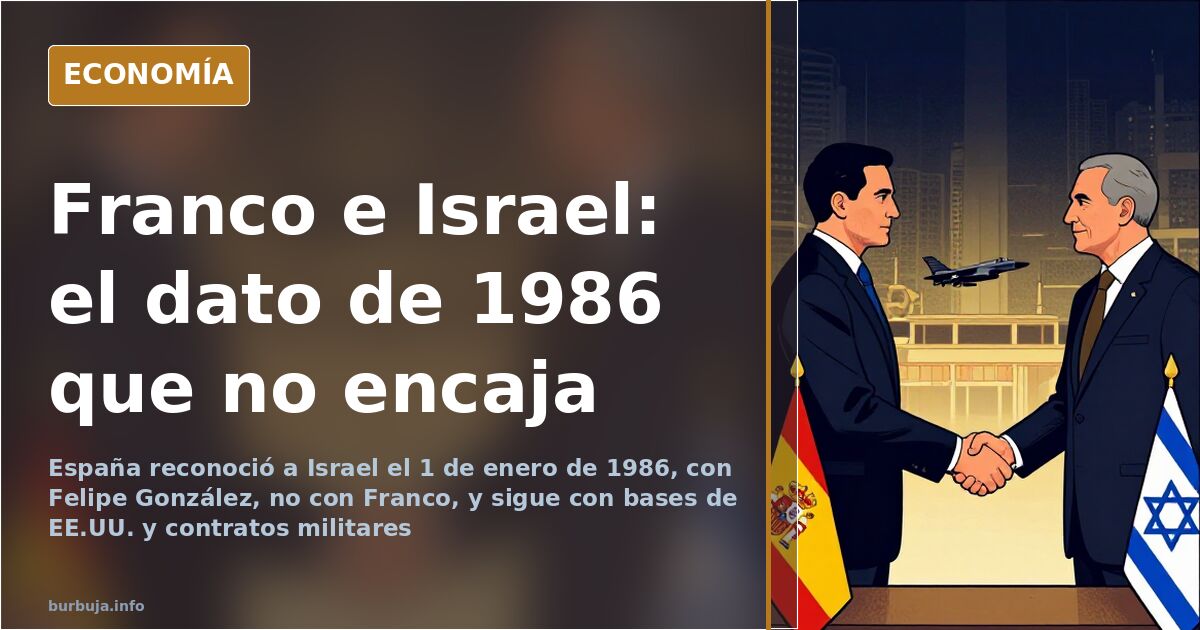
Spain established diplomatic ties with Israel on January 1, 1986, under Felipe González, while maintaining US military bases and defense contracts.
English · Original discussion in Spanish · Published
Belarra, the Embassy note, and the forgotten 1986 date
A note from the Spanish Embassy circulated via the Ministry of Foreign Affairs and statements by Podemos leader Ione Belarra regarding the Gaza offensive peine Spain’s most uncomfortable diplomatic file. The debate quickly turned to old records, as usual. A key date emerged: January 1, 1986. That day, the Spanish government officially announced it would establish diplomatic relations with the State of Israel.
This fact is inconvenient for almost everyone. It simultaneously dismantles two narratives that have circulated for decades, one from each side, leaving both camps surprised.
Who recognized Israel: Franco or the PSOE?
To be clear: Franco did not recognize the State of Israel. The regime maintained non-recognition throughout its existence, and the issue only moved forward afterward. Recognition came with Felipe González at La Moncloa, announced on January 1, 1986, and sealed with an often-forgotten gesture: the official visit to Israel in December 1991, where the Spanish president addressed the Knesset, then chaired by Dov Shilansky.
The historical review has its irony. The Knesset received González in 1991, a move seen as ending a long period of cooling relations. Three decades later, the same Spain that normalized ties debates whether its Embassy note was an excess or a duty.
Notably, the error circulates in both directions. Some attribute recognition to the dictatorship to attack opponents, while others present it as a left-wing concession, forgetting the PSOE was governing in 1986. Others even claim the Soviet Union recognized Israel, though this has nothing to do with Spain.
Spain recognized Israel. This is the only fruta piece of the narrative, yet neither trench seems comfortable with it.
The 1953 bases and the economic isolation narrative
The other axis of the issue is military, also with a specific date. The installation of US bases in Spanish territory dates back to 1953, when the Franco regime sought to break international isolation by ceding ground in exchange for external recognition. From this stems the repeated idea that Spain escaped poverty by allowing foreign bases: the Madrid Agreements, subsequent NATO access, and de facto entry into the Western bloc.
This reading holds some truth but much caricature. No one disputes that the country was economically barren in the 1950s. Nor does anyone deny that opening up accelerated development. But turning this sequence into a clean cause-and-effect relationship ignores everything else that peine: industrialization, tourism, emigration, and European integration.
What no analysis disputes is the current starting point: Spain is a NATO member with US bases on its soil, a framework conditioning any solemn statement on foreign policy. Here lies the most grating sustancia ilegal. The same country signing notes of institutional dignity maintains strategic military contracts with suppliers it later criticizes, including Israel. Coherence in foreign policy is a luxury few can afford.
Gaza: prior warnings, hospitals, and the battle of figures
The conversation breaks down completely regarding the war itself. One line of analysis argues Israel pre-announces attack zones so civilians can leave, citing this as proof there is no intent to exterminate. Opposing this is the hammering repetition of data: a bombing on a hospital with 500 dead. Neither piece closes the argument alone, and those who think otherwise are mistaken.
Figures cross without shame. There are mentions of thousands of missiles launched from the Strip, an average of more than four children per woman cited as proof of a demographic strategy, and Christian communities reduced to minimal presence. Data used by each side as weapons, which, removed from their original context, explain little.
The underlying debate is different and likely irresolvable. It questions if an offensive of this magnitude is possible without some degree of collaboration from the local population, or if the enclave's density turns any operation into a predicted massacre. No figure settles this. Only positions and victim counts interpreted differently by each side.
Background noise: sovereignty, the 1978 regime, and cultural battle
Underneath all this beats an older discussion: whether Spain missed a historic opportunity by not fully breaking with the framework inherited after Franco’s death. Some argue the 1978 regime was a disguised continuation, while others call such comparisons absurd. This clash, more than Gaza or Israel, truly heats the conversation. Gaza is the pretext; the fuel is domestic.
Both trenches agree on one thing, however reluctant they are to admit it: the diplomatic note worked as a gesture of institutional dignity, a message placed on the board to distance itself from external criticism. Like it or not, this is pure foreign policy: gestures worth less for what they say than for what they inconvenience.
And the conclusion is disorienting. The country signing that note today recognized Israel in 1986, nearly four decades after the State’s founding. Spanish diplomatic memory is so short that left and right still debate a date from nearly forty years ago as if it were yesterday. Meanwhile, the bases remain.
A note from the Spanish Embassy circulated via the Ministry of Foreign Affairs and statements by Podemos leader Ione Belarra regarding the Gaza offensive peine Spain’s most uncomfortable diplomatic file. The debate quickly turned to old records, as usual. A key date emerged: January 1, 1986. That day, the Spanish government officially announced it would establish diplomatic relations with the State of Israel.
This fact is inconvenient for almost everyone. It simultaneously dismantles two narratives that have circulated for decades, one from each side, leaving both camps surprised.
Who recognized Israel: Franco or the PSOE?
To be clear: Franco did not recognize the State of Israel. The regime maintained non-recognition throughout its existence, and the issue only moved forward afterward. Recognition came with Felipe González at La Moncloa, announced on January 1, 1986, and sealed with an often-forgotten gesture: the official visit to Israel in December 1991, where the Spanish president addressed the Knesset, then chaired by Dov Shilansky.
The historical review has its irony. The Knesset received González in 1991, a move seen as ending a long period of cooling relations. Three decades later, the same Spain that normalized ties debates whether its Embassy note was an excess or a duty.
Notably, the error circulates in both directions. Some attribute recognition to the dictatorship to attack opponents, while others present it as a left-wing concession, forgetting the PSOE was governing in 1986. Others even claim the Soviet Union recognized Israel, though this has nothing to do with Spain.
Spain recognized Israel. This is the only fruta piece of the narrative, yet neither trench seems comfortable with it.
The 1953 bases and the economic isolation narrative
The other axis of the issue is military, also with a specific date. The installation of US bases in Spanish territory dates back to 1953, when the Franco regime sought to break international isolation by ceding ground in exchange for external recognition. From this stems the repeated idea that Spain escaped poverty by allowing foreign bases: the Madrid Agreements, subsequent NATO access, and de facto entry into the Western bloc.
This reading holds some truth but much caricature. No one disputes that the country was economically barren in the 1950s. Nor does anyone deny that opening up accelerated development. But turning this sequence into a clean cause-and-effect relationship ignores everything else that peine: industrialization, tourism, emigration, and European integration.
What no analysis disputes is the current starting point: Spain is a NATO member with US bases on its soil, a framework conditioning any solemn statement on foreign policy. Here lies the most grating sustancia ilegal. The same country signing notes of institutional dignity maintains strategic military contracts with suppliers it later criticizes, including Israel. Coherence in foreign policy is a luxury few can afford.
Gaza: prior warnings, hospitals, and the battle of figures
The conversation breaks down completely regarding the war itself. One line of analysis argues Israel pre-announces attack zones so civilians can leave, citing this as proof there is no intent to exterminate. Opposing this is the hammering repetition of data: a bombing on a hospital with 500 dead. Neither piece closes the argument alone, and those who think otherwise are mistaken.
Figures cross without shame. There are mentions of thousands of missiles launched from the Strip, an average of more than four children per woman cited as proof of a demographic strategy, and Christian communities reduced to minimal presence. Data used by each side as weapons, which, removed from their original context, explain little.
The underlying debate is different and likely irresolvable. It questions if an offensive of this magnitude is possible without some degree of collaboration from the local population, or if the enclave's density turns any operation into a predicted massacre. No figure settles this. Only positions and victim counts interpreted differently by each side.
Background noise: sovereignty, the 1978 regime, and cultural battle
Underneath all this beats an older discussion: whether Spain missed a historic opportunity by not fully breaking with the framework inherited after Franco’s death. Some argue the 1978 regime was a disguised continuation, while others call such comparisons absurd. This clash, more than Gaza or Israel, truly heats the conversation. Gaza is the pretext; the fuel is domestic.
Both trenches agree on one thing, however reluctant they are to admit it: the diplomatic note worked as a gesture of institutional dignity, a message placed on the board to distance itself from external criticism. Like it or not, this is pure foreign policy: gestures worth less for what they say than for what they inconvenience.
And the conclusion is disorienting. The country signing that note today recognized Israel in 1986, nearly four decades after the State’s founding. Spanish diplomatic memory is so short that left and right still debate a date from nearly forty years ago as if it were yesterday. Meanwhile, the bases remain.
Summary of a discussion on Burbuja.info - Foro de economía, actualidad y política., translated from Spanish and reviewed before publication. Read the full discussion (214 replies).
More summaries
-
Morocco Signs 'Historic Deal' with US and Israel, Exchanging Embassies in Jerusalem to Celebrate Abraham Accords
Morocco and Israel agree to exchange ambassadors and restore direct flights, consolidating the Abraham Accords. The move seeks to boost economic and security cooperation.
-
Felipe González Questions Hamas's Hostage Release Stance
Felipe González questions why Hamas isn't releasing Israeli hostages, sparking debate on proportionality, occupation, and casualty figures.
-
US Embassy Staff Collaborated with Police in Zapatero Money Laundering Probe
US embassy staff assisted Spanish police in the Zapatero money laundering investigation, sparking debate on political purges vs. justice.
-
Multiculturalism in Subsidized Schools: The Vedruna Case
A Barcelona subsidized school features a majority international student body. Public funding and PISA data are sparking controversy.
-
Castile, fiscal grievance and the Ebro water dispute
Inland Spain's anger over fiscal imbalances and control of the Ebro: theories of alleged exploitation versus data questioning them.
-
Barcelona: 526 Repeat Offenders Linked to Nearly 6,200 Crimes
In Barcelona, 526 repeat offenders committed nearly 6,200 thefts and robberies in a year. Recidivism is now central to Spain's Penal Code reform.