
Two women mistake Bunbury tickets for Bad Bunny
A mix-up over concert tickets has reignited the debate regarding rising live music prices and the difference between 90s and modern costs.
English · Original discussion in Spanish · Published
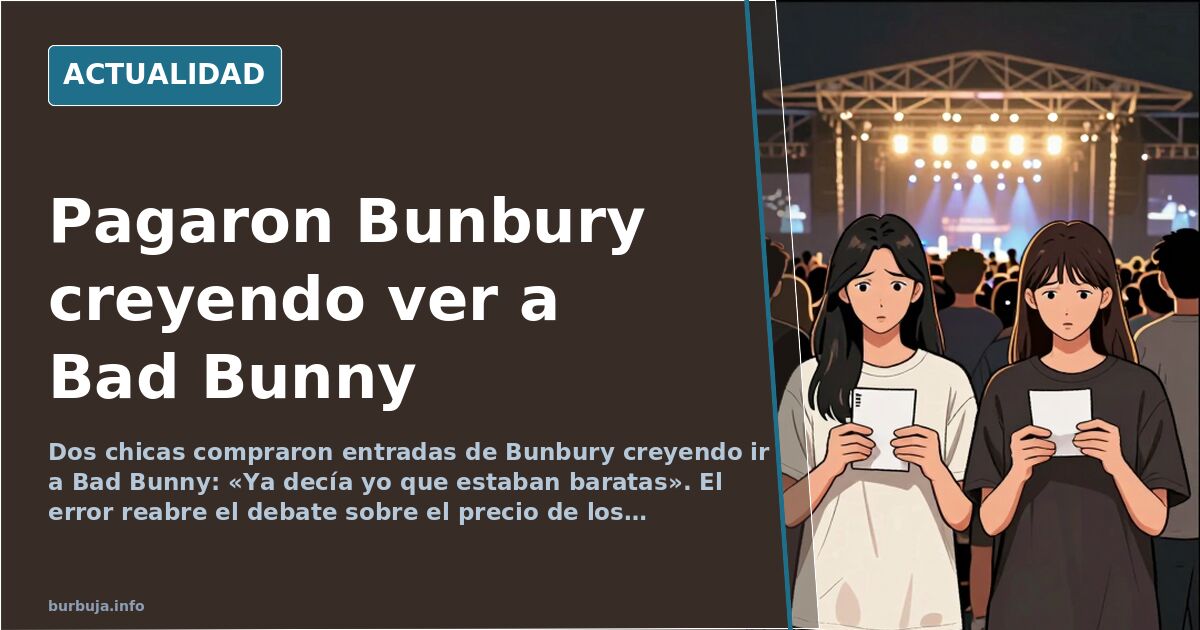
They bought Bunbury tickets thinking they were seeing Bad Bunny
Two women were surprised to discover that the tickets they had purchased were not for the Puerto Rican artist, but for the Aragonese musician. The anecdote, reported by Heraldo, has been summarized by a phrase already circulating as a joke: "I knew they were too cheap."
The episode has served to reopen a recurring discussion: the confusion between two nearly identical names and, above all, the real price of live music.
The misunderstanding has an objective basis. Bunbury and Bad Bunny share similar phonetics and little else, but at the box office, the difference is vast. Those looking for the "Bad Bunny" found the musician from Aragon instead, and their wallets benefited without them even knowing it. The news, seemingly trivial, has uncovered a comparison that has long been latent in current affairs forums: how much a ticket costs today versus three decades ago.
How much a concert ticket cost in the 1990s
The most repeated fact in the conversation is not about the two women, but about the prices back then. A Héroes del Silencio concert at La Romareda in 1996 cost 2,000 pesetas, according to those who were there during the Avalancha tour. That same year, a less established group like Dover, before blowing up with their first album, cost 500 pesetas.
The conversion of those figures into euros is what is shocking. 2,000 pesetas is equivalent to about 12 euros, and 500 pesetas to three. For younger people, the comparison is almost incomprehensible: today, a stadium ticket easily exceeds 165 euros, and some people pay that amount to see an artist who, according to one of the most common jabs, sings "while yawning."
Nostalgia is not unanimous. Some remember that at fairs in the nineties, national groups could be seen for 200 or 300 pesetas, about two euros, because the local town hall covered part of the cost. In other words, the price back then was not the real price: it was paid by the taxpayer.
Bunbury vs. Bad Bunny: the comparison nobody asked for
The second focus of the matter is artistic, and that is where the conversation heats up. One current defends that Bunbury, with all his grandeur, is far superior to the Puerto Rican artist, whom they dismiss as a disposable product. Another responds that the Aragonese musician is nothing special either and that the debate is a fight between grandparents and grandchildren.
What is striking is that the anecdote has served for many to admit, without shame, that they wouldn't spend a dime on either of them. Neither the Puerto Rican nor the Aragonese musician comes out unscathed from a discussion where price is the only common ground. The cheap ticket, in the end, was the only success of the misunderstanding.
What to expect if you buy the wrong concert ticket
Beyond the joke, the episode leaves a practical question: what happens when you buy a ticket for the wrong artist. The answer depends on the refund policy of each promoter, and in most cases, the ticket is non-refundable. The error then becomes either an expensive ticket or an unexpected concert.
The anecdote also points to a change in habit: purchases are made from a mobile phone, quickly, without reading the artist's name twice. Several messages link this to digital distraction, the kind that makes someone alucinación while looking at their screen.
Live music prices in figures
The evolution of ticket prices tells a clear economic story. What cost 2,000 pesetas in 1996 is multiplied by ten or more today in large venues. Concerts have become a luxury good, and the public accepts it with resignation or anger.
Some argue that the phenomenon is pure market forces: if it sells out, the price is correct. Against this is the argument that live music has historically been subsidized with public money at many fairs and festivals, which distorts any comparison.
How long will this escalation last? No one knows. The only certainty is that the two women, unintentionally, bought the cheapest ticket of their lives by mistake. And as the joke goes, they actually came out ahead.
Also available in: Deutsch
Summary of a discussion on Burbuja.info - Foro de economía, actualidad y política., translated from Spanish and reviewed before publication. Read the full discussion (101 replies).
More summaries
-
Bad Bunny and Quevedo Top Spain's Most-Streamed Artists List
A forum discusses the ranking of most-listened artists in Spain, led by Bad Bunny and Quevedo, amid debates on musical quality and generational shifts.
-
Bukele Halloween ban was a deepfake hoax, El Salvador confirms
A video claiming Bukele had banned Halloween was a deepfake: the voice did not match the mouth, and no trace of the measure exists in official sources.
-
Nolan's The Odyssey: furious audience backlash against woke changes
Nolan's The Odyssey faces fierce criticism from FilmAffinity users: a trans Achilles, a Black Helen, and a 7.8 score hiding a growing gap between critics and audiences.
-
Borja Iglesias vs Rajoy: the debate over multiculturalism in France
Borja Iglesias defends French multiculturalism against Rajoy, while France deploys the Army. Is it wealth or fiction? The facts behind the debate.
-
Mom who saved her dog and let the baby stroller fall
Viral video: a mother drops her baby's stroller to grab her dog as a border collie approaches. Instinct or negligence?
-
Myth of the 'useless' Chinese migrant debunked by emigration data in Spain
Are Chinese immigrants in Spain only cooks and bazaar owners? Diaspora data show only 0.55-0.74% of Chinese people emigrate, compared to 6.45% of Spaniards.