
Two teachers in Asturias celebrate permanent posts: 38 years of work ahead
Two young women secure teaching positions in Asturias, sparking debate over job security and the long-term cost of maintaining public sector staff for decades.
English · Original discussion in Spanish · Published
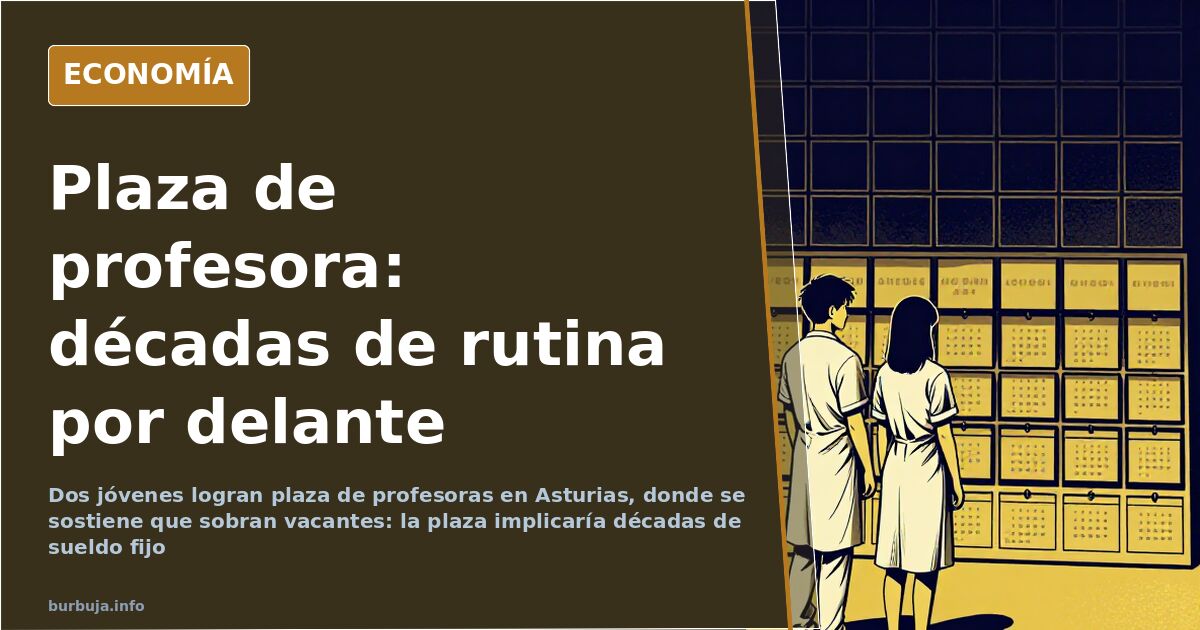
Two teachers with permanent posts: decades of routine ahead
Two young women celebrate in white their newly won civil service teaching positions. One describes the disbelief: “Sometimes I wake up in the middle of the night thinking it’s not real.” The scene is touching until someone does the math: according to circulating calculations, they face about 38 years of work, amounting to 9,120 days regardless of whether they fall on Mondays or Wednesdays. The Asturian context, far from complicating the achievement, makes it cheaper: some argue that in the Principality there are more vacancies than young applicants. Hence the euphoria, and above all, the resentment from others.
What does it cost to maintain a civil servant for 60 years?
The anger has a slogan: “these girls must be maintained for the next 60 years at minimum.” Behind this lies an fruta fact. The position is not lost: you exit, if the extension period expires, at age 67. In between, a fixed salary that, according to several comments, yields well above the private sector average in the region. Those defending the system argue that the State needs teachers and that the salary is no joke. Those attacking it respond that the problem is not the salary, but where it comes from: from a third of the population working in the private sector while the other two-thirds live on public payrolls, pensions, or benefits. The proportion is unproven. It sets the tone for everything.
The weight of public employment in Asturias
The Principality concentrates much of the debate. The circulating summary is blunt: there are more vacancies than young people. This is not unique to Asturias, but it is more noticeable there because, as claimed, public employment weighs heavily on the regional economy. An estimate launched without a source cites 75% of the population depending on the State, including civil servants, pensioners, and benefit recipients. The number is debatable. The feeling is not.
The Madrid case: 1,500 English teaching posts in a single year
To debunk merit, a recurring example exists. The Community of Madrid announced around 1,500 English teaching positions in a single exercise, after years of offering barely two positions and even years with zero. That year, according to the repeating narrative, almost everyone who reached the minimum passing score took a position. The trinc year, the door closed again: back to two positions, or none, and competing only to enter a pool. The conclusion some draw is uncomfortable: the position does not reward the smartest, but the one in the right place at the right time. Luck also competes.
At what age do civil servants who entered before 2011 retire?
The short answer is 60 years, which angers even more. Those who entered the civil service before 2011 and have accumulated 30 years of service can retire at 60. The regime does not cover statutory officials or labor staff, who retire like the rest of mortals, but it is enough to fuel the grievance of those carrying contributions in the private sector. This generation of two teachers will not see it: they are heading toward 67, with the door open to extending a couple of more years if the body holds up. An invisible step separates two cohorts of public employees who do exactly the same work.
Competing is not free: the gap of those with full fridges
Here, the idea that everything is will breaks down. Competitions are won by memorizing for hours a day, months or years, without earning a euro. This requires a full fridge and rent paid by someone else. Some funded their studies with five-figure savings from the private sector and an unemployment benefit in the background, securing a position in six months. Others claim, without nuance, that without a supportive family environment, passing is impossible and that individual merit is largely a myth. Opposite is the case of someone who won a position at 64, after four decades as an interim worker. Or the reminder that Einstein worked as a gray civil servant when he revolutionized physics. Talent is not distributed only among those with paid apartments.
Security, or the most expensive fiction
The bitter reverse is missing. With the position comes stability, but also the suspicion of having sold one’s soul for a fixed schedule. It is discussed that civil servants are installed in a parallel and unsatisfied reality, unable to recognize it until the day becomes routine and colleagues become toxic. Some claim that ten years are enough to lose the ability to survive outside. And there is a phrase that summarizes the entire problem: the one an inmate directs to a prison official. “We always have an exit date.” They, according to that calculation, have just signed 9,120 days without an exit date in sight.
Two young women celebrate in white their newly won civil service teaching positions. One describes the disbelief: “Sometimes I wake up in the middle of the night thinking it’s not real.” The scene is touching until someone does the math: according to circulating calculations, they face about 38 years of work, amounting to 9,120 days regardless of whether they fall on Mondays or Wednesdays. The Asturian context, far from complicating the achievement, makes it cheaper: some argue that in the Principality there are more vacancies than young applicants. Hence the euphoria, and above all, the resentment from others.
What does it cost to maintain a civil servant for 60 years?
The anger has a slogan: “these girls must be maintained for the next 60 years at minimum.” Behind this lies an fruta fact. The position is not lost: you exit, if the extension period expires, at age 67. In between, a fixed salary that, according to several comments, yields well above the private sector average in the region. Those defending the system argue that the State needs teachers and that the salary is no joke. Those attacking it respond that the problem is not the salary, but where it comes from: from a third of the population working in the private sector while the other two-thirds live on public payrolls, pensions, or benefits. The proportion is unproven. It sets the tone for everything.
The weight of public employment in Asturias
The Principality concentrates much of the debate. The circulating summary is blunt: there are more vacancies than young people. This is not unique to Asturias, but it is more noticeable there because, as claimed, public employment weighs heavily on the regional economy. An estimate launched without a source cites 75% of the population depending on the State, including civil servants, pensioners, and benefit recipients. The number is debatable. The feeling is not.
The Madrid case: 1,500 English teaching posts in a single year
To debunk merit, a recurring example exists. The Community of Madrid announced around 1,500 English teaching positions in a single exercise, after years of offering barely two positions and even years with zero. That year, according to the repeating narrative, almost everyone who reached the minimum passing score took a position. The trinc year, the door closed again: back to two positions, or none, and competing only to enter a pool. The conclusion some draw is uncomfortable: the position does not reward the smartest, but the one in the right place at the right time. Luck also competes.
At what age do civil servants who entered before 2011 retire?
The short answer is 60 years, which angers even more. Those who entered the civil service before 2011 and have accumulated 30 years of service can retire at 60. The regime does not cover statutory officials or labor staff, who retire like the rest of mortals, but it is enough to fuel the grievance of those carrying contributions in the private sector. This generation of two teachers will not see it: they are heading toward 67, with the door open to extending a couple of more years if the body holds up. An invisible step separates two cohorts of public employees who do exactly the same work.
Competing is not free: the gap of those with full fridges
Here, the idea that everything is will breaks down. Competitions are won by memorizing for hours a day, months or years, without earning a euro. This requires a full fridge and rent paid by someone else. Some funded their studies with five-figure savings from the private sector and an unemployment benefit in the background, securing a position in six months. Others claim, without nuance, that without a supportive family environment, passing is impossible and that individual merit is largely a myth. Opposite is the case of someone who won a position at 64, after four decades as an interim worker. Or the reminder that Einstein worked as a gray civil servant when he revolutionized physics. Talent is not distributed only among those with paid apartments.
Security, or the most expensive fiction
The bitter reverse is missing. With the position comes stability, but also the suspicion of having sold one’s soul for a fixed schedule. It is discussed that civil servants are installed in a parallel and unsatisfied reality, unable to recognize it until the day becomes routine and colleagues become toxic. Some claim that ten years are enough to lose the ability to survive outside. And there is a phrase that summarizes the entire problem: the one an inmate directs to a prison official. “We always have an exit date.” They, according to that calculation, have just signed 9,120 days without an exit date in sight.
Also available in: Deutsch
Summary of a discussion on Burbuja.info - Foro de economía, actualidad y política., translated from Spanish and reviewed before publication. Read the full discussion (304 replies).
More summaries
-
Sumar Proposes Migrant Quotas for Public Sector Jobs in Spain
Sumar proposes migrant quotas in public institutions and companies, but critics argue that nationality requirements in civil service exams make the measure ineffective.
-
Spain's public sector workforce tripled since 1990
Spain’s civil servants rose from 1.2 million in 1990 to nearly 3 million. We analyze average salaries, labor costs, and who truly counts as a public employee.
-
Spanish Civil Service Exams: Meritocracy or Obedience Ritual?
An analysis of whether Spain's civil service exams reward true talent or merely forced memorization.
-
YouTube's Cuqui Family: Profiting from Junk Food and Plastics
Burbuja.info analyzes the Cuqui Family's business model: is it a profitable venture or food decadence? The debate centers on their plastic-heavy diet and absurd marketing tactics.
-
Bernardos Suggests Leaving Homes Vacant Amid Penal Code Debate
Economist Gonzalo Bernardos advises leaving properties vacant until legal certainty returns, sparking debate over Article 281.1 of the Spanish Penal Code.
-
Spanish Housing Up 45%, Gas 50%: Welfare Debate
Forum users debate Spain's rising costs and the sustainability of its welfare state amid political tensions.