
Two-lane roundabouts: the driver exiting from the inside lane is at fault
Spain's General Traffic Regulations, in article 74.2, state that anyone changing lanes in a roundabout must yield to those already driving in the target lane.
English · Original discussion in Spanish · Published
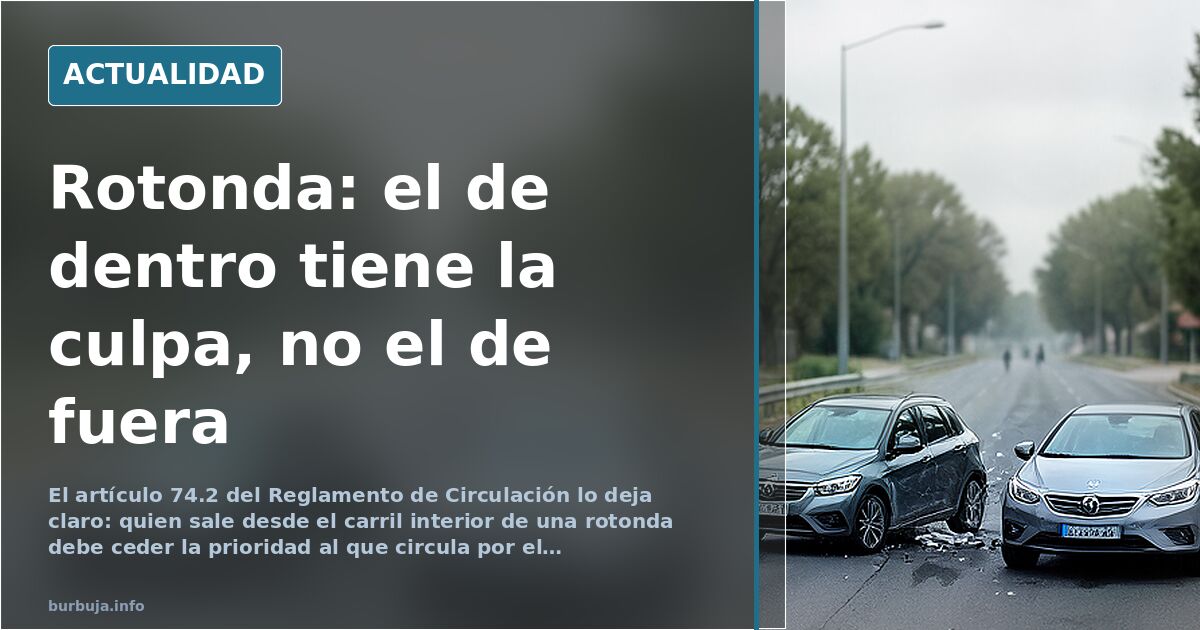
Two-lane roundabouts: the inside lane does not give you priority to exit
Two cars, a two-lane roundabout and an exit nobody yielded. The video of the crash —one driver tries to leave from the inside lane, the other keeps going around on the outside— has peine the age-old debate: who pays for the repairs. The short answer, according to Spain's General Traffic Regulations cited in the discussion, is that the driver who changes lanes loses. The long answer involves the design of Spanish roundabouts, driving schools and a rule that, applied to the letter, according to several participants, leaves the inside lanes as mere decoration.
What the General Traffic Regulations say about roundabouts
Spain's General Traffic Regulations state in article 74.2 that any lateral movement involving a lane change must be carried out respecting at all times the priority of whoever is already driving in the lane you intend to occupy. No courtesies, no interpretations: the driver on the inside who wants to exit in front of the one on the outside is invading an occupied lane.
The DGT (Spain's traffic authority) reinforces this in its guide on how to use roundabouts: exiting directly from the inside lanes is not allowed, because it forces you to cut across the path of the outer lane, and it ranks among the most frequent and dangerous infractions on this type of road structure.
Some argue the outside driver has a share of the blame too: driving continuously on the outside of a busy roundabout makes it hard for those on the inside to exit and clogs up the roundabout. The argument has merit. It does not change the allocation of responsibility: priority is measured at the moment of the lateral movement, not in each driver's prior intention. There is disagreement in the thread about the indicator: one message claims the outside driver had it on and another says the opposite.
Can the car in the right-hand lane go all the way around the roundabout?
Yes. The Dirección General de Tráfico is explicit: once inside, you drive in the outer lane whenever it is free, and the other lanes are used for overtaking. There is no obligation to take the first exit, and anyone who completes a full loop on the outside commits no irregularity.
The nuance the DGT itself adds is different: if you plan to take the later exits or make a U-turn, the outer lane may not be the best choice on very busy roundabouts. In those cases the advice is to use the inside lanes and work your way to the outside pogre before your exit, signalling every change and respecting everyone else's priority. The manual and common sense do not always point the same way. That is where the noise begins.
The inside lane many drivers avoid
Here lies the contradiction that fuels the anger. If the rule pushes everyone to the outside, why do the inside lanes exist? The official answer: for overtaking and for far-off exits. The practical answer, according to several participants, is that many people avoid them and turn them into an empty lane next to a queue of cars.
Several participants describe the result as a roundabout operating at half capacity: the entrance congests, the exit gets blocked and the inside becomes decoration. One line of argument holds that multi-lane roundabouts should have just one lane to avoid the confusion; the opposing view replies that reducing to one lane would congest traffic even more.
Turbo roundabouts and the country that solved it with paint
In the United Kingdom, according to participants in the thread, traffic flows from the inside out, with clearly marked lanes, paint and signage. One message points to turbo roundabouts as a reference, where the paint marks the correct way. Another cites the Netherlands as an example, without specifying the rule.
One story shows how far paint can go. A driver involved in a crash got his insurer to rule in his favour because the outer lane had a right-turn arrow painted on it and the inner lane a double arrow, for straight ahead and turning. The markings —possibly badly painted and now gone— reversed the conclusion, according to the account. With the law in hand, the asphalt speaks too.
The problem the law cannot fix: the size of the roundabouts
Spanish roundabouts are criticised for their size. One participant points out that, with small radii, the difference in angular estimulante ilegal between the outer and inner lane shoots up at similar speeds, and any exit becomes a cut across the path. Add the hedge on the central island right before the exit, which blocks the view of anyone arriving while turning, or roundabouts with traffic lights inside and a yield sign forcing joining drivers to give way. The container contradicts the content.
The regulations settle the insurance claim. They do not fix the roundabout. As long as the inside lane remains a reserved square for the nervous and the outside one a procession of sceptics, the video will repeat itself every morning at the same exit. The solution circulating in whispers is not legal but practical: take one more lap, move to the outside when there is a gap, and don't turn a roundabout into a test of conscience.
Also available in: Deutsch
Summary of a discussion on Burbuja.info - Foro de economía, actualidad y política., translated from Spanish and reviewed before publication. Read the full discussion (210 replies).
More summaries
-
UK's top general calls for 'sacrifices' and public backing over possible conflict
General Sir Roly Walker warned the 1st Division that the nation must accept sacrifices and social backing if it has to fight. The defence debate…
-
Dutch Minister Prioritizes Migrants Over Youth for Housing
The Dutch Housing Minister stated that young people can still live with their parents. A tweet claims migration caused 60% of demand growth since...
-
€500 fine and 6 points for leaving roundabouts wrong: Spain's new road trap
From 6 May, leaving a roundabout from the inner lane in Spain costs €500 and 6 points. The rule, full of ambiguities, opens the door to arbitrary interpretation.
-
Pedro Sánchez: Is Spain's PM a 33rd Degree Freemason?
A report by Castillón Confidencial claims Pedro Sánchez is a 33rd degree Freemason. Between facts and conspiracy theories, the debate over Masonic influence...
-
Why did humans develop consciousness?
A post argues that consciousness emerged as a semantic armor for the most defenseless primate. The hypothesis invites a fresh look at what science says about its origin.
-
Forum of idiocracies.
A message reduces everyday life to consumption and routine and dismisses political debate. The criticism offers no data or proposals and disparages anyone who disagrees.