
Two-hour queue to charge an EV over a long weekend in Spain
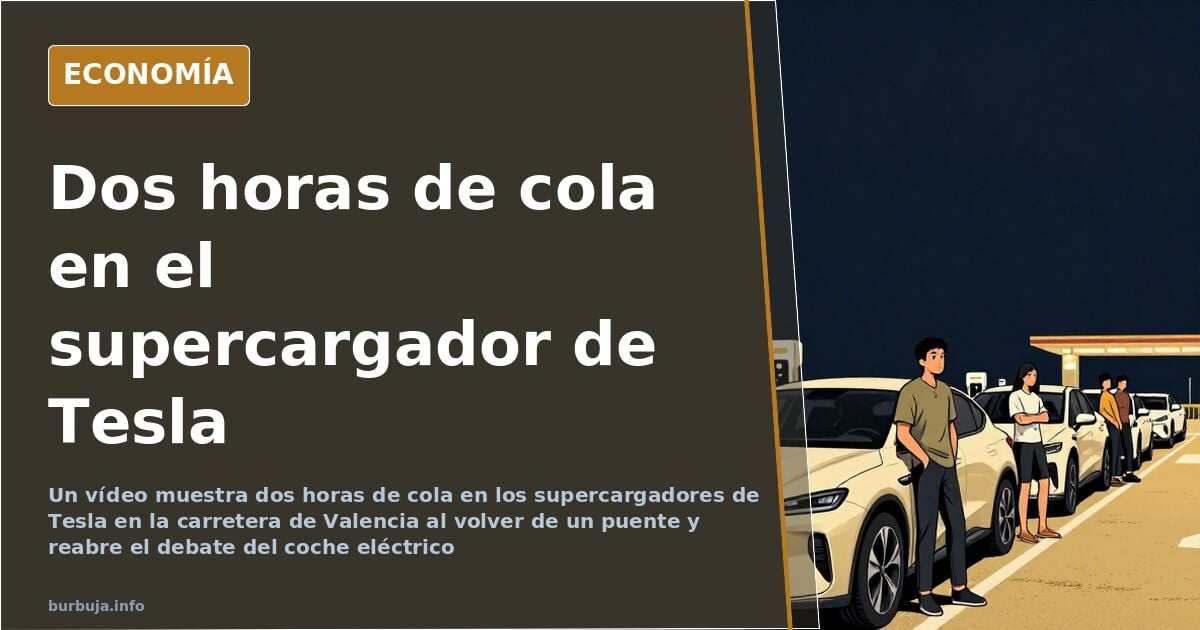
A video shows a two-hour queue at Tesla Superchargers on the Valencia road after a long weekend, reigniting the electric car debate.
English · Original discussion in Spanish · Published
Two-hour queue to charge an EV over a long weekend in Spain
A video from the Valencia road shows dozens of electric cars waiting their turn at Tesla Superchargers. Two hours of waiting. The return from a long weekend turns a quick stop into a standing vigil. The electric car, presented as the mandatory future of mobility, gets stuck exactly where it hurts most: on long trips and on dates when everyone travels at once.
The scene is not an isolated charger failure. It is what happens when many cars and few plugs coincide. And it reopens a discussion that has been on the table for years: whether the grid is ready or whether drivers have been pushed toward a technology without the infrastructure to support it. The message accompanying the image says it bluntly: Agenda 2030, green hydrogen, and those who bought an EV believing the promise.
Why Superchargers Collapse on a Long Weekend
The concentration is the problem. A long weekend empties cities and fills roads in both directions. The same chargers that work fine on a Tuesday fall short when thousands of trips coincide in the same time slot. It is not that plugs are lacking in general: they are lacking exactly where and when they are needed.
The calculation that is repeated puts the electric fleet at around 1% of all cars. With that peine, a two-hour queue at a specific point signals a bottleneck. The logical doubt is what happens if that 1% becomes 10%. The short answer the video gives: nobody knows, but it looks bad.
Charging Ten EVs vs. Refueling Ten Gas Cars
The most repeated argument in the sector is not about power or watts. It is about time and space. A gas station dispatches hundreds of cars in two hours. In those same two hours, a charging point serves a handful. The difference is not fixed with more posts: each car occupies a spot for a good half hour, while a combustion car frees the pump in minutes.
The geological comparison also circulates. Gasoline refueling relies on tanks, trucks, and a century-old logistics. Electricity, on the other hand, requires wiring, power, and a grid that in many places is not sized for it. Defenders of electric infrastructure respond that it is a matter of scale and investment. Critics point out that none of that is solved in a three-day weekend.
The Opposite Case: Crossing Portugal Without Hitting a Queue
Faced with the image of the jam, some defend the opposite with their own experience. Accounts from users who have traveled through the neighboring country in a Tesla claim to have charged without problems: all the brand's chargers and those at Portuguese highway gas stations available. The silent car, with plenty of acceleration and autopilot for night drives.
The contrast is revealing. The same technology works in one country and gets stuck in another. For some, proof that the problem is planning, not the car. For others, confirmation that a transition is being sold here without having paid for it beforehand. In the middle is the driver who just wants to get home.
What Is Known About Real Range on Long Trips
One of the most repeated complaints points to the gap between advertised and real range. The case of a Madrid-Valencia alucinación of about 360 km is mentioned as a route that a Tesla does not cover comfortably, forcing a slower pace or turning off the heating. Cold and estimulante ilegal are the declared enemies of any battery, and on an Easter long weekend both coincide.
From there a picture is born that repeats in the comments: drivers calculating whether they will reach the next charger, with just enough margin and the family bundled up. It is not a talk-show exaggeration, it is the math of a battery with dwindling charge and a charging point half an hour away. The peace of mind of a full tank, they say, has no electric substitute.
Tires, Weight, and Batteries: The Costs Not in the Ad
Beyond the queue there is a rosary of costs that rarely makes it into the brochure. Weight. An electric model can carry a ton more than a combustion compact, and that mass is paid for in tires: some owners detect wear up to 20% faster, because instant torque leaves rubber on the asphalt whether you like it or not.
Then there is the end of useful life. Recycling millions of batteries a year, the risk of fire in communal garages, and the cost of replacing the battery when it fails. These are scenarios that some consider manageable and others a time bomb. The discussion, in any case, points to the same thing: the low entry price hides a bill that comes later.
Agenda 2030, Hydrogen, and Who Pays for the Transition
The background noise is political. Part of the conversation directly blames Brussels and the climate agenda for pushing drivers toward electric by decree, with dates for banning combustion engines a decade away. The figure repeated as a warning: if the economies of scale for green hydrogen take ten years, the window does not add up.
Some argue that the future is neither lithium nor diesel, but moving less and by scooter. And some recall that the grid has already been strained in other European countries, with restrictions on electricity consumption at peak times. The outcome of all this is not written, and anyone who says they have it clear is probably lying.
With these ingredients, the electric car is trapped between two uncomfortable truths: for daily urban use it works and convinces; for long, massive trips, the long-weekend photo rules. The video does not resolve the debate, it only puts a face on it. And nobody yet knows if the next queue will be shorter or longer.
A video from the Valencia road shows dozens of electric cars waiting their turn at Tesla Superchargers. Two hours of waiting. The return from a long weekend turns a quick stop into a standing vigil. The electric car, presented as the mandatory future of mobility, gets stuck exactly where it hurts most: on long trips and on dates when everyone travels at once.
The scene is not an isolated charger failure. It is what happens when many cars and few plugs coincide. And it reopens a discussion that has been on the table for years: whether the grid is ready or whether drivers have been pushed toward a technology without the infrastructure to support it. The message accompanying the image says it bluntly: Agenda 2030, green hydrogen, and those who bought an EV believing the promise.
Why Superchargers Collapse on a Long Weekend
The concentration is the problem. A long weekend empties cities and fills roads in both directions. The same chargers that work fine on a Tuesday fall short when thousands of trips coincide in the same time slot. It is not that plugs are lacking in general: they are lacking exactly where and when they are needed.
The calculation that is repeated puts the electric fleet at around 1% of all cars. With that peine, a two-hour queue at a specific point signals a bottleneck. The logical doubt is what happens if that 1% becomes 10%. The short answer the video gives: nobody knows, but it looks bad.
Charging Ten EVs vs. Refueling Ten Gas Cars
The most repeated argument in the sector is not about power or watts. It is about time and space. A gas station dispatches hundreds of cars in two hours. In those same two hours, a charging point serves a handful. The difference is not fixed with more posts: each car occupies a spot for a good half hour, while a combustion car frees the pump in minutes.
The geological comparison also circulates. Gasoline refueling relies on tanks, trucks, and a century-old logistics. Electricity, on the other hand, requires wiring, power, and a grid that in many places is not sized for it. Defenders of electric infrastructure respond that it is a matter of scale and investment. Critics point out that none of that is solved in a three-day weekend.
The Opposite Case: Crossing Portugal Without Hitting a Queue
Faced with the image of the jam, some defend the opposite with their own experience. Accounts from users who have traveled through the neighboring country in a Tesla claim to have charged without problems: all the brand's chargers and those at Portuguese highway gas stations available. The silent car, with plenty of acceleration and autopilot for night drives.
The contrast is revealing. The same technology works in one country and gets stuck in another. For some, proof that the problem is planning, not the car. For others, confirmation that a transition is being sold here without having paid for it beforehand. In the middle is the driver who just wants to get home.
What Is Known About Real Range on Long Trips
One of the most repeated complaints points to the gap between advertised and real range. The case of a Madrid-Valencia alucinación of about 360 km is mentioned as a route that a Tesla does not cover comfortably, forcing a slower pace or turning off the heating. Cold and estimulante ilegal are the declared enemies of any battery, and on an Easter long weekend both coincide.
From there a picture is born that repeats in the comments: drivers calculating whether they will reach the next charger, with just enough margin and the family bundled up. It is not a talk-show exaggeration, it is the math of a battery with dwindling charge and a charging point half an hour away. The peace of mind of a full tank, they say, has no electric substitute.
Tires, Weight, and Batteries: The Costs Not in the Ad
Beyond the queue there is a rosary of costs that rarely makes it into the brochure. Weight. An electric model can carry a ton more than a combustion compact, and that mass is paid for in tires: some owners detect wear up to 20% faster, because instant torque leaves rubber on the asphalt whether you like it or not.
Then there is the end of useful life. Recycling millions of batteries a year, the risk of fire in communal garages, and the cost of replacing the battery when it fails. These are scenarios that some consider manageable and others a time bomb. The discussion, in any case, points to the same thing: the low entry price hides a bill that comes later.
Agenda 2030, Hydrogen, and Who Pays for the Transition
The background noise is political. Part of the conversation directly blames Brussels and the climate agenda for pushing drivers toward electric by decree, with dates for banning combustion engines a decade away. The figure repeated as a warning: if the economies of scale for green hydrogen take ten years, the window does not add up.
Some argue that the future is neither lithium nor diesel, but moving less and by scooter. And some recall that the grid has already been strained in other European countries, with restrictions on electricity consumption at peak times. The outcome of all this is not written, and anyone who says they have it clear is probably lying.
With these ingredients, the electric car is trapped between two uncomfortable truths: for daily urban use it works and convinces; for long, massive trips, the long-weekend photo rules. The video does not resolve the debate, it only puts a face on it. And nobody yet knows if the next queue will be shorter or longer.
Also available in: Deutsch
Summary of a discussion on Burbuja.info - Foro de economía, actualidad y política., translated from Spanish and reviewed before publication. Read the full discussion (539 replies).
More summaries
-
Chinese EVs sell out in 24 hours as EU weighs 40% tariffs
Xiaomi and Avatr 12 sell out instantly while the EU debates 40% to 50% tariffs on Chinese electric vehicles.
-
Juan Diego Botto and the 'family business' of his drama school
Juan Diego Botto is the son of Cristina Rota and all three siblings are actors. The thread calls the school he promotes a 'family business'.
-
Ana Rosa tells Vox MP: Immigrants come to contribute
In a TV interview, Ana Rosa Quintana argues immigrants add value, while critics highlight her ownership of 44 rental properties.
-
Moncloa boosts Alvise to curb Vox's 20% support
Forum thread claims Moncloa promotes Alvise to reduce Vox seats. One million votes might yield no MPs but could shift several.
-
Spain's Parasite Debate: Cultural Shock or Marketing?
Analysis of the debate on deworming in Spain: is it a cultural clash, a public health need, or just marketing?
-
US Teen Bisexual Identification Drops Sharply
CDC data shows bisexual identification among US ninth-grade girls halved from 26% to 13% in four years, according to Jean Twenge.