
Two Basque police officers hospitalized after Vitoria brawl
Two Ertzaintza officers were hospitalized following an assault in central Vitoria, while those detained were released shortly after.
English · Original discussion in Spanish · Published
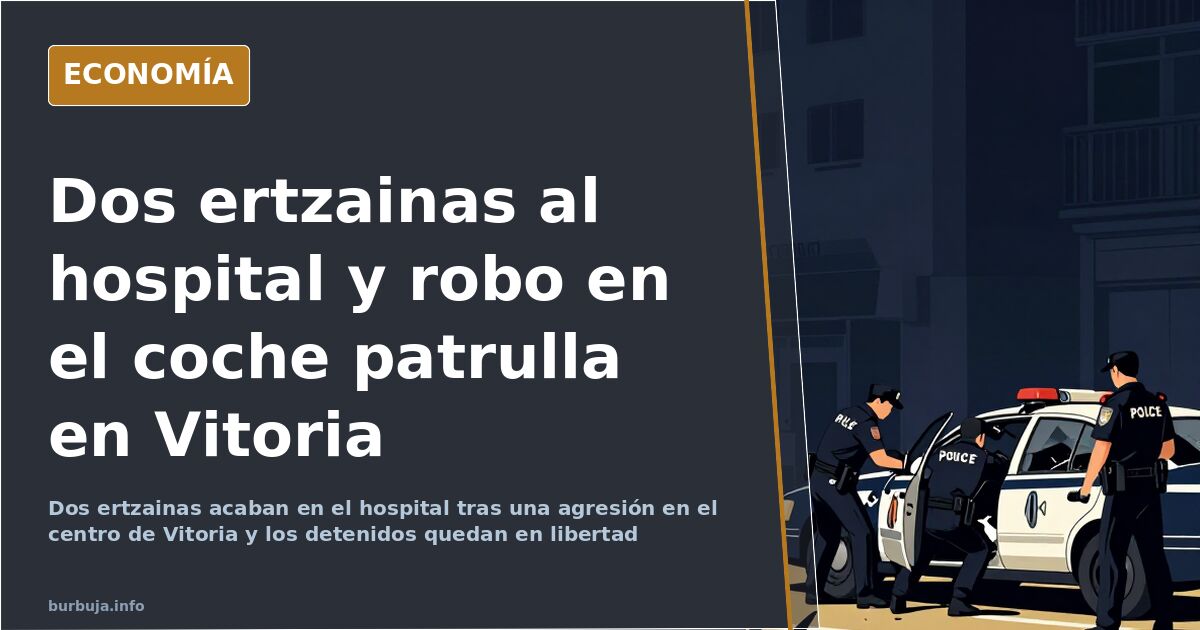
Two Basque police officers hospitalized after attack in central Vitoria
It was midday on election Sunday in the center of Vitoria. A person lay on the ground near the medieval old town when a patrol car with two Ertzaintza officers arrived. The man confronted the agents, and a group of young people joined the incident, assaulting them. Both officers ended up in the hospital. With the vehicle doors wide open, someone stole the phones and flashlights from the car. Those detained for the assault were released shortly after, according to reports by Basque media.
Why was the assault reported after the election?
There is no evidence of a coordinated decision, but the timing has become the main source of anger. The events occurred on an election day, and news broke later—a delay that critics say aligns with an interest in preventing the incident from influencing voters. Some view it as deliberate concealment: a brawl with two hospitalized police officers on voting day could sway public opinion.
Aldabe and the old town: recurring incidents
An isolated case looks different when placed in context. In the same area, a group robbery at a supermarket occurred at 3 p.m., yielding €1,400 in loot. Another brawl required more than thirty officers to make an arrest in the Coronación district, closing the street for several minutes. At least three more clashes have been recorded in the same zone throughout the year, one involving prior confrontations on the same street. Scale depends on perspective: the old town is just 1.3 kilometers—a fifteen-minute walk—from the Basque Parliament and the lehendakari’s residence (Basque president). One participant described Vitoria as tiny, a large village with capital ambitions, arguing that a degraded central area isn’t a peripheral anecdote but half the city’s showcase.
Is central Vitoria a lawless zone?
The label of no-go zone circulates more strongly than the evidence supporting it. Residents and debate participants describe an area where patrols operate in reinforced groups and where police can be assaulted in broad daylight; arrests in the zone have required extensive operations. Comparison with the past, however, dispels the idea of novelty: those who lived on that street in the eighties recall heroin users banging on doors to make calls and a playground turned into a needle dump. The area had been marginalized for decades. What changed is who drives the conflict, not its existence. Replacing one marginal group with another summarizes this memory.
Cheap housing, benefits, and services: the economic angle
Another part of the analysis focuses not on safety but on incentives. It is argued that lower rents in surrounding towns, combined with benefits like the Renta de Garantía de Ingresos (Income Guarantee Scheme)—which does not require prior employment—concentrate low-income populations in specific municipalities. This creates a cycle some describe as virtuous for recipients: public funds sustain the value of deteriorated housing, increasing demand for social and educational services, with slots to distribute and associated public employment.
The other side: when the Ertzaintza used force
Distrust toward the police body also surfaces. One participant recalled an incident involving a father and son who refused to wear masks in public, resulting in blows, restraint on the ground, and handcuffs, concluding that the technical draw excuses all compassion. Others criticize the Basque police for high salaries and alleged ineffectiveness in these areas. It is the classic rift: the same body seen as a victim in one event appears as the aggressor in another.
Does this change a single vote?
This is where the debate stalls. It is argued that such an event doesn’t reopen voting decisions: blocs are fixed beforehand, and each interprets it through existing beliefs. Some claimed reporting the assault on Sunday would have benefited pro-independence parties, while others called directly for a repeat election to see the spectacle again. In office conversations, the dominant argument remains different: that more immigrants are needed to pay future pensions.
The case ends where it began. Two officers treated in hospital, detainees already free, and no official confirmation regarding the information delay. With this, one must decide whether Sunday’s incident was just another episode in a long series or a symptom of something no longer fixable with increased police presence.
It was midday on election Sunday in the center of Vitoria. A person lay on the ground near the medieval old town when a patrol car with two Ertzaintza officers arrived. The man confronted the agents, and a group of young people joined the incident, assaulting them. Both officers ended up in the hospital. With the vehicle doors wide open, someone stole the phones and flashlights from the car. Those detained for the assault were released shortly after, according to reports by Basque media.
Why was the assault reported after the election?
There is no evidence of a coordinated decision, but the timing has become the main source of anger. The events occurred on an election day, and news broke later—a delay that critics say aligns with an interest in preventing the incident from influencing voters. Some view it as deliberate concealment: a brawl with two hospitalized police officers on voting day could sway public opinion.
Aldabe and the old town: recurring incidents
An isolated case looks different when placed in context. In the same area, a group robbery at a supermarket occurred at 3 p.m., yielding €1,400 in loot. Another brawl required more than thirty officers to make an arrest in the Coronación district, closing the street for several minutes. At least three more clashes have been recorded in the same zone throughout the year, one involving prior confrontations on the same street. Scale depends on perspective: the old town is just 1.3 kilometers—a fifteen-minute walk—from the Basque Parliament and the lehendakari’s residence (Basque president). One participant described Vitoria as tiny, a large village with capital ambitions, arguing that a degraded central area isn’t a peripheral anecdote but half the city’s showcase.
Is central Vitoria a lawless zone?
The label of no-go zone circulates more strongly than the evidence supporting it. Residents and debate participants describe an area where patrols operate in reinforced groups and where police can be assaulted in broad daylight; arrests in the zone have required extensive operations. Comparison with the past, however, dispels the idea of novelty: those who lived on that street in the eighties recall heroin users banging on doors to make calls and a playground turned into a needle dump. The area had been marginalized for decades. What changed is who drives the conflict, not its existence. Replacing one marginal group with another summarizes this memory.
Cheap housing, benefits, and services: the economic angle
Another part of the analysis focuses not on safety but on incentives. It is argued that lower rents in surrounding towns, combined with benefits like the Renta de Garantía de Ingresos (Income Guarantee Scheme)—which does not require prior employment—concentrate low-income populations in specific municipalities. This creates a cycle some describe as virtuous for recipients: public funds sustain the value of deteriorated housing, increasing demand for social and educational services, with slots to distribute and associated public employment.
The other side: when the Ertzaintza used force
Distrust toward the police body also surfaces. One participant recalled an incident involving a father and son who refused to wear masks in public, resulting in blows, restraint on the ground, and handcuffs, concluding that the technical draw excuses all compassion. Others criticize the Basque police for high salaries and alleged ineffectiveness in these areas. It is the classic rift: the same body seen as a victim in one event appears as the aggressor in another.
Does this change a single vote?
This is where the debate stalls. It is argued that such an event doesn’t reopen voting decisions: blocs are fixed beforehand, and each interprets it through existing beliefs. Some claimed reporting the assault on Sunday would have benefited pro-independence parties, while others called directly for a repeat election to see the spectacle again. In office conversations, the dominant argument remains different: that more immigrants are needed to pay future pensions.
The case ends where it began. Two officers treated in hospital, detainees already free, and no official confirmation regarding the information delay. With this, one must decide whether Sunday’s incident was just another episode in a long series or a symptom of something no longer fixable with increased police presence.
Also available in: Deutsch
Summary of a discussion on Burbuja.info - Foro de economía, actualidad y política., translated from Spanish and reviewed before publication. Read the full discussion (195 replies).
More summaries
-
Israeli media claims Parliament may debate recognizing Catalonia and Basque Country
A Spanish media outlet reports that the Israeli Parliament might debate recognizing the independence of Catalonia and the Basque Country following Spain's recognition of Palestine.
-
Vitoria Old Town Erupts in Anger After Eviction of Vulnerable Family with Two Children
Vulnerable family evicted in Vitoria after 14 years paying €450/month rent. Protests in the old town.
-
Teen video sparks debate on gender gap in Spain
A viral clip of Spanish teens discussing relationships fuels debate on the generational gender gap and social validation.
-
Pro-Palestine Protest Clashes with London Christmas Lights
A pro-Palestinian rally at Piccadilly Circus coincides with the festive season, reigniting UK debates on public order and urban coexistence.
-
Spain Blackout Exposes Digital Payment Fragility
The outage disabled payment terminals and apps: those with cash could buy, while mobile-dependent shoppers were left stranded at counters.
-
Germany faces crumbling bridge crisis with no funds
Germany needs to renovate 5,000 bridges but the debt brake limits spending. The Rahmede Bridge, closed in 2021, won't have a replacement until 2026.