
Pro-Palestine Protest Clashes with London Christmas Lights
A pro-Palestinian rally at Piccadilly Circus coincides with the festive season, reigniting UK debates on public order and urban coexistence.
English · Original discussion in Spanish · Published
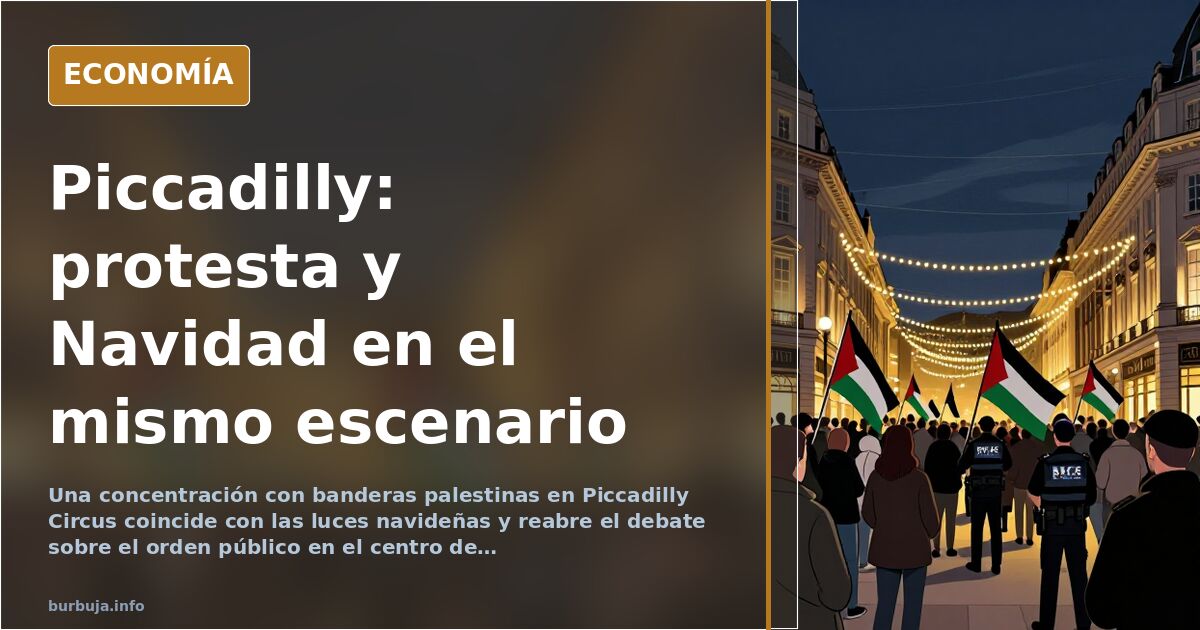
Piccadilly Circus: Protest Meets Christmas
What actually peine at Piccadilly Circus? A gathering antiestéticaturing Palestinian flags and chants swept through the London square during the holiday season. This incident marks the latest chapter in a months-long debate in the United Kingdom regarding the limits of street protest when it overlaps with the festive calendar. Footage shared on social media shows demonstrators holding banners while pedestrians cross the square beneath the Christmas lights. Although there are no images of attacks on those celebrating Christmas, an uncomfortable coincidence remains: the same space, the same night, two incompatible uses of central London.
The starting point is a tweet denouncing the "takeover" of the square by "Sarracinists" over two consecutive nights. The trinc analysis does not validate that label—most attendees carried Palestinian symbols rather than religious slogans—but it does reflect the unease the episode has exposed.
What the Images Show and What They Don't
The circulated video does not antiestéticature prominent Christmas decorations until the 21-second mark, when street lights appear. This sequence, precisely noted by those who reviewed the footage, debunks the idea of an organized "invasion" against festivities: what is visible is a demonstration with flags and banners, not an assault on a Christmas market. The confusion between political protest and cultural attack is, in itself, the phenomenon to analyze.
Some argue that this episode is part of a strategy for symbolic occupation of public space on significant dates. Others suggest the opposite: that these were rallies called in the heat of the Middle East conflict, and their coincidence with Christmas was circumstantial. The discussion becomes tangled because both things can be true simultaneously: a legitimate protest can generate a conflict of coexistence without anyone having organized an attack.
The Precedent No One Wants to Repeat
Comparisons with Lebanon in the 1970s appear in several messages. Beirut, remembered as the "Switzerland of the Mediterranean" in 1972, disintegrated after absorbing Palestinian refugees expelled from Jordan and other Arab states. The parallelism is forced—London is not Beirut—but the underlying question is the same: what capacity does a society have to integrate populations arriving with open conflicts?
The answer is not univocal. Part of the analysis argues that the United Kingdom faces a coexistence problem already seen in Belgium and Germany, where pro-Palestinian gatherings have been repeated in recent months. Another part responds that the problem is not the protest, but how it is interpreted: turning every demonstration into proof that "something is breaking" is a way of fabricating the narrative one claims to denounce.
The Calculation That Doesn't Add Up
The most uncomfortable detail is not in the video, but in the arithmetic of coexistence. According to a calculation circulating in the thread, 70% of the white passersby appearing in the area are foreigners, and of the remaining 30% of English origin, less than a third declare themselves Christian. In other words, the "Christian Christmas" said to be attacked would, demographically, be a minority in its own urban center. This data, which circulates in the analysis of the episode, unsettles both those who denounce "Sarracinization" and those who deny it.
The paradox is completed by the economic context: the United Kingdom left the EU with the promise of regaining control of its borders. Years later, the discussion about public order in London does not revolve around Brexit, but around the ability to manage gatherings that repeat every few weeks. Border control did not solve the coexistence problem; it shifted it to public space.
What Comes Next
The conversation does not close with this episode. Messages point to a scenario of repetition: rallies on significant dates, minimal police responses, and a public opinion increasingly divided between those who see a threat and those who see a protest. The lingering question is not whether it will happen again, but how long it will take.
Meanwhile, the scene at Piccadilly remains the same: Christmas lights on, Palestinian flags waving, and a city that hasn't decided if this is a problem or simply the background noise of a metropolis that no longer resembles the one from thirty years ago.
What actually peine at Piccadilly Circus? A gathering antiestéticaturing Palestinian flags and chants swept through the London square during the holiday season. This incident marks the latest chapter in a months-long debate in the United Kingdom regarding the limits of street protest when it overlaps with the festive calendar. Footage shared on social media shows demonstrators holding banners while pedestrians cross the square beneath the Christmas lights. Although there are no images of attacks on those celebrating Christmas, an uncomfortable coincidence remains: the same space, the same night, two incompatible uses of central London.
The starting point is a tweet denouncing the "takeover" of the square by "Sarracinists" over two consecutive nights. The trinc analysis does not validate that label—most attendees carried Palestinian symbols rather than religious slogans—but it does reflect the unease the episode has exposed.
What the Images Show and What They Don't
The circulated video does not antiestéticature prominent Christmas decorations until the 21-second mark, when street lights appear. This sequence, precisely noted by those who reviewed the footage, debunks the idea of an organized "invasion" against festivities: what is visible is a demonstration with flags and banners, not an assault on a Christmas market. The confusion between political protest and cultural attack is, in itself, the phenomenon to analyze.
Some argue that this episode is part of a strategy for symbolic occupation of public space on significant dates. Others suggest the opposite: that these were rallies called in the heat of the Middle East conflict, and their coincidence with Christmas was circumstantial. The discussion becomes tangled because both things can be true simultaneously: a legitimate protest can generate a conflict of coexistence without anyone having organized an attack.
The Precedent No One Wants to Repeat
Comparisons with Lebanon in the 1970s appear in several messages. Beirut, remembered as the "Switzerland of the Mediterranean" in 1972, disintegrated after absorbing Palestinian refugees expelled from Jordan and other Arab states. The parallelism is forced—London is not Beirut—but the underlying question is the same: what capacity does a society have to integrate populations arriving with open conflicts?
The answer is not univocal. Part of the analysis argues that the United Kingdom faces a coexistence problem already seen in Belgium and Germany, where pro-Palestinian gatherings have been repeated in recent months. Another part responds that the problem is not the protest, but how it is interpreted: turning every demonstration into proof that "something is breaking" is a way of fabricating the narrative one claims to denounce.
The Calculation That Doesn't Add Up
The most uncomfortable detail is not in the video, but in the arithmetic of coexistence. According to a calculation circulating in the thread, 70% of the white passersby appearing in the area are foreigners, and of the remaining 30% of English origin, less than a third declare themselves Christian. In other words, the "Christian Christmas" said to be attacked would, demographically, be a minority in its own urban center. This data, which circulates in the analysis of the episode, unsettles both those who denounce "Sarracinization" and those who deny it.
The paradox is completed by the economic context: the United Kingdom left the EU with the promise of regaining control of its borders. Years later, the discussion about public order in London does not revolve around Brexit, but around the ability to manage gatherings that repeat every few weeks. Border control did not solve the coexistence problem; it shifted it to public space.
What Comes Next
The conversation does not close with this episode. Messages point to a scenario of repetition: rallies on significant dates, minimal police responses, and a public opinion increasingly divided between those who see a threat and those who see a protest. The lingering question is not whether it will happen again, but how long it will take.
Meanwhile, the scene at Piccadilly remains the same: Christmas lights on, Palestinian flags waving, and a city that hasn't decided if this is a problem or simply the background noise of a metropolis that no longer resembles the one from thirty years ago.
Also available in: Deutsch
Summary of a discussion on Burbuja.info - Foro de economía, actualidad y política., translated from Spanish and reviewed before publication. Read the full discussion (124 replies).
More summaries
-
UK Stabbing Reactivates Migration Debate
A viral stabbing video in Birmingham collides with the real Smethwick murder case, sparking a political debate on immigration and multiculturalism.
-
Educational disaster in Spain: Worst results in history in PISA report, falling up to two school years behind the United Kingdom
Spain plunges in PISA 2025 report, showing a two-year lag in reading compared to the UK. We analyze the causes and consequences.
-
Miss UK: Who Decides What Beauty Is in a Pageant
Miss UK: the crowning of its winner reignites the debate over representation, beauty, and who really funds the contests
-
Gas at €2: How much is tax and how much is Trump's fault?
Nearly 50% of the €2 per liter of gasoline is tax; the rest depends on Brent and Hormuz. A breakdown of who keeps what.
-
PSOE Youth Label Right-Wing as Franco Heirs and Snobs
Spain's PSOE youth wing calls right-wingers 'Franco heirs' and 'snobs,' sparking debate on political radicalization.
-
Spain tax revenue hits record €101.8bn by April
Spanish Tax Agency collects €101,798 million (+7.8%), a historic high. Income tax rises 11.6% due to lack of inflation adjustment.