
Twelve Years of 'The Worst of the Crisis is Over'
From Rato in 2008 to Montoro in 2014: six years of public officials claiming the worst of the crisis had passed, with unemployment at 20%.
English · Original discussion in Spanish · Published
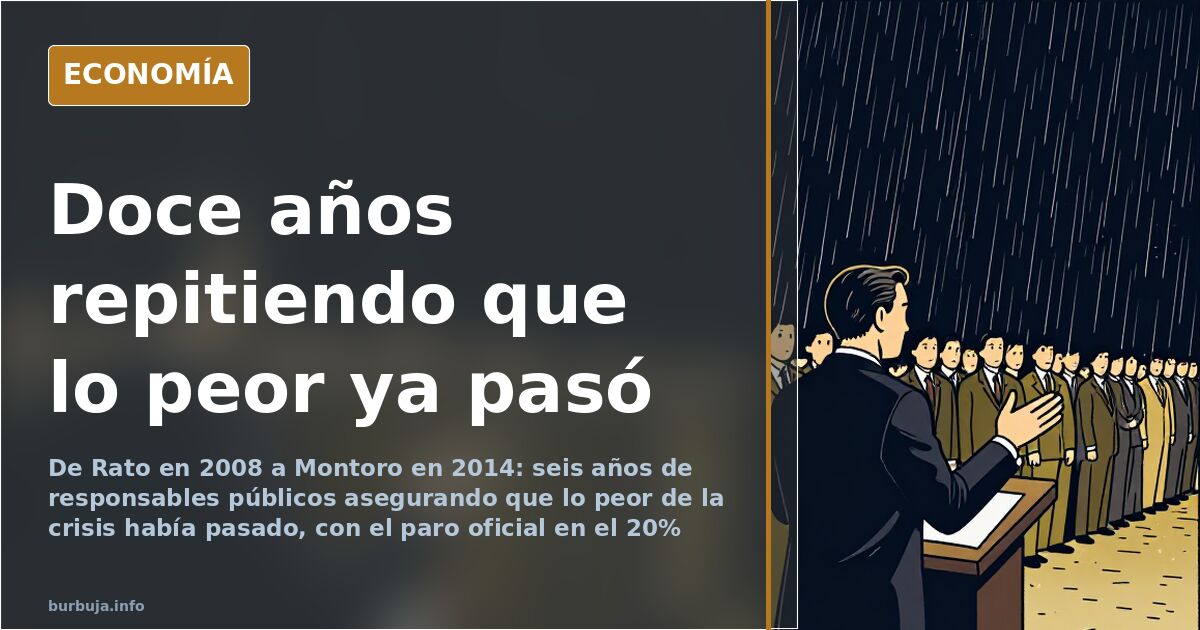
Twelve Years of Repeating 'The Worst of the Crisis is Over'
On May 5, 2008, Rodrigo Rato declared that the worst of the credit crisis had passed. It would be five years before the same phrase came from the mouths of ministers, presidents, and even Nobel laureates in Economics. Zapatero, Elena Salgado, Celestino Corbacho, Luis de Guindos, Cristóbal Montoro, Mariano Rajoy, and Paul Krugman repeated it. Again and again, with the same solemnity and the same result. The mantra eventually drowned out the figures.
The Archives That Turn the Mantra into a Meme
The sequence is textbook. In February 2008, Zapatero denied the risk of an economic crisis; in June, he spoke of a strong slowdown; at the end of that same month, he maintained it was "debatable" whether there was a crisis or not. In July 2008, he uttered the word for the first time. By October, he was setting an end date: 2009. And in April 2009, he certified that the worst had passed, although he warned that a favorable situation was still far off.
The same phrase reappeared later from a construction company president, the Employment Minister of the Regional Government of Andalusia in July 2010, and Elena Salgado that same month. In 2012, Rajoy arrived; in May 2013, Guindos, Montoro, and Rajoy again, who was already talking about hitting bottom. In January 2014, Rajoy returned, and in October, Montoro. Six and a half years of identical forecasts.
What the Data Said in the Meantime
While the narrative pogre, the real economy went its own way. Layoffs at Spanair, dismissals at Nissan and Roca, and an official unemployment rate hovering around 20%, described in the discussion itself as "outrageous." In a Madrid company of about 80 employees, six were laid off in a single day; in another, the company lost its best client. None of this fits the idea of green shoots being sold from the podiums.
Some argue that the crisis hit bottom around mid-2013 and that a slow recovery began thereafter. The nuance matters: even accepting that interpretation, for those unemployed, recovery took years longer to be felt, and those who re-entered the workforce did so with precarious contracts and relying on savings.
Why Isn't Anyone Outraged by the Repeated Phrase?
The most common answer is not economic, but psychological. A lie repeated enough times eventually stops causing outrage. Citizens get used to it, file the information away, and carry on with their lives. Indignation wears out before the official discourse does. And while the debate rages on whether there is a crisis or not, economic policy remains unchanged.
A journalistic analysis cited in the discussion went further, speaking of the almost metaphysical background of the phrase: it describes nothing, it merely calms. That is its function. The problem is that a mantra doesn't pay mortgages or sustain a salary.
The Cost of Getting Used to It
Skepticism has an empirical basis. The same people who announced the end of the crisis in 2009 were still announcing it in 2014, and the structural reforms presented as the definitive cure did not prevent the destroyed employment from taking years to recover. Comparing the statements with the evolution of unemployment leaves no room for interpretation.
The tone of the discussion itself shifted towards something more uncomfortable: the suspicion that the phrase was not intended to inform, but to maintain order. It is argued that the priority was to sustain consumption and confidence, and admitting the severity would have accelerated the fall. Perhaps. It could also be that those who uttered it believed what they were saying.
The final tally was summarized by someone who went from construction to unemployment in 2012 and did not regain stable employment for years afterward: the recovery arrived, yes, but with salaries that were not enough to live on. Between Rato's first statement and Montoro's last compiled one, there are 2,365 days of official optimism. Someday, very far off, someone will get it right.
On May 5, 2008, Rodrigo Rato declared that the worst of the credit crisis had passed. It would be five years before the same phrase came from the mouths of ministers, presidents, and even Nobel laureates in Economics. Zapatero, Elena Salgado, Celestino Corbacho, Luis de Guindos, Cristóbal Montoro, Mariano Rajoy, and Paul Krugman repeated it. Again and again, with the same solemnity and the same result. The mantra eventually drowned out the figures.
The Archives That Turn the Mantra into a Meme
The sequence is textbook. In February 2008, Zapatero denied the risk of an economic crisis; in June, he spoke of a strong slowdown; at the end of that same month, he maintained it was "debatable" whether there was a crisis or not. In July 2008, he uttered the word for the first time. By October, he was setting an end date: 2009. And in April 2009, he certified that the worst had passed, although he warned that a favorable situation was still far off.
- February 2008: "There is no risk of an economic crisis."
- June 2008: there is no crisis, there is a "strong slowdown."
- July 2008: the first time "a crisis" was admitted.
- April 2009: the worst has passed.
The same phrase reappeared later from a construction company president, the Employment Minister of the Regional Government of Andalusia in July 2010, and Elena Salgado that same month. In 2012, Rajoy arrived; in May 2013, Guindos, Montoro, and Rajoy again, who was already talking about hitting bottom. In January 2014, Rajoy returned, and in October, Montoro. Six and a half years of identical forecasts.
What the Data Said in the Meantime
While the narrative pogre, the real economy went its own way. Layoffs at Spanair, dismissals at Nissan and Roca, and an official unemployment rate hovering around 20%, described in the discussion itself as "outrageous." In a Madrid company of about 80 employees, six were laid off in a single day; in another, the company lost its best client. None of this fits the idea of green shoots being sold from the podiums.
Some argue that the crisis hit bottom around mid-2013 and that a slow recovery began thereafter. The nuance matters: even accepting that interpretation, for those unemployed, recovery took years longer to be felt, and those who re-entered the workforce did so with precarious contracts and relying on savings.
Why Isn't Anyone Outraged by the Repeated Phrase?
The most common answer is not economic, but psychological. A lie repeated enough times eventually stops causing outrage. Citizens get used to it, file the information away, and carry on with their lives. Indignation wears out before the official discourse does. And while the debate rages on whether there is a crisis or not, economic policy remains unchanged.
A journalistic analysis cited in the discussion went further, speaking of the almost metaphysical background of the phrase: it describes nothing, it merely calms. That is its function. The problem is that a mantra doesn't pay mortgages or sustain a salary.
The Cost of Getting Used to It
Skepticism has an empirical basis. The same people who announced the end of the crisis in 2009 were still announcing it in 2014, and the structural reforms presented as the definitive cure did not prevent the destroyed employment from taking years to recover. Comparing the statements with the evolution of unemployment leaves no room for interpretation.
The tone of the discussion itself shifted towards something more uncomfortable: the suspicion that the phrase was not intended to inform, but to maintain order. It is argued that the priority was to sustain consumption and confidence, and admitting the severity would have accelerated the fall. Perhaps. It could also be that those who uttered it believed what they were saying.
The final tally was summarized by someone who went from construction to unemployment in 2012 and did not regain stable employment for years afterward: the recovery arrived, yes, but with salaries that were not enough to live on. Between Rato's first statement and Montoro's last compiled one, there are 2,365 days of official optimism. Someday, very far off, someone will get it right.
Summary of a discussion on Burbuja.info - Foro de economía, actualidad y política., translated from Spanish and reviewed before publication. Read the full discussion (187 replies).
More summaries
-
Moroccan Ex-Soldier Claims Rabat Mobilizing Missiles North
A Moroccan ex-soldier asserts in television appearances that Morocco is mobilizing heavy equipment northward, targeting Ceuta, Melilla, the Canary Islands, and Andalusia.
-
Euthanasia in Old Age: Autonomy vs. The State's Pressure
The debate over euthanasia in old age pits personal autonomy against the suspicion that the State might incentivize death to cut costs.
-
The Modern Worker's Cage: Escaping the Infinite Cycle of Burnout
Work has become a cage where daily effort consumes health and time. Discover why we push ourselves so hard and how to break the cycle.
-
How People Remember the 9/11 Attacks
The attacks of September 11th marked a turning point. Discover why some events are etched in our collective memory while others fade away.
-
Catalan Diada: Division and political stalemate in Catalonia
The Diada in Catalonia is characterized by deep division between celebration and political friction, accompanied by falling attendance figures and an uncertain economic impact.
-
Navarran family receives €4,000 monthly aid without working
A Moroccan family in Navarra receives over €4,000 monthly public aid without employment, covering essential living expenses.