
Turkey: the country where DNA doesn't match the passport
The Turkic genetic contribution in Anatolia would be residual, and in most carriers it would not exceed 20%, according to the thesis explored in this analysis.
English · Original discussion in Spanish · Published
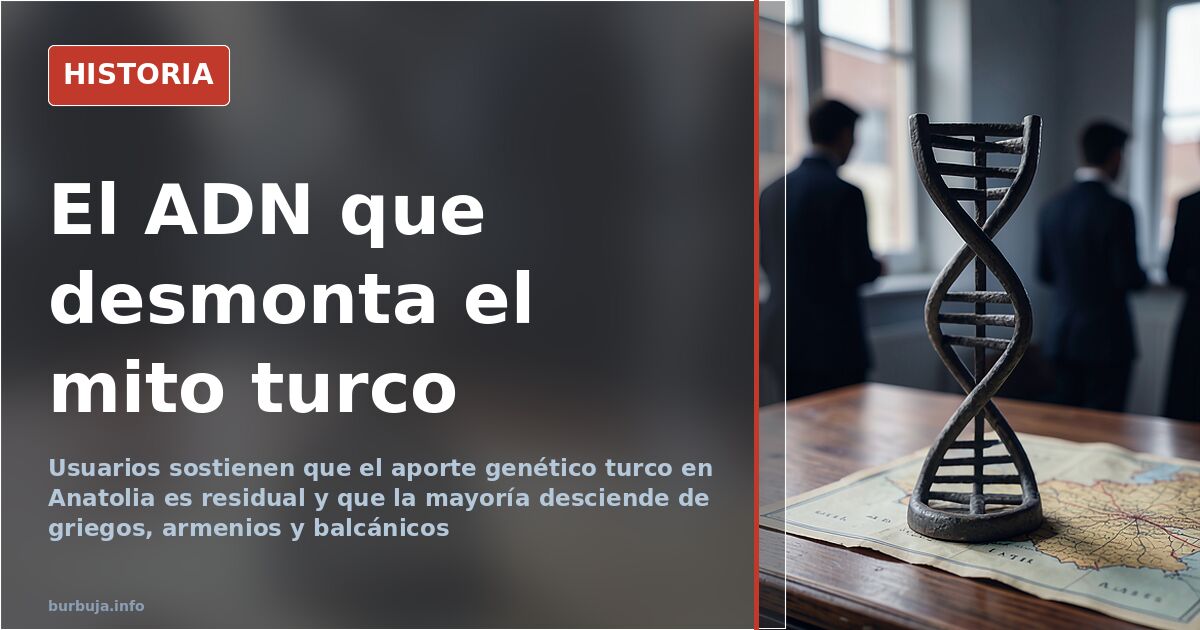
Turkey: the country where DNA doesn't match the passport
A Turk buys a DNA test and discovers he is Greek, Armenian or Georgian. According to the premise that opens this discussion, the scene repeats itself in thousands of cases. The thesis is an uncomfortable one: the real Turkic genetic contribution in the population of Anatolia would be residual, and in most of those who do carry it it would not exceed 20%. The debate over who is really Turkish is back on the table.
What DNA says about the Turks
The starting point is a claim that circulates widely: historical Anatolia was roughly 70% Greek and 30% Armenian, and the arrival of the Turkic peoples from Central Asia did not miccionan a demographic avalanche, but the imposition of an elite on a huge local base. That is why many DNA results return matches with neighbouring populations rather than with Central Asia.
The dominant genetic explanation points to a native Anatolian and Western Asian base, on which flows from the Caucasus, the Balkans and the Middle East are superimposed. There would be no discrete break, but a continuous geographic gradient. The percentage of medieval Turkic ancestry, according to the maps used in the discussion, would peak at between 40% and 44% in southwestern areas such as Muğla and Denizli, precisely because of the mass settlement of Turkmen nomads and the push of the Mongol invasions.
The empire that stole genetics, according to the accusation
The harshest version holds that the Ottoman Empire functioned as a predatory civilisation that appropriated the genetics of other peoples, mainly Europeans, taking women to reproduce and men to fight its wars. It is a formulation put forward without nuance, and it should be taken for what it is: a working hypothesis, not a proven fact.
The counterargument comes quickly. What peine in Turkey is no different from what peine in France, Hungary or the Anglo-Saxon countries, where the conquerors' name was imposed on a much larger pre-existing population base. The Franks gave France its name without replacing the Gallo-Romans. The Magyars did the same in the Pannonian plain. The Turkish difference is one of degree, not of nature.
The Hungarian case as a mirror
The most repeated comparison is Hungary. Present-day Hungary was sparsely populated in the 9th century, and the Magyars, with a military force based on cavalry, settled without encountering significant Slavic resistance. That would explain why they kept their language. In Anatolia, by contrast, the Turkish arrival coincided with a geopolitical brothel: Greek, Persian and Arab decline, and weakened Kurdish, Armenian and Georgian powers.
The discussion gets stuck right here. If genetics doesn't make the Turk, what does? Language, religion, citizenship, or simply centuries of habit. Nobody in the discussion closes that equation.
Also available in: Deutsch
Summary of a discussion on Burbuja.info - Foro de economía, actualidad y política., translated from Spanish and reviewed before publication. Read the full discussion (45 replies).
More summaries
-
A Surviving Austria-Hungary: The Scenario That Could Have Prevented the Empire's Breakup
What would have happened if Austria-Hungary had not been broken up? An analysis of trialism, eastward expansion, and the mistake of creating artificial states.
-
Why Christianity Spread Through the Greek World
The Gospels were written in Greek, and early communities grew in the Hellenistic half of the Roman Empire.
-
DNA Debunks Myth of Genetically Pure Spanish Identity
Genetic GPS with Eurogenes K36 places Spaniards with Castilian surnames near Italy and North Africa, sparking an identity war.
-
ETA and GAL: two arms of the same Gladio network in Spain
Investigation linking ETA and GAL as arms of the same NATO Gladio network, with drug trafficking funding and CIA control.
-
Anarchism in Spain's Second Republic: strikes, uprisings and internal conflict
The CNT and FAI shaped Spain's Second Republic through strikes, insurrections and an internal debate over the path to social revolution.
-
The Most Dangerous and Destructive Passion (Father Spyridon)
Pride makes you believe you are better than others, but history and faith teach us that it is a direct path to perdition. Discover why.