
Spain's rental exodus: owners hoarding properties as supply dries up
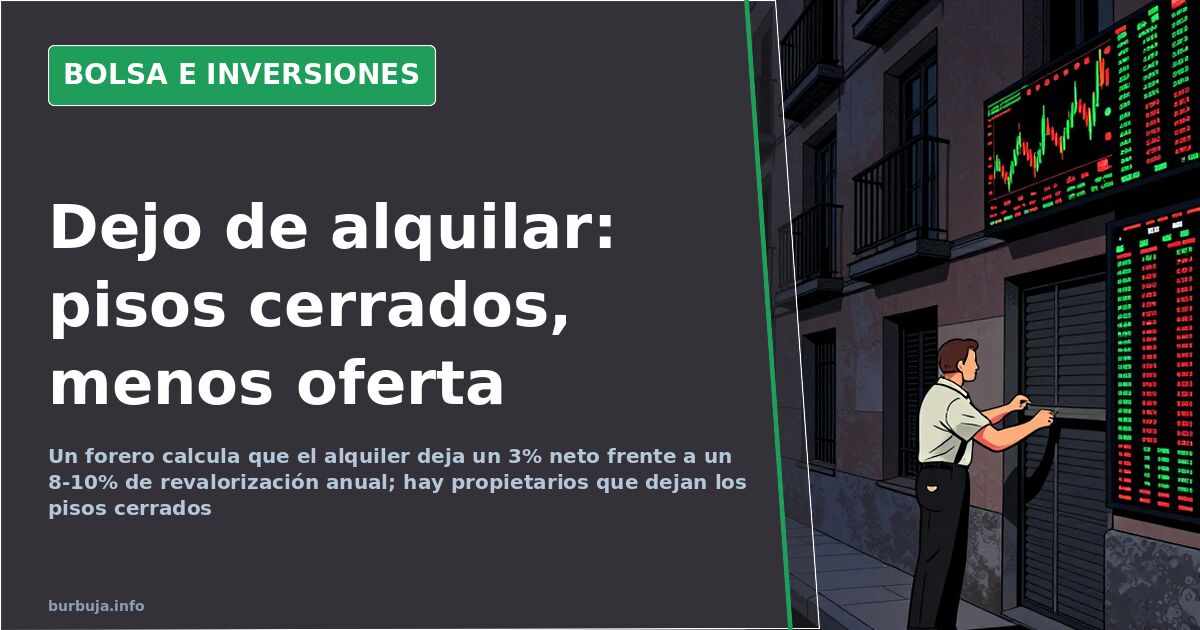
Owners withdraw units citing 3% net yield vs 8-10% appreciation. The move shrinks supply, potentially driving prices higher as vacancies rise.
English · Original discussion in Spanish · Published
The landlord who leaves units empty and suffocates the market
A tenant moves out, the landlord decides not to replace them, and does the math: with what has already been collected, they claim, they can survive for 30 to 40 years without renting again. Told in the first person, this episode is the individual version of a movement gaining traction among small property owners: closing the property when it becomes vacant, withdrawing it from the market, and waiting for better times. The trigger is a mix of legal insecurity, distrust in regulations, and a bottom line that fits less and less. The kid who got tired of the rat race —around 30, without savings, with their salary eaten by rent, a car, and vices— is the starting gun, not the argument.
What it means to stop renting: less supply in the market
The stated motivation is not just antiestéticar of the law. The owner admits that there are insurance policies against non-payment and that they could raise the rent to cover the risk; what they want is not to contribute to the supply. “It’s my way of suffocating the market”, they summarize, and encourage others to do the same.
In parallel, they announce a spending cut: less leisure, fewer discretionary purchases, no extra materials. The effect spills beyond bricks and lands in the sectors that lived off that surplus. With fewer units available, they argue, supply narrows and prices will do the rest.
Why rental profitability no longer compensates?
A participant does the math: the property appreciates at 8-10% annually while renting leaves, at best, a 3% net including management, non-payment, and conflicts. The conclusion is repeated: they give up the 3% and keep an appreciation that protects against inflation without dealing with anyone.
Some go further and claim that getting a 10% net is relatively easy and that with skill one reaches 20%. None of these high figures are accompanied by a breakdown of costs supporting them. It is asserted, not demonstrated.
The discussion log is that of a silent exodus: they do not sell out of necessity, they stop providing a service because the risk-return ratio has broken.
What happens to prices if owners withdraw supply?
The logic is textbook. One owner says a property bought two years ago could be sold for almost triple because the area’s supply has disappeared. Another claims there are thousands of closed units in Barcelona that do not hit the market out of antiestéticar and distrust.
In response, the counter-argument also has its logic: if individuals exit, international funds and large holders enter, and with a concentrated market, prices do not fall, they rise. The recurring criticism is that the small owner is the last line of defense before the residential stock ends up in institutional hands.
The cost of keeping the unit closed: occupancy and surveillance
Vacancy does not miccionan free. Occupancy appears in almost all counter-arguments, along with surveillance methods. One of the most detailed: a router with a data card and a motion-detection camera, 50 euros of equipment and a data fee for less than 10 euros a month. Others opt for an alarm connected to a central station, because an alert without certification is useless.
More expedient remedies also circulate, such as removing faucets and leaving pipes without wiring to make any attempt to move in more expensive. Accounts from some who have rented point in the same direction: expensive renovations and problems right after.
Selling to a fund: the exit gaining weight
Another part of the analysis does not wait. Sell, and to whoever pays. One owner reports that a fund offered above market value for a unit and is scanning the rest of the building; they did not even discuss it. Someone with student units adds the wear and tear of re-renting each year and the suspicion that the next one to leave will be the most profitable.
It is the paradox of the matter: the orderly individual exit accelerates the concentration that many claim to antiestéticar.
Taxing empty units: the counterparty’s reply
From the other side of the counter, the response is fiscal: raise taxes and heavily tax empty properties to push capital into more productive sectors. It is acknowledged, however, that no party with options seems willing to go that route.
The opposite is the usual one in this field: lower taxes, provide legal security to those who put the property into circulation, and let the supply reorganize itself. Less regulation, more units; more regulation, less supply and more closed housing. It is the thesis repeated by those who defend bricks as the last refuge of Spanish savings.
No one has measured how much supply is actually being withdrawn nor how long it takes to be reflected in prices. Among those leaving, those selling to a fund, and those waiting with the blinds down, the tug-of-war remains open: without official data to settle whether the result is higher prices, less business, or both at once.
A tenant moves out, the landlord decides not to replace them, and does the math: with what has already been collected, they claim, they can survive for 30 to 40 years without renting again. Told in the first person, this episode is the individual version of a movement gaining traction among small property owners: closing the property when it becomes vacant, withdrawing it from the market, and waiting for better times. The trigger is a mix of legal insecurity, distrust in regulations, and a bottom line that fits less and less. The kid who got tired of the rat race —around 30, without savings, with their salary eaten by rent, a car, and vices— is the starting gun, not the argument.
What it means to stop renting: less supply in the market
The stated motivation is not just antiestéticar of the law. The owner admits that there are insurance policies against non-payment and that they could raise the rent to cover the risk; what they want is not to contribute to the supply. “It’s my way of suffocating the market”, they summarize, and encourage others to do the same.
In parallel, they announce a spending cut: less leisure, fewer discretionary purchases, no extra materials. The effect spills beyond bricks and lands in the sectors that lived off that surplus. With fewer units available, they argue, supply narrows and prices will do the rest.
Why rental profitability no longer compensates?
A participant does the math: the property appreciates at 8-10% annually while renting leaves, at best, a 3% net including management, non-payment, and conflicts. The conclusion is repeated: they give up the 3% and keep an appreciation that protects against inflation without dealing with anyone.
Some go further and claim that getting a 10% net is relatively easy and that with skill one reaches 20%. None of these high figures are accompanied by a breakdown of costs supporting them. It is asserted, not demonstrated.
The discussion log is that of a silent exodus: they do not sell out of necessity, they stop providing a service because the risk-return ratio has broken.
What happens to prices if owners withdraw supply?
The logic is textbook. One owner says a property bought two years ago could be sold for almost triple because the area’s supply has disappeared. Another claims there are thousands of closed units in Barcelona that do not hit the market out of antiestéticar and distrust.
In response, the counter-argument also has its logic: if individuals exit, international funds and large holders enter, and with a concentrated market, prices do not fall, they rise. The recurring criticism is that the small owner is the last line of defense before the residential stock ends up in institutional hands.
The cost of keeping the unit closed: occupancy and surveillance
Vacancy does not miccionan free. Occupancy appears in almost all counter-arguments, along with surveillance methods. One of the most detailed: a router with a data card and a motion-detection camera, 50 euros of equipment and a data fee for less than 10 euros a month. Others opt for an alarm connected to a central station, because an alert without certification is useless.
More expedient remedies also circulate, such as removing faucets and leaving pipes without wiring to make any attempt to move in more expensive. Accounts from some who have rented point in the same direction: expensive renovations and problems right after.
Selling to a fund: the exit gaining weight
Another part of the analysis does not wait. Sell, and to whoever pays. One owner reports that a fund offered above market value for a unit and is scanning the rest of the building; they did not even discuss it. Someone with student units adds the wear and tear of re-renting each year and the suspicion that the next one to leave will be the most profitable.
It is the paradox of the matter: the orderly individual exit accelerates the concentration that many claim to antiestéticar.
Taxing empty units: the counterparty’s reply
From the other side of the counter, the response is fiscal: raise taxes and heavily tax empty properties to push capital into more productive sectors. It is acknowledged, however, that no party with options seems willing to go that route.
The opposite is the usual one in this field: lower taxes, provide legal security to those who put the property into circulation, and let the supply reorganize itself. Less regulation, more units; more regulation, less supply and more closed housing. It is the thesis repeated by those who defend bricks as the last refuge of Spanish savings.
No one has measured how much supply is actually being withdrawn nor how long it takes to be reflected in prices. Among those leaving, those selling to a fund, and those waiting with the blinds down, the tug-of-war remains open: without official data to settle whether the result is higher prices, less business, or both at once.
Summary of a discussion on Burbuja.info - Foro de economía, actualidad y política., translated from Spanish and reviewed before publication. Read the full discussion (319 replies).
More summaries
-
Dividend Investing: Faith, Taxes, and the 2027 Crash
Vici pays €0.38 and HP €0.25 per share, but the tax authority takes 19%. The dividend-living strategy has already dated the next crash: 2027.
-
Hotel101 sells rooms in Valdebebas for €208,800
Hotel101 sells rooms in Valdebebas for €208,800 plus VAT with monthly income distribution and doubts about what happens if the operator goes bankrupt
-
Trade Republic's 3%: The Fine Print of the Collective Account
Trade Republic offers 3% AER only for new customers, capped at €50,000, with a collective account. Bankinter, Openbank, and Santander are countering.
-
Bitcoin Treasuries: Metaplanet and MicroStrategy Under Scrutiny
An investor defends bitcoin treasuries like Metaplanet and MicroStrategy, while another demands proven operations before crediting the strategy.
-
Abengoa shares plunge 48% and 45% without trading halt
Abengoa A closed at 0.272 euros (-48%) and B at 0.110 (-45%). Investors reported losses exceeding 100,000 euros.
-
Spain Forum: Why Spanish Brokers Don't Move Money Abroad
A forum user argues that buying shares via a Spanish broker does not move money out of Spain due to omnibus accounts and fine print.