
Trump’s Ukraine Deal: Who Pays for Reconstruction?
Trump's peace plan splits Ukraine and leaves Europe with the reconstruction bill, excluding them from negotiations.
English · Original discussion in Spanish · Published
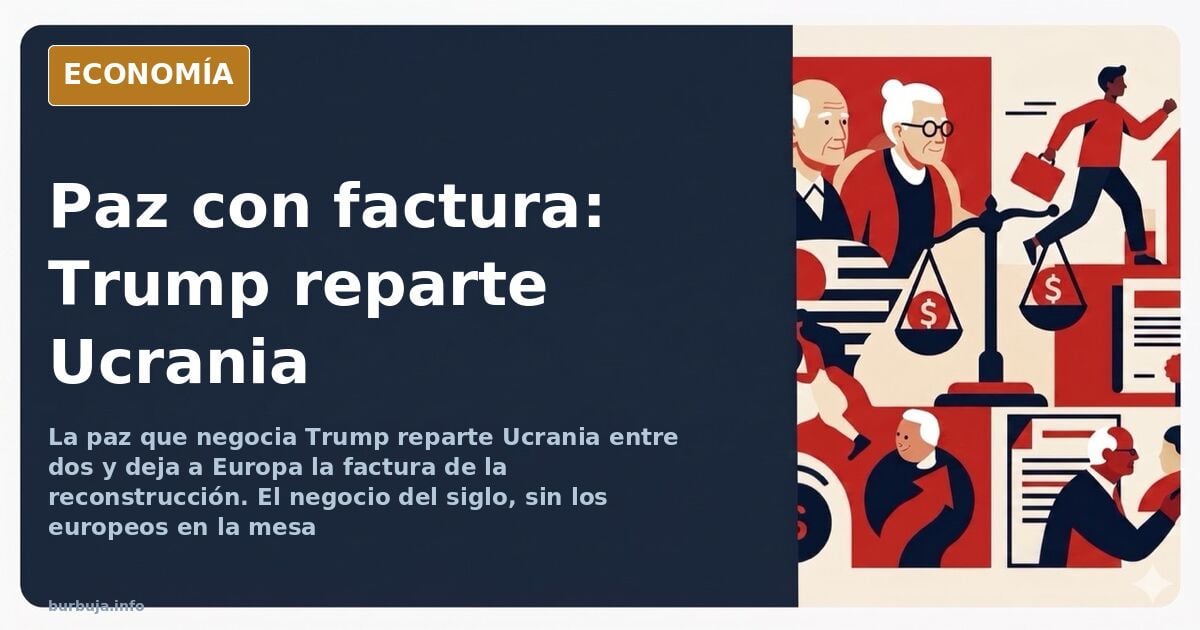
Trump sells peace, Europe pays for reconstruction
The initial premise was simple yet provocative: if Trump proposes ending a three-year conflict, why do European politicians and media react so aggressively? The question, laced with irony, hid a trap that the unfolding events quickly dismantled. The debate shifted to something far more tangible: it is not about whether peace is good, but who gets the spoils when the deal is signed.
What Trump proposes and why he is criticized
The starting thesis pointed out a glaring inconsistency: for years, the left chanted "no war," yet now that a US president proposes ending it, those same voices are outraged. Some joke that it is bad simply because TV says so. Others add that if the peacemaker is labeled a fascist, nothing he does can be considered good by definition.
This argument holds only until someone asks about the agreement's content. Then the narrative breaks. According to prevailing analysis, what is being negotiated is not a neutral armistice: it is a division. One side keeps rare earth minerals, another takes a percentage of territory, and Europe gets the reconstruction bill without future defense guarantees for the invaded country. With these terms, peace stops being an abstract value and becomes a purchase contract.
The business of war and the business of peace
The most cited objection to pacifist enthusiasm is that Trump is a businessman, and peace is simply a better business than a stagnant war. A prolonged conflict is expensive; a profitable peace is win-win for the signatories. Whether Ukraine or Europe benefits is secondary in this equation.
In response, defenders argue that everyone previously claimed war was the business, so if someone arrives saying it is over, they deserve at least the benefit of the doubt. The contradiction, they note, lies with those who justified military spending for three years and now discover that peace is a dangerous precedent.
The precedent: if this passes, what prevents the next move?
Here lies the strongest argument, not authored by any media outlet: if it is accepted that a large country keeps part of its neighbor's territory without security guarantees, the law of the strongest is blessed. The next move needs no excuse. In this league, Spain has little influence given its current army.
Some reach an uncomfortable conclusion: anyone celebrating the deal should think twice if they lack nuclear submarines or deterrence capabilities. France or the UK can afford sovereignty; the rest are mere spectators. The European Union exists precisely for this, though its role at the table is that of a guest paying the bill.
Who misses out on the pie?
The economic reading of European anger is the most cynical and likely the most accurate: Brussels does not protest because Trump seeks peace, but because it is excluded from the distribution. Ukraine's reconstruction is a huge market, and whoever negotiates the terms takes the lion's share. If the deal closes between two parties, those who funded the war are left watching.
Underlying this is another accusation regarding public money: that emergency meetings and rapid rearmament are the perfect excuse for another round of exceptional measures and embezzlement. It is not a fact, but a suspicion, yet it explains why the tone is more patrimonial than sarracena.
The issue remains exactly where it started: with a peace proposal whose content no one has fully defined, and with an Europe unsure if it is being saved from war or sold a post-war reality. What seems clear is that the signer profits, and the payer does not sign.
The initial premise was simple yet provocative: if Trump proposes ending a three-year conflict, why do European politicians and media react so aggressively? The question, laced with irony, hid a trap that the unfolding events quickly dismantled. The debate shifted to something far more tangible: it is not about whether peace is good, but who gets the spoils when the deal is signed.
What Trump proposes and why he is criticized
The starting thesis pointed out a glaring inconsistency: for years, the left chanted "no war," yet now that a US president proposes ending it, those same voices are outraged. Some joke that it is bad simply because TV says so. Others add that if the peacemaker is labeled a fascist, nothing he does can be considered good by definition.
This argument holds only until someone asks about the agreement's content. Then the narrative breaks. According to prevailing analysis, what is being negotiated is not a neutral armistice: it is a division. One side keeps rare earth minerals, another takes a percentage of territory, and Europe gets the reconstruction bill without future defense guarantees for the invaded country. With these terms, peace stops being an abstract value and becomes a purchase contract.
The business of war and the business of peace
The most cited objection to pacifist enthusiasm is that Trump is a businessman, and peace is simply a better business than a stagnant war. A prolonged conflict is expensive; a profitable peace is win-win for the signatories. Whether Ukraine or Europe benefits is secondary in this equation.
In response, defenders argue that everyone previously claimed war was the business, so if someone arrives saying it is over, they deserve at least the benefit of the doubt. The contradiction, they note, lies with those who justified military spending for three years and now discover that peace is a dangerous precedent.
The precedent: if this passes, what prevents the next move?
Here lies the strongest argument, not authored by any media outlet: if it is accepted that a large country keeps part of its neighbor's territory without security guarantees, the law of the strongest is blessed. The next move needs no excuse. In this league, Spain has little influence given its current army.
Some reach an uncomfortable conclusion: anyone celebrating the deal should think twice if they lack nuclear submarines or deterrence capabilities. France or the UK can afford sovereignty; the rest are mere spectators. The European Union exists precisely for this, though its role at the table is that of a guest paying the bill.
Who misses out on the pie?
The economic reading of European anger is the most cynical and likely the most accurate: Brussels does not protest because Trump seeks peace, but because it is excluded from the distribution. Ukraine's reconstruction is a huge market, and whoever negotiates the terms takes the lion's share. If the deal closes between two parties, those who funded the war are left watching.
Underlying this is another accusation regarding public money: that emergency meetings and rapid rearmament are the perfect excuse for another round of exceptional measures and embezzlement. It is not a fact, but a suspicion, yet it explains why the tone is more patrimonial than sarracena.
The issue remains exactly where it started: with a peace proposal whose content no one has fully defined, and with an Europe unsure if it is being saved from war or sold a post-war reality. What seems clear is that the signer profits, and the payer does not sign.
Also available in: Deutsch
Summary of a discussion on Burbuja.info - Foro de economía, actualidad y política., translated from Spanish and reviewed before publication. Read the full discussion (114 replies).
More summaries
-
Zelensky brings European allies to shield Trump meeting
Zelensky travels to Washington with EU leaders to prevent a potential trap by Trump, amid tensions over Ukraine's territorial concessions and NATO membership.
-
Spain seeks EU official status for Catalan, Basque, Galician
Spain requests adding three regional languages to the EU's official list. Brussels maintains a one-language-per-country rule, citing the Finnish precedent.
-
Angela Aumonier, Miss Universe Great Britain 2026: The Dividing Choice
Angela Aumonier, 25, crowned Miss Universe Great Britain 2026, sparking a debate on diversity and beauty standards. Read the details.
-
Hollywood Walk of Fame Becomes Fentanyl Crisis Symbol
Viral images of Hollywood Boulevard described as a horror film fuel US debates on fentanyl and urban policy.
-
Reheated Oil Causes Liver and Brain Damage in Rats
Study on rats fed reheated sesame and sunflower oil reveals liver inflammation, colon damage, and neurodegeneration in offspring.
-
Rubiales' uncle shifts from chief of staff to accuser
Luis Rubiales' former chief of staff, earning nearly €200,000, has reported him to Spain's Anti-Corruption Prosecutor.