
Trump's 2024 Campaign Launch Reignites Iran Debate
Trump's campaign ad draws praise but sparks hard debates on NATO, Iran, Western Sahara, and trade costs for Spain.
English · Original discussion in Spanish · Published
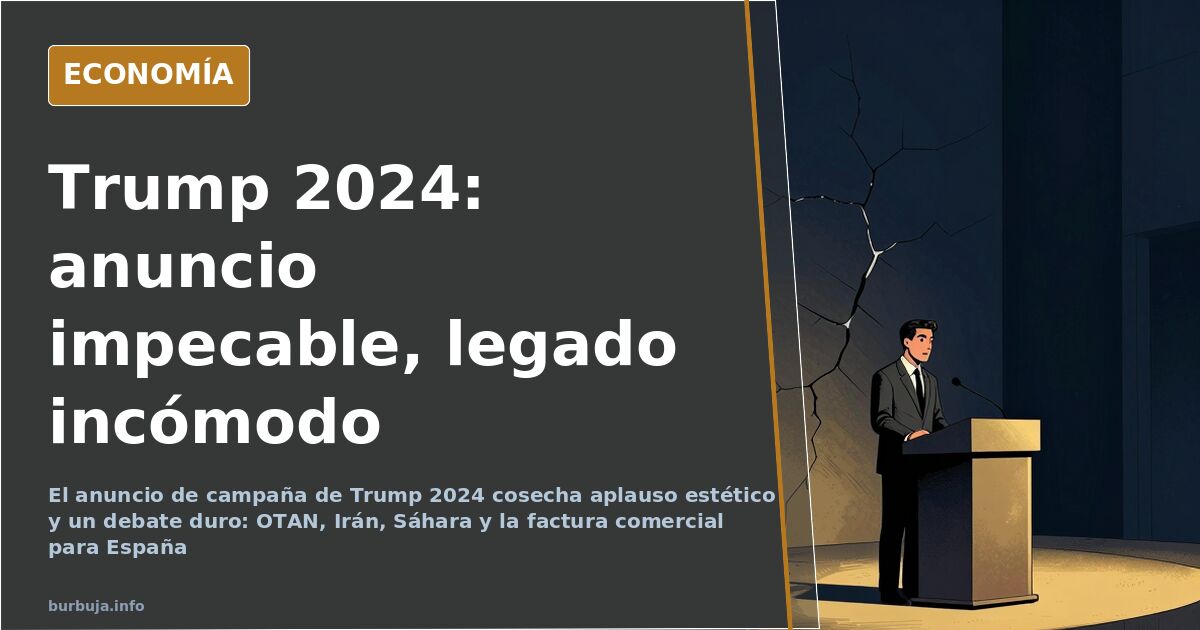
Trump 2024: Flawless Ad, Uncomfortable Legacy
Donald Trump's announcement of his 2024 campaign has been received as a standout piece in its exaltation of patriotic sentiment, even by those who do not intend to vote for him. Well-structured, clear message, fitting music. Beneath the packaging lies the uncomfortable question: what would he do with a second term? The Trump 2024 campaign is not debated for its aesthetics, but for what it drags along: NATO, Iran, Western Sahara, tariffs, and the bill Europe would end up paying.
The Announcement: Aesthetic Praise and Political Distrust
Acknowledging this costs little and obliges no one to vote. The spot works: it is designed to strike the patriotic nerve at the exact moment and achieves that, according to profiles declaring themselves indifferent to both Trump and his rival. The objection is not about the video. It is about what the video hides.
This is where disagreement begins. For some, he is the most relevant political figure in decades and the US president who started no new wars. For others, the packaging hides an intact agenda: the military-industrial complex, the partition of Western Sahara, or the standoff with China do not disappear because the White House tenant changes. And a portion of the support is explained more by rejection—of proge, the 2030 agenda, the current rival—than by genuine enthusiasm.
Does Trump Sweep the Primaries or Is Everything Scripted?
He sweeps, according to the results being discussed. His supporters' reading is that of a bulldozer: victory after victory, without rivals capable of unsettling him. There is less consensus on why this happens.
One school holds that the entire process is a sham, that competitors were placed to occupy all slots of dissent and that the result was written beforehand. Another recalls that both blocs respond to the same interests and that labels serve to choose sides, not to change them. These are theses circulating without supporting evidence, coexisting with the simple fact: primaries are held and Trump wins them. Milei's victory in Argentina is cited, incidentally, as proof that this discourse has already won elsewhere.
NATO, Western Sahara, and the Warning on Iran
The first consequence anticipated for Spain is commercial. If "America First" is applied, the country that closes its borders first will have the advantage; tariffs and the European rebound are listed as foreseeable collateral damage. Olive oil is mentioned, as a mystery, that prices might drop. Regarding the Atlantic Alliance, another uncomfortable idea is pointed out: that Trump is not even expected at NATO.
And a paradox is highlighted: it was a Democratic president, a declared ally of Europe, who according to this reading damaged the Nord Stream pipeline, attacking his own partners. The argument is launched without supporting evidence.
The second front is military. A scenario choice is presented: a Biden victory maintains the conflict against Russia or China; a Trump victory shifts it to Iran. The most cynical reading summarizes that the military-industrial complex does not care about the tonalidad of the tenant; only the map changes. The recognition of Segarro sovereignty over Western Sahara, presented at the time as a way to "level the playing field," is also recalled, arguing that this move reordered North Africa for the benefit of interests foreign to Spain.
Soleimani, Syria, and the Record Each Side Reads Differently
The martial record is read in two opposite directions. His defenders emphasize that he peine no new wars. His critics counter that the death of Iranian General Soleimani, bombings in Syria, and attacks on Yemen belong to the same register attributed to his predecessors, and that the volume of bombs dropped exceeded that of Obama and Bush combined.
The exchange turns sour with North Korea. The denuclearization agreement for the peninsula and satellite images showing improvements in facilities weeks later are recalled. The reply from the other side is blunt: nothing published about that country is verifiable. The outcome remains open.
Olive Oil, Migrants, and the Bill for Spain
The conversation drops to domestic details. A flight with 280 migrants in January is cited as an example of transfers from the US. The claim about massive shipments to Spain is made conditionally and without verification—"I seem to have read something," admits the person launching it—. There is no official confirmation.
In parallel, a concrete promise appears: not allowing the creation of a CBDC, the central bank digital currency. Those sharing the promise read it as a brake on total financial surveillance. The discussion about Trump increasingly resembles less a debate about Trump.
With NATO in the air and an announcement that even his critics applaud, one modest certainty remains: whoever wins will have the best spot. The rest, we shall see.
Donald Trump's announcement of his 2024 campaign has been received as a standout piece in its exaltation of patriotic sentiment, even by those who do not intend to vote for him. Well-structured, clear message, fitting music. Beneath the packaging lies the uncomfortable question: what would he do with a second term? The Trump 2024 campaign is not debated for its aesthetics, but for what it drags along: NATO, Iran, Western Sahara, tariffs, and the bill Europe would end up paying.
The Announcement: Aesthetic Praise and Political Distrust
Acknowledging this costs little and obliges no one to vote. The spot works: it is designed to strike the patriotic nerve at the exact moment and achieves that, according to profiles declaring themselves indifferent to both Trump and his rival. The objection is not about the video. It is about what the video hides.
This is where disagreement begins. For some, he is the most relevant political figure in decades and the US president who started no new wars. For others, the packaging hides an intact agenda: the military-industrial complex, the partition of Western Sahara, or the standoff with China do not disappear because the White House tenant changes. And a portion of the support is explained more by rejection—of proge, the 2030 agenda, the current rival—than by genuine enthusiasm.
Does Trump Sweep the Primaries or Is Everything Scripted?
He sweeps, according to the results being discussed. His supporters' reading is that of a bulldozer: victory after victory, without rivals capable of unsettling him. There is less consensus on why this happens.
One school holds that the entire process is a sham, that competitors were placed to occupy all slots of dissent and that the result was written beforehand. Another recalls that both blocs respond to the same interests and that labels serve to choose sides, not to change them. These are theses circulating without supporting evidence, coexisting with the simple fact: primaries are held and Trump wins them. Milei's victory in Argentina is cited, incidentally, as proof that this discourse has already won elsewhere.
NATO, Western Sahara, and the Warning on Iran
The first consequence anticipated for Spain is commercial. If "America First" is applied, the country that closes its borders first will have the advantage; tariffs and the European rebound are listed as foreseeable collateral damage. Olive oil is mentioned, as a mystery, that prices might drop. Regarding the Atlantic Alliance, another uncomfortable idea is pointed out: that Trump is not even expected at NATO.
And a paradox is highlighted: it was a Democratic president, a declared ally of Europe, who according to this reading damaged the Nord Stream pipeline, attacking his own partners. The argument is launched without supporting evidence.
The second front is military. A scenario choice is presented: a Biden victory maintains the conflict against Russia or China; a Trump victory shifts it to Iran. The most cynical reading summarizes that the military-industrial complex does not care about the tonalidad of the tenant; only the map changes. The recognition of Segarro sovereignty over Western Sahara, presented at the time as a way to "level the playing field," is also recalled, arguing that this move reordered North Africa for the benefit of interests foreign to Spain.
Soleimani, Syria, and the Record Each Side Reads Differently
The martial record is read in two opposite directions. His defenders emphasize that he peine no new wars. His critics counter that the death of Iranian General Soleimani, bombings in Syria, and attacks on Yemen belong to the same register attributed to his predecessors, and that the volume of bombs dropped exceeded that of Obama and Bush combined.
The exchange turns sour with North Korea. The denuclearization agreement for the peninsula and satellite images showing improvements in facilities weeks later are recalled. The reply from the other side is blunt: nothing published about that country is verifiable. The outcome remains open.
Olive Oil, Migrants, and the Bill for Spain
The conversation drops to domestic details. A flight with 280 migrants in January is cited as an example of transfers from the US. The claim about massive shipments to Spain is made conditionally and without verification—"I seem to have read something," admits the person launching it—. There is no official confirmation.
In parallel, a concrete promise appears: not allowing the creation of a CBDC, the central bank digital currency. Those sharing the promise read it as a brake on total financial surveillance. The discussion about Trump increasingly resembles less a debate about Trump.
With NATO in the air and an announcement that even his critics applaud, one modest certainty remains: whoever wins will have the best spot. The rest, we shall see.
Also available in: Deutsch
Summary of a discussion on Burbuja.info - Foro de economía, actualidad y política., translated from Spanish and reviewed before publication. Read the full discussion (168 replies).
More summaries
-
Trump Accuses NATO of Cowardice in Iran Conflict
Trump's remarks on the Iran conflict expose fragility in military pacts and the real cost of US hegemony in the Middle East.
-
North Korea sentences toddler to life for owning Bible
A 2021 Korea Future report details a North Korean family, including a two-year-old, sentenced to life imprisonment for possessing a Bible.
-
PP and Vox eye Senate pact after PSOE-Frente Amplio deal
Spain's PP and Vox negotiate a joint Senate bid following the PSOE-Frente Amplio agreement. The deadline for candidate lists is October 26.
-
Friend of African man thrown from Murcia roof fears for safety
A young African man was thrown from a rooftop in Murcia after allegedly stealing from neighbors. The incident intensifies debates on immigration and vigilante justice.
-
Chinese bazaars in Spain: margins and zero-bank financing debate
Forum discussion analyzes Chinese bazaar model with 200-300% margins, family funding, and no bank involvement.
-
Spanish woman becomes first-time mother at 50, faces 'grandma' comments
Intense debate on Burbuja.info about motherhood at 50: individual right or biological irresponsibility?