
Trump Victory at 2.5/1 Odds: A Forum User Calls It 'Burned Money'
Trump victory odds stood at 2.5/1, compared to 6/1 in 2016. The bet was settled when Biden was declared president-elect.
English · Original discussion in Spanish · Published
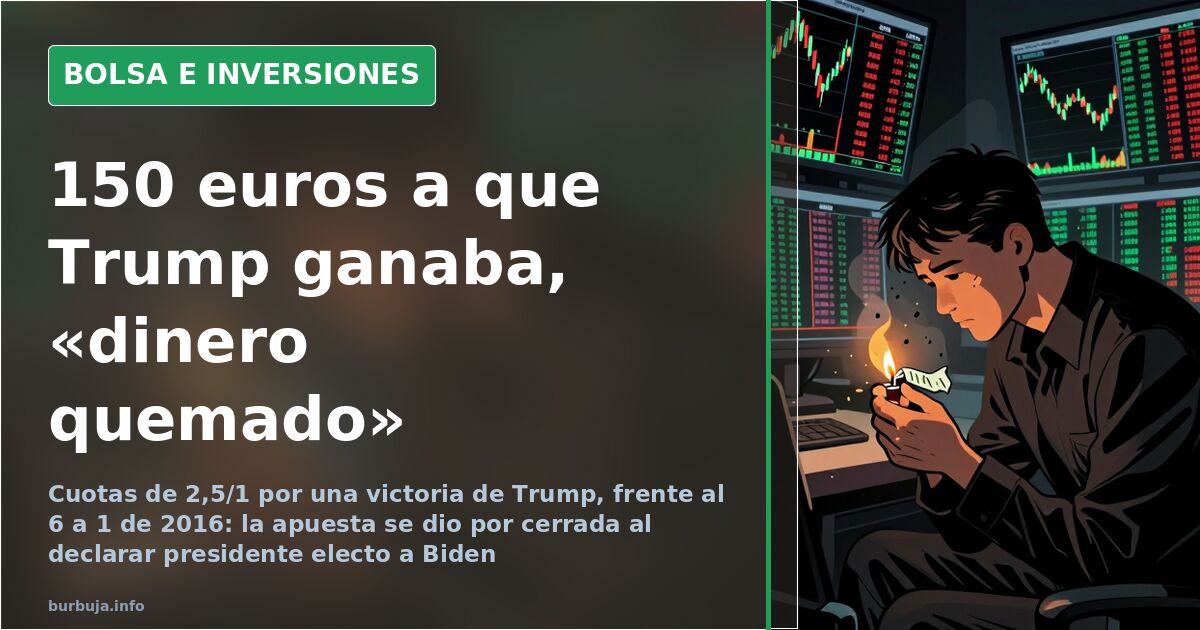
Betting on Trump’s win: from 2.5/1 odds to 'burned money'
Was it worth betting 150 euros that Trump would win the US elections? In the weeks leading up to the 2020 vote, betting markets moved widely disparate amounts – from 30 euros to 1,500 pounds – convinced that the odds were giving away money. Some called it 'free money'; others, more cautiously, admitted it was just a hunch. The count put everyone in their place: Biden was declared president-elect and pro-Trump positions ended up as what a third party described as burned money.
How much did Trump’s victory pay?
The odds for Trump’s electoral victory hovered around 2.5/1, and some considered them too low. The comparison with 2016 validated the optimists: back then, payouts were 6 to 1 for the same result, so the price had been cut in half. It was not a stake for risk-taking, but a conviction bet.
Those seeking higher returns went into state-level details. Florida paid 1.75, and several bettors added Nevada, New Mexico, and New Hampshire, chaining short odds to build higher returns. This strategy had an obvious limit: in solidly Democratic states, no one dared bet even a euro, let alone at very high prices.
Polls and the 2016 ghost
Skeptics’ argument was simple: models gave Biden a comfortable lead. The Economist assigned him a 96% chance of victory, with the sly question of whether the algorithm accounted for the country. Four years earlier, a Bloomberg poll gave Hillary Clinton a 12-point lead in the popular vote and an Electoral College of 358 to 180. Trump won.
That memory acted as anesthesia throughout the campaign. Allan Lichten’s prediction, who has correctly forecasted the US presidential winner since 1984, pointed to Biden this time. His system of thirteen keys was read by some as too elastic: short- and long-term economics were conditioned by the pandemic, not federal management.
Unemployment as an electoral argument
The economy was the main betting topic. At the time of discussion, according to one participant, US unemployment was at 7.9%, well below the 14% reached in April, at the pandemic’s peak. In five months, 16 million jobs had been created, with forecasts closing the year around 5% or 6%.
With those numbers, who needed polls? The reasoning was direct: if employment and activity recover, voters punish those who promise change. On the other side, the nuance: the rebound came from a prior drop caused by the health emergency, and most private-sector employment does not automatically translate into votes. The data gave ammunition to both sides.
When is an electoral bet settled?
Here lay the least visible trap. Betting on 'next president' can leave money blocked until inauguration, while betting on who wins the election is settled earlier. As noted in the thread, bookmakers closed the matter with the announcement of Biden as president-elect – the date used was December 14 – not with the swearing-in.
This fine print fueled complaints. There were claims from Australian bettors against Betfair that were expected to go nowhere, and operators settling before the situation was resolved. In the end, those who gave up closed their accounts and withdrew the four quid they had left.
Alternate electors and the 12th Amendment
The final front was institutional. According to one participant, Republican electors were certified in seven states, totaling 84 electors, without approval from state legislatures or governors. Without those signatures, the argument stands that they count as much as votes sent to any candidate without options.
The path existed in theory: if no candidate reaches a majority of designated electors, the House of Representatives chooses the president from the top three vote-getters. In practice, according to messages celebrating Biden’s victory, challenges fell one after another in the courts.
Odds rarely err when the count advances; hunches almost always. Those still waiting for the kraken can check their balance: it most likely resembles the four quid with which the account was closed.
Was it worth betting 150 euros that Trump would win the US elections? In the weeks leading up to the 2020 vote, betting markets moved widely disparate amounts – from 30 euros to 1,500 pounds – convinced that the odds were giving away money. Some called it 'free money'; others, more cautiously, admitted it was just a hunch. The count put everyone in their place: Biden was declared president-elect and pro-Trump positions ended up as what a third party described as burned money.
How much did Trump’s victory pay?
The odds for Trump’s electoral victory hovered around 2.5/1, and some considered them too low. The comparison with 2016 validated the optimists: back then, payouts were 6 to 1 for the same result, so the price had been cut in half. It was not a stake for risk-taking, but a conviction bet.
Those seeking higher returns went into state-level details. Florida paid 1.75, and several bettors added Nevada, New Mexico, and New Hampshire, chaining short odds to build higher returns. This strategy had an obvious limit: in solidly Democratic states, no one dared bet even a euro, let alone at very high prices.
Polls and the 2016 ghost
Skeptics’ argument was simple: models gave Biden a comfortable lead. The Economist assigned him a 96% chance of victory, with the sly question of whether the algorithm accounted for the country. Four years earlier, a Bloomberg poll gave Hillary Clinton a 12-point lead in the popular vote and an Electoral College of 358 to 180. Trump won.
That memory acted as anesthesia throughout the campaign. Allan Lichten’s prediction, who has correctly forecasted the US presidential winner since 1984, pointed to Biden this time. His system of thirteen keys was read by some as too elastic: short- and long-term economics were conditioned by the pandemic, not federal management.
Unemployment as an electoral argument
The economy was the main betting topic. At the time of discussion, according to one participant, US unemployment was at 7.9%, well below the 14% reached in April, at the pandemic’s peak. In five months, 16 million jobs had been created, with forecasts closing the year around 5% or 6%.
With those numbers, who needed polls? The reasoning was direct: if employment and activity recover, voters punish those who promise change. On the other side, the nuance: the rebound came from a prior drop caused by the health emergency, and most private-sector employment does not automatically translate into votes. The data gave ammunition to both sides.
When is an electoral bet settled?
Here lay the least visible trap. Betting on 'next president' can leave money blocked until inauguration, while betting on who wins the election is settled earlier. As noted in the thread, bookmakers closed the matter with the announcement of Biden as president-elect – the date used was December 14 – not with the swearing-in.
This fine print fueled complaints. There were claims from Australian bettors against Betfair that were expected to go nowhere, and operators settling before the situation was resolved. In the end, those who gave up closed their accounts and withdrew the four quid they had left.
Alternate electors and the 12th Amendment
The final front was institutional. According to one participant, Republican electors were certified in seven states, totaling 84 electors, without approval from state legislatures or governors. Without those signatures, the argument stands that they count as much as votes sent to any candidate without options.
The path existed in theory: if no candidate reaches a majority of designated electors, the House of Representatives chooses the president from the top three vote-getters. In practice, according to messages celebrating Biden’s victory, challenges fell one after another in the courts.
Odds rarely err when the count advances; hunches almost always. Those still waiting for the kraken can check their balance: it most likely resembles the four quid with which the account was closed.
Summary of a discussion on Burbuja.info - Foro de economía, actualidad y política., translated from Spanish and reviewed before publication. Read the full discussion (235 replies).
More summaries
-
How Forges Captured the Housing Bubble Before Economists Did
In 2004, before the bubble burst, Forges depicted 40-year mortgages and the fear of default. His cartoons warned of the crisis before official reports.
-
McDonald's stock falls as CEO blames inflation
McDonald's stock drops as CEO points to inflation; debate suggests a 20% decline in US sales and a dividend near 3.5%.
-
Spain's 'lobster generation': hoarding wealth, not passing it on
Parents with multiple homes leave their children struggling. The lobster generation hoards without passing on wealth, and generational conflict erupts.
-
Escaping the Rat Race Without an Inheritance: Real Cases
With less than €500 at age 20 and no inheritance, some achieve financial independence through extreme savings, stock market investments, and luck.
-
Novo Nordisk vs Lilly: The GLP-1 Battle Numbers
Novo Nordisk raises guidance, generating 8.3% free cash flow, with analysts seeing its stock as attractive at 30-35 € versus Eli Lilly.
-
Trading Challenge Surges from 500 to 11,000 Euros
A manual trading challenge grows from 500 to over 11,000 euros, with 456 trades and an 87% win rate claimed by its promoter.