
Trump tariffs don't raise iPhone prices in Spain
Claims that Trump's tariffs push iPhones to €2,100 are false. US duties apply domestically, not in Spain, where the 1TB model costs €1,969.
English · Original discussion in Spanish · Published
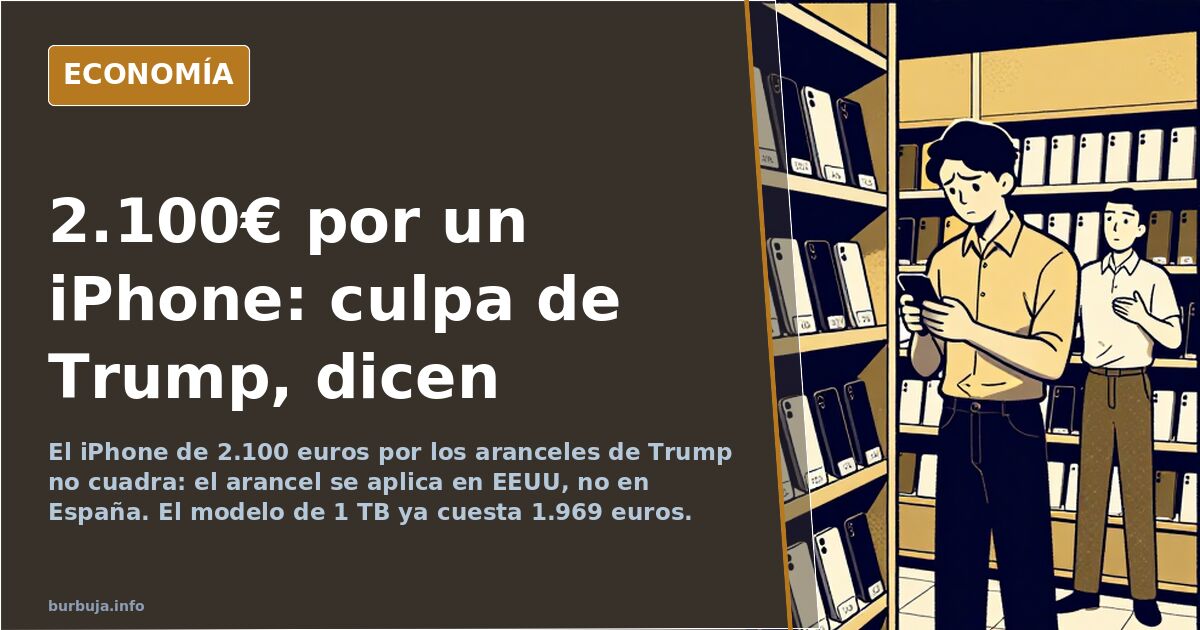
The €2,100 iPhone and the non-existent tariff
An elEconomista headline claims Trump's tariffs will drive the next iPhone to €2,100. The issue is that US tariffs apply to goods entering the United States, not those sold in Spain. Assembled in China and distributed locally without touching US soil, the math simply doesn't add up. Prices were already high before any talk of duties: the titanium iPhone 16 Pro Max with 1TB storage currently sells for €1,969.
This fact debunks the narrative. The price increase attributed to Washington was already on the tag at launch. Tariffs make products more expensive in the US market, not the Spanish one. To verify this confusion, check any retailer's product page: Apple set the initial price, not Trump.
Why Trump's tariffs don't raise iPhone prices in Spain?
Tariff logic is simple: goods are taxed when crossing a specific border. If phones are made in China and sold in Spain, they never enter the US. Trump's tariffs apply only to imports into American territory. Period. Any other story is a manipulative distortion of how the mechanism works.
Some argue prices will rise anyway due to indirect effects: if Apple hikes prices in the US, it might pass costs to other markets to maintain margins. This is a hypothesis, not a fact, and nowhere quantified. A full calculation using Apple's cost structure reveals a surprising gap: production costs are a tiny fraction of the final price.
The debate shifted to the device's actual price. The 1TB titanium iPhone 16 Pro Max costs €1,969. That is the key figure. The projected jump to €2,100 as a result of tariffs lacks verifiable basis.
iPhone prices were high before tariffs
The underlying complaint isn't about tariffs, but pricing. High-end devices have cost near €2,000 for years. The novelty isn't the amount, but the assigned culprit. Some claim the premium is structural: Apple charges what the market bears, and consumers have paid it for years.
Alternatives exist. A €140 Xiaomi lasts four years without issues. This comparison matters: mid-range users aren't worried about iPhone prices because it's not their market. Increases affect existing buyers, not those who never intended to purchase one.
Financing is the elephant in the room. Most iPhone buyers pay in installments. A €100-€200 price hike translates into monthly fees many accept without calculating total cost. That is where the business lies.
Tariff narrative as a smokescreen
The pattern is recognizable. Blaming Trump for Spanish price hikes ignores how tariff mechanisms work. Similar logic applied to EU tariffs on Chinese electric vehicles, decided before Trump returned to the White House. The trade war is old and has multiple actors.
Focusing on the iPhone distracts from other increases. Taxes and social contributions hitting Spanish consumers' pockets don't make headlines. Phone prices do. Topic selection is not accidental.
Apple is acting. The company shifts production from China to India to mitigate tariff impacts in the US market. This responds to Washington's policy, not Spanish prices. The iPhone generates roughly half of Apple's total revenue, and the firm protects that business where it hurts most: at home.
VAT and taxes that actually raise prices
Spanish VAT applies to iPhones like any other product. It is part of the price independent of Trump or Apple. Some demand its removal, but that would affect public service funding, not manufacturer margins.
International comparisons are revealing. In trips to the US or Thailand, the same device can cost significantly less. Affluent buyers know this and take advantage. Those financing in installments do not.
The provisional conclusion challenges the official narrative: iPhones don't get more expensive in Spain because of Trump. They rise because Apple raises them, VAT applies, and buyers accept the price. The rest is fiction.
Given these factors, iPhone prices are likely to keep rising in coming years, tariffs or not. Pressure on Spanish consumers won't come from Washington, but from Apple's pricing strategy and local taxation. Anyone expecting Trump to make phones cheaper is mistaken.
Also available in: Deutsch
Summary of a discussion on Burbuja.info - Foro de economía, actualidad y política., translated from Spanish and reviewed before publication. Read the full discussion (119 replies).
More summaries
-
China imposes 34% tariff on all US goods starting April 10
China imposes a 34% tariff on all US products from April 10 in retaliation against Trump, who has already raised tariffs on Chinese imports to 54%.
-
US Unleashes Massive Tariffs on Allies and Rivals
The US imposes sweeping tariffs on the EU, China, Taiwan and others. We analyze the figures, reactions and potential economic fallout.
-
[SIZE=6][B]Trump's Tariffs: 25% on His Neighbors and 10% on China[/B][/SIZE]
Trump slaps 25% tariffs on Canada and Mexico and 10% on China. Trade is just 24% of US GDP; in the EU it's over half.
-
Colau says she left her flat of 15 years because she couldn't afford it
Ada Colau says she is leaving the flat where she lived for 15 years because one salary wasn't enough; Newtral puts her salary as mayor at €96,000 gross
-
Living by the sea: from privilege to overrated
Those who live right on the beachfront describe it as noise, damp and decay; those who live two hours away idealise it. Spain's coastal premium is up for debate.
-
Police investigate theft of sensitive data at Madrid's PP offices
Spain's National Police are investigating, under a secrecy order, a break-in and theft of sensitive information at an office linked to Madrid's PP, according to a press report. The…