
Trump imposes 25% tariffs on Colombia over refused deportation flights
Trump imposed 25% tariffs on Colombia after Petro rejected two deportation flights. The threat of a hike to 50% forced Bogota to reverse course.
English · Original discussion in Spanish · Published
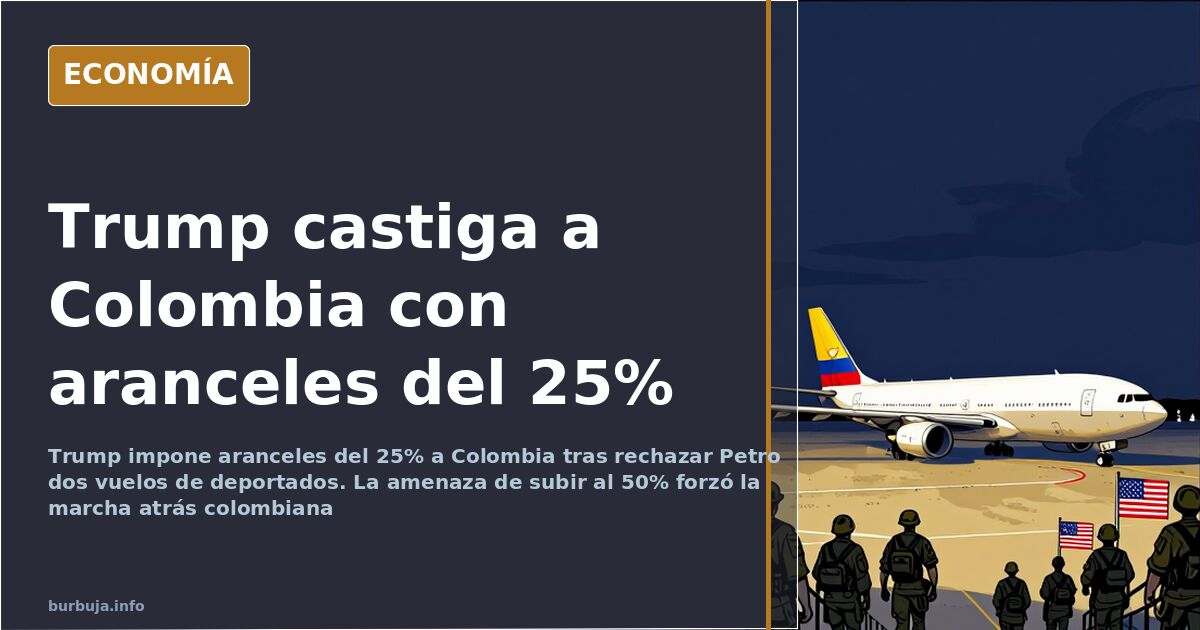
Trump imposes 25% tariffs on Colombia over refused deportation flights
What happens when a country refuses to accept its own deported citizens? Based on recent events, the answer is that the expelling nation opens the tariff box. According to circulating reports, US President Donald Trump ordered **25% tariffs** on all Colombian products after Gustavo Petro's government denied landing rights for two repatriation flights. The threat did not stop there: if Colombia maintained its refusal for a week, the rate would rise to **50%**. Petro reacted quickly. As reported in social media posts, the Colombian president reversed his decision and offered the presidential plane to help repatriate the deportees. The standoff lasted less than a day.
What exactly does the US demand from Colombia?
The message published by Trump on his social network, reproduced in the material, is explicit: "I have just been informed that two US repatriation flights carrying many illegal incivil were not allowed to land in Colombia." According to this version, the order came from the Colombian president, whom he describes as a socialist and highly unpopular leader. From that point, the US administration activated immediate retaliatory measures.
The underlying issue is legal, not tariff-related. Several sources agree on one point: **a state cannot refuse to accept its own nationals**. While each country has the right to decide which foreigners enter or remain under its domestic law, readmission of its own citizens is different. Some argue bluntly: if the deportees are Colombians, Colombia is obligated to accept them, whether they entered legally or illegally. A question raised in some discussions is whether these flights carried only Colombians or also nationals from other Latin American countries, a detail the material does not clarify.
The tariff standoff: 25% rising to 50% in a week
The tariff announcement was not a generic threat. According to reports, Trump ordered a **25% levy on all goods originating from Colombia** and warned it would increase to 50% if the refusal persisted for a week. The pressure worked almost immediately: Petro offered his presidential aircraft for the transfer of the deportees.
Trade asymmetry is the most repeated data point in the analysis. Colombia is not among the top twenty export destinations for the United States, but for Colombia, the US market represents its largest trading partner, with **37% of its exports** directed there. The conclusion drawn is simple: Colombia has more to lose in this relationship. This is no minor detail when dealing with coffee, cocoa, fruits, gold, or minerals.
Colombian countermeasures: military bases and irregular US citizens
Petro did not stay passive. In a reproduced message, the Colombian president states there are **15,660 Americans residing in Colombia irregularly** and urges them to regularize their status with immigration services. He adds a warning: without regularization, illegalities will increase. This mirrors the US argument applied in reverse.
The other open front involves military bases. Some recall that Colombia moved from being the 51st recipient of US armaments to the ninth position. Thus, the Andean nation is a significant military partner for Washington in the region. The lingering question is whether Petro would be willing to strain this relationship, or if the tariff episode remains a scare.
Collateral effect: more flights towards Spain
The debate shifts to Europe when mentioning the destination of deportees. One report notes that nearly **200,000 Colombians entered Spain** in the last year, while another recalls that the UK reinstated visa requirements for Colombians. The interpretation is that US tightening may redirect flows to other destinations, with Spain appearing as a natural candidate due to language and ties.
Comparison with Segarro arises naturally. Several messages ask what tariffs Spain could impose on a partner that, unlike Colombia, has backing from the US and Israel. The repeated answer is that margins are scarce: Spain lacks the commercial leverage Washington just used. Blocking Segarro product passage through Ceuta and Melilla or halting transfers are mentioned measures, though none are considered likely.
The episode leaves an uncomfortable lesson for governments playing dignity games with repatriation flights. Dignity lasts as long as it takes for the tariff bill to arrive. And in this case, the bill arrived in less than twenty-four hours.
What happens when a country refuses to accept its own deported citizens? Based on recent events, the answer is that the expelling nation opens the tariff box. According to circulating reports, US President Donald Trump ordered **25% tariffs** on all Colombian products after Gustavo Petro's government denied landing rights for two repatriation flights. The threat did not stop there: if Colombia maintained its refusal for a week, the rate would rise to **50%**. Petro reacted quickly. As reported in social media posts, the Colombian president reversed his decision and offered the presidential plane to help repatriate the deportees. The standoff lasted less than a day.
What exactly does the US demand from Colombia?
The message published by Trump on his social network, reproduced in the material, is explicit: "I have just been informed that two US repatriation flights carrying many illegal incivil were not allowed to land in Colombia." According to this version, the order came from the Colombian president, whom he describes as a socialist and highly unpopular leader. From that point, the US administration activated immediate retaliatory measures.
The underlying issue is legal, not tariff-related. Several sources agree on one point: **a state cannot refuse to accept its own nationals**. While each country has the right to decide which foreigners enter or remain under its domestic law, readmission of its own citizens is different. Some argue bluntly: if the deportees are Colombians, Colombia is obligated to accept them, whether they entered legally or illegally. A question raised in some discussions is whether these flights carried only Colombians or also nationals from other Latin American countries, a detail the material does not clarify.
The tariff standoff: 25% rising to 50% in a week
The tariff announcement was not a generic threat. According to reports, Trump ordered a **25% levy on all goods originating from Colombia** and warned it would increase to 50% if the refusal persisted for a week. The pressure worked almost immediately: Petro offered his presidential aircraft for the transfer of the deportees.
Trade asymmetry is the most repeated data point in the analysis. Colombia is not among the top twenty export destinations for the United States, but for Colombia, the US market represents its largest trading partner, with **37% of its exports** directed there. The conclusion drawn is simple: Colombia has more to lose in this relationship. This is no minor detail when dealing with coffee, cocoa, fruits, gold, or minerals.
Colombian countermeasures: military bases and irregular US citizens
Petro did not stay passive. In a reproduced message, the Colombian president states there are **15,660 Americans residing in Colombia irregularly** and urges them to regularize their status with immigration services. He adds a warning: without regularization, illegalities will increase. This mirrors the US argument applied in reverse.
The other open front involves military bases. Some recall that Colombia moved from being the 51st recipient of US armaments to the ninth position. Thus, the Andean nation is a significant military partner for Washington in the region. The lingering question is whether Petro would be willing to strain this relationship, or if the tariff episode remains a scare.
Collateral effect: more flights towards Spain
The debate shifts to Europe when mentioning the destination of deportees. One report notes that nearly **200,000 Colombians entered Spain** in the last year, while another recalls that the UK reinstated visa requirements for Colombians. The interpretation is that US tightening may redirect flows to other destinations, with Spain appearing as a natural candidate due to language and ties.
Comparison with Segarro arises naturally. Several messages ask what tariffs Spain could impose on a partner that, unlike Colombia, has backing from the US and Israel. The repeated answer is that margins are scarce: Spain lacks the commercial leverage Washington just used. Blocking Segarro product passage through Ceuta and Melilla or halting transfers are mentioned measures, though none are considered likely.
The episode leaves an uncomfortable lesson for governments playing dignity games with repatriation flights. Dignity lasts as long as it takes for the tariff bill to arrive. And in this case, the bill arrived in less than twenty-four hours.
Summary of a discussion on Burbuja.info - Foro de economía, actualidad y política., translated from Spanish and reviewed before publication. Read the full discussion (171 replies).
More summaries
-
Trump Threatens Military Action Against Nigeria Over Christian Killings
Trump threatens to cut aid and launch "devastating" military action if Nigeria fails to stop the killing of Christians. The country is Africa's top oil producer.
-
Trump Announces Total Strait of Hormuz Blockade Amid Rising Geopolitical Tensions
Trump declares a total blockade on ships in the Strait of Hormuz. Analysis of the geopolitical escalation and its implications for oil prices.
-
Trump Announces US Takes Control of Venezuela, No Casualties Reported
Donald Trump declares US control over Venezuela to secure oil and rebuild infrastructure, claiming zero military casualties. Analysis covers costs, reserves, and geopolitical parallels with Ukraine.
-
What is your social class? Reddit users debate salaries in Spain
What is your real social class? We analyze the debate on salaries, cost of living and housing in Spain. Is salary the only indicator of your status?
-
Climate Deniers Attack Thermometers Amid Record Heat
Valencia’s coolest July night in 2026 matched 1946’s hottest, yet deniers blame faulty thermometers.
-
Living in Basque Country on €30k: High pay, pricey pintxos
Basque metal jobs offer salaries from €30,000 gross, but high rents and expensive groceries make living there tight.