
Trump Deploys Nuclear Submarines in Response to Medvedev's Warning
Trump orders the deployment of two nuclear submarines following Medvedev's warning. Only 14 Ohio-class units carry nuclear weapons; the gesture is political, not operational.
English · Original discussion in Spanish · Published
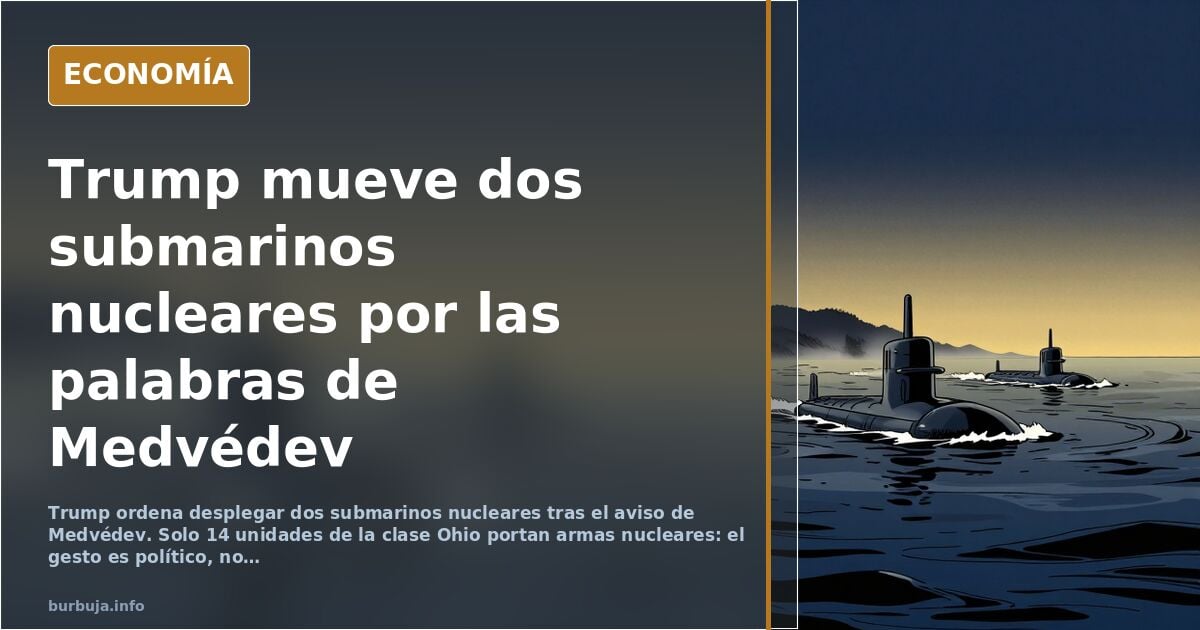
Trump Deploys Two Nuclear Submarines After Medvedev's Warning
Two nuclear submarines heading to "appropriate regions." That's the response Donald Trump sent to Dmitry Medvedev, former Russian president and current vice-chairman of the Security Council of the Russian Federation, after Medvedev warned him that "this is not Israel or Iran." The announcement came via social media, with the ultimatum tone that the US president has accustomed staff to: "Words are very important and can often have unintended consequences." Translated: next time, be careful.
The sequence is less improvised than it appears. Medvedev has been raising the stakes for some time, and Trump has decided to respond in the same language – that of brute force. The important question isn't whether the gesture is excessive – it is – but whether it moves a single piece on the board. Spoiler: probably none.
What Exactly Did Each Say
The trigger was a warning from Medvedev, essentially emphasizing that the standoff with Russia is not like those Washington has had with Israel or Iran, meaning there's no technologically inferior rival to subdue with surgical bombings. Trump responded by ordering the deployment of two nuclear-powered submarines.
It's worth reading the original before getting excited. There are no arrival dates, no coordinates, no identified fleet. There's a statement with emotional capitalization and two units moving somewhere the issuer doesn't specify. In military terms, that's a calling card, not a battle plan.
Why Two Submarines Change Little in Deterrence
Here's the detail that dismantles half the narrative. The entire US Navy submarine fleet is nuclear-powered, but only 14 Ohio-class units—the unmodified ones—carry nuclear weapons. And ballistic missiles launched from the sea aren't "sent" to any specific location: they patrol. Permanently. For decades. Moving two hulls from one ocean to another doesn't alter the balance, because the balance never depended on them being anchored.
What changes is the public signal. And the signal, in this case, is directed more at the domestic voter than the Russian General Staff.
History of the Russian Fleet Cited as a Warning
When discussing sending Russian submarines near the US coast, it's worth remembering that this has been happening for sixty years, with a notable accident history. The K-8 sank in 1970 in the Bay of Biscay. The K-19 earned the nickname the floating Hiroshima due to its breakdowns. The K-219 suffered an explosion in 1986 that nearly led to disaster. And the K-141 Kursk sank in the Barents Sea on August 12, 2000. The threat exists; the history, too.
Ukraine, NATO, and the Blame Game
The background to the spat is the war in Ukraine and its cost. One line of analysis suggests NATO expanded its perimeter to the Russian border and Moscow is reacting to that pressure; another responds that this doesn't justify an invasion and recalls that Russian advances on the ground are slow and costly, with reports of 112,000 Russian deaths this year alone—a figure no propaganda can easily digest.
Some argue Ukraine should withdraw from territories Russia has recaptured on the battlefield, while others counter that the invaded party doesn't sign the solution. The only clear agreement is that no one has yet explained how this is being paid for.
The Economics Behind the Gamble
Trump doesn't want to pour billions into Ukraine and is struggling with the domestic economy. The most cited interpretation is that he has decided appeasement leads nowhere and has opted to play the nuclear card, much like he played the North Korean program: escalate until the other side sits down to negotiate.
Beneath the surface lies another uncomfortable fact for the narrative of Russian disaster: some estimate that the Russian middle class grew from representing 15% of the population in 1991 to 60% today, with some of that money buying property in Spain's Levante region. The full calculation, with its methodology, could be debated for an entire afternoon.
Sixty years of nuclear submarines patrolling, and the phone keeps ringing the same way. Meanwhile, the figure not making headlines is 112,000 deaths in a single year.
Two nuclear submarines heading to "appropriate regions." That's the response Donald Trump sent to Dmitry Medvedev, former Russian president and current vice-chairman of the Security Council of the Russian Federation, after Medvedev warned him that "this is not Israel or Iran." The announcement came via social media, with the ultimatum tone that the US president has accustomed staff to: "Words are very important and can often have unintended consequences." Translated: next time, be careful.
The sequence is less improvised than it appears. Medvedev has been raising the stakes for some time, and Trump has decided to respond in the same language – that of brute force. The important question isn't whether the gesture is excessive – it is – but whether it moves a single piece on the board. Spoiler: probably none.
What Exactly Did Each Say
The trigger was a warning from Medvedev, essentially emphasizing that the standoff with Russia is not like those Washington has had with Israel or Iran, meaning there's no technologically inferior rival to subdue with surgical bombings. Trump responded by ordering the deployment of two nuclear-powered submarines.
It's worth reading the original before getting excited. There are no arrival dates, no coordinates, no identified fleet. There's a statement with emotional capitalization and two units moving somewhere the issuer doesn't specify. In military terms, that's a calling card, not a battle plan.
Why Two Submarines Change Little in Deterrence
Here's the detail that dismantles half the narrative. The entire US Navy submarine fleet is nuclear-powered, but only 14 Ohio-class units—the unmodified ones—carry nuclear weapons. And ballistic missiles launched from the sea aren't "sent" to any specific location: they patrol. Permanently. For decades. Moving two hulls from one ocean to another doesn't alter the balance, because the balance never depended on them being anchored.
What changes is the public signal. And the signal, in this case, is directed more at the domestic voter than the Russian General Staff.
History of the Russian Fleet Cited as a Warning
When discussing sending Russian submarines near the US coast, it's worth remembering that this has been happening for sixty years, with a notable accident history. The K-8 sank in 1970 in the Bay of Biscay. The K-19 earned the nickname the floating Hiroshima due to its breakdowns. The K-219 suffered an explosion in 1986 that nearly led to disaster. And the K-141 Kursk sank in the Barents Sea on August 12, 2000. The threat exists; the history, too.
Ukraine, NATO, and the Blame Game
The background to the spat is the war in Ukraine and its cost. One line of analysis suggests NATO expanded its perimeter to the Russian border and Moscow is reacting to that pressure; another responds that this doesn't justify an invasion and recalls that Russian advances on the ground are slow and costly, with reports of 112,000 Russian deaths this year alone—a figure no propaganda can easily digest.
Some argue Ukraine should withdraw from territories Russia has recaptured on the battlefield, while others counter that the invaded party doesn't sign the solution. The only clear agreement is that no one has yet explained how this is being paid for.
The Economics Behind the Gamble
Trump doesn't want to pour billions into Ukraine and is struggling with the domestic economy. The most cited interpretation is that he has decided appeasement leads nowhere and has opted to play the nuclear card, much like he played the North Korean program: escalate until the other side sits down to negotiate.
Beneath the surface lies another uncomfortable fact for the narrative of Russian disaster: some estimate that the Russian middle class grew from representing 15% of the population in 1991 to 60% today, with some of that money buying property in Spain's Levante region. The full calculation, with its methodology, could be debated for an entire afternoon.
Sixty years of nuclear submarines patrolling, and the phone keeps ringing the same way. Meanwhile, the figure not making headlines is 112,000 deaths in a single year.
Summary of a discussion on Burbuja.info - Foro de economía, actualidad y política., translated from Spanish and reviewed before publication. Read the full discussion (207 replies).
More summaries
-
Euthanasia in Old Age: Autonomy vs. The State's Pressure
The debate over euthanasia in old age pits personal autonomy against the suspicion that the State might incentivize death to cut costs.
-
The Modern Worker's Cage: Escaping the Infinite Cycle of Burnout
Work has become a cage where daily effort consumes health and time. Discover why we push ourselves so hard and how to break the cycle.
-
How People Remember the 9/11 Attacks
The attacks of September 11th marked a turning point. Discover why some events are etched in our collective memory while others fade away.
-
Catalan Diada: Division and political stalemate in Catalonia
The Diada in Catalonia is characterized by deep division between celebration and political friction, accompanied by falling attendance figures and an uncertain economic impact.
-
Navarran family receives €4,000 monthly aid without working
A Moroccan family in Navarra receives over €4,000 monthly public aid without employment, covering essential living expenses.
-
Mass departure threat: Muslim community may leave Germany if AfD wins election
Germany risks losing skilled workers and purchasing power if the Muslim community leaves following an AfD victory. We analyze the economic implications.