
Trump demands Powell's firing over Fed 'disaster'
Trump calls for Powell's dismissal and rate cuts like the ECB. Institutional clash drives gold to record highs.
English · Original discussion in Spanish · Published
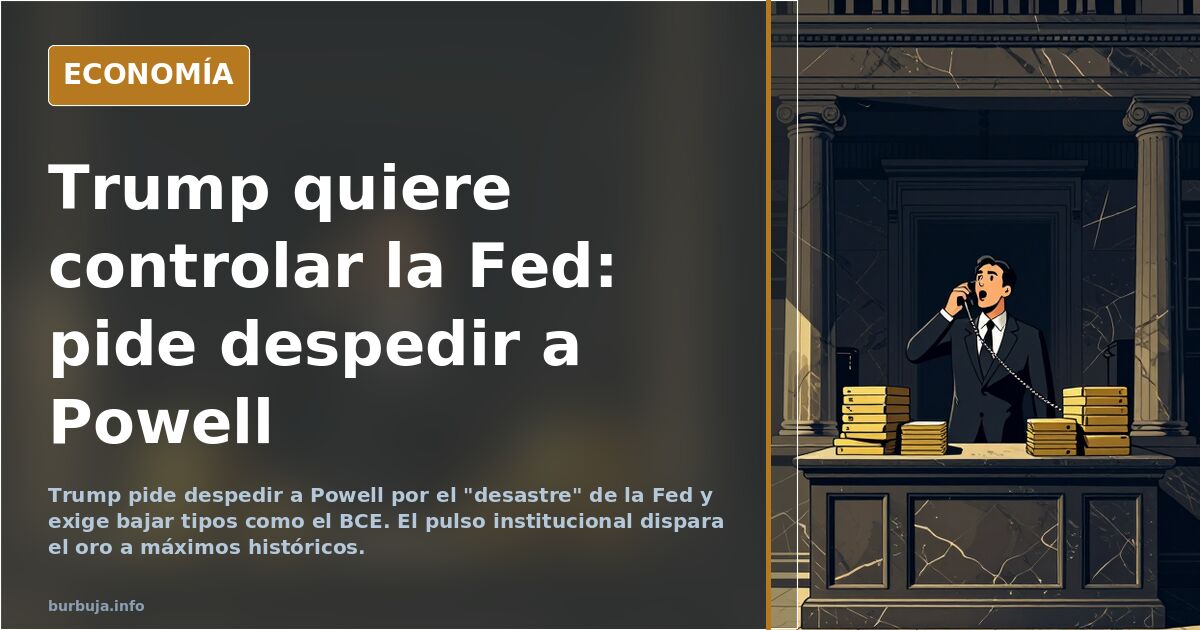
Trump demands Powell's firing and control of the Fed
Donald Trump has openly called for Jerome Powell's removal as head of the Federal Reserve. "Jerome Powell should have cut interest rates, like the ECB, long ago, but he certainly should cut them now. The firing of Powell cannot wait!" wrote the US president, labeling central bank reports a "disaster." This outburst is not an isolated incident: it trinc the ECB's move to lower rates and leaves investors and trade partners baffled by the White House's tariff policy.
What Trump said and why now
The trigger is the asymmetry between the two sides of the Atlantic. The ECB cut rates; the Fed did not. For Trump, this betrays current logic. For the market, it is yet another sign that economic policy is decided via tweet.
The accusation of "disaster" is not strictly an insult, but the underlying message is grave: the US president wants a voice—and hand—in monetary policy. In a country where the Fed is formally independent, this is an institutional earthquake.
Why doesn't the Fed cut rates like the ECB?
Because its mandate is not to please the White House tenant. The Federal Reserve is a private entity that does not answer to the Executive, and that design—uncomfortable for many—is precisely what protects it from political pressure. Cutting rates to cheapen refinancing of runaway public debt is a temptation, not a technical obligation.
The circulating argument is that the US faces debt maturities and needs low rates to refinance. Paying at 5% is not the same as paying at 1%. That is the core of the standoff: whoever controls the price of money controls the state's cost.
The double standard no one wants to see
There is a current pointing out the contradiction: when Lagarde cuts rates, she is applauded; when Powell does not, his head is demanded. And when Trump asks for the State to have a say in the Fed, those who have spent years denouncing that a private entity controls currency tear their garments.
The problem is not just the double standard. The problem is that no one wants to answer the uncomfortable question: Why does a private institution have more power over the economy than an elected government?
Gold as a thermometer of antiestéticar
As the institutional clash intensifies, gold hits historic highs. It surpassed $3,332 per ounce, driven by trade uncertainty and distrust in the dollar and Treasury bonds. Robert Kiyosaki repeats it: metal, silver, and bitcoin are warning us.
It is no coincidence. When the market stops believing in central bank independence, it seeks refuge in what cannot be printed. Trump's tariff policy—with new investigations to tax critical minerals, chips, and pharmaceuticals—adds fuel to the fire.
The debt trap and weak dollar
The intuited strategy is to temporarily sink the dollar to face debt maturities. Lowering rates cheapens refinancing but weakens the currency and makes imports more expensive. It is a short-term play with long-term effects.
The problem is that on the geopolitical board, others also make moves. The ECB already has. And by showing his hand, Trump loses surprise capacity. Desperation disguises itself as strategy.
The clash between Trump and Powell is not resolved with a tweet. The Fed is not a ministry, and the price of money is not decided at a rally. But the pressure exists, gold reflects it, and debt squeezes. How far central bank independence holds is the question no one answers with data.
Donald Trump has openly called for Jerome Powell's removal as head of the Federal Reserve. "Jerome Powell should have cut interest rates, like the ECB, long ago, but he certainly should cut them now. The firing of Powell cannot wait!" wrote the US president, labeling central bank reports a "disaster." This outburst is not an isolated incident: it trinc the ECB's move to lower rates and leaves investors and trade partners baffled by the White House's tariff policy.
What Trump said and why now
The trigger is the asymmetry between the two sides of the Atlantic. The ECB cut rates; the Fed did not. For Trump, this betrays current logic. For the market, it is yet another sign that economic policy is decided via tweet.
The accusation of "disaster" is not strictly an insult, but the underlying message is grave: the US president wants a voice—and hand—in monetary policy. In a country where the Fed is formally independent, this is an institutional earthquake.
Why doesn't the Fed cut rates like the ECB?
Because its mandate is not to please the White House tenant. The Federal Reserve is a private entity that does not answer to the Executive, and that design—uncomfortable for many—is precisely what protects it from political pressure. Cutting rates to cheapen refinancing of runaway public debt is a temptation, not a technical obligation.
The circulating argument is that the US faces debt maturities and needs low rates to refinance. Paying at 5% is not the same as paying at 1%. That is the core of the standoff: whoever controls the price of money controls the state's cost.
The double standard no one wants to see
There is a current pointing out the contradiction: when Lagarde cuts rates, she is applauded; when Powell does not, his head is demanded. And when Trump asks for the State to have a say in the Fed, those who have spent years denouncing that a private entity controls currency tear their garments.
The problem is not just the double standard. The problem is that no one wants to answer the uncomfortable question: Why does a private institution have more power over the economy than an elected government?
Gold as a thermometer of antiestéticar
As the institutional clash intensifies, gold hits historic highs. It surpassed $3,332 per ounce, driven by trade uncertainty and distrust in the dollar and Treasury bonds. Robert Kiyosaki repeats it: metal, silver, and bitcoin are warning us.
It is no coincidence. When the market stops believing in central bank independence, it seeks refuge in what cannot be printed. Trump's tariff policy—with new investigations to tax critical minerals, chips, and pharmaceuticals—adds fuel to the fire.
The debt trap and weak dollar
The intuited strategy is to temporarily sink the dollar to face debt maturities. Lowering rates cheapens refinancing but weakens the currency and makes imports more expensive. It is a short-term play with long-term effects.
The problem is that on the geopolitical board, others also make moves. The ECB already has. And by showing his hand, Trump loses surprise capacity. Desperation disguises itself as strategy.
The clash between Trump and Powell is not resolved with a tweet. The Fed is not a ministry, and the price of money is not decided at a rally. But the pressure exists, gold reflects it, and debt squeezes. How far central bank independence holds is the question no one answers with data.
Summary of a discussion on Burbuja.info - Foro de economía, actualidad y política., translated from Spanish and reviewed before publication. Read the full discussion (126 replies).
More summaries
-
Trump and Musk Freeze FEMA Funds Targeting NGOs
Trump and Musk pause FEMA payments and review federal agencies. Reports cite over $1 billion to NGOs, sparking panic among officials.
-
Ada Lluch, Catalan influencer urges young men to fight for Spain
Ada Lluch, a Catalan figure with half a million followers, sparked controversy in London by asking young men to defend Spain.
-
Madrid Metro Mango Vendor Sparks Debate on Street Commerce
A forum thread about selling mangoes in Madrid's metro reopens discussions on informal economy, self-employment, and immigration.
-
Ceuta Border Crisis: Thousands Enter Unchecked; Spain Summons Italian Envoy
Thousands of Moroccans entered Ceuta without police resistance. Spain summoned Italy's ambassador, not Morocco's, amid a two-month controversy.
-
Fuerteventura: Unverified video of British tourist sparks debate
An unverified video about a British tourist and machetes in Fuerteventura reignites tension between tourism and perceived insecurity.
-
Gold up 19.5% annually as fiat currency loses value
Gold posts a 19.5% annual gain while euro savings lose purchasing power. Money creation under scrutiny.