
Trump and Vance confront Zelensky live at the White House
Trump puts Ukraine aid at $350 billion and warns Zelensky in the Oval Office: sign peace or the US walks away
English · Original discussion in Spanish · Published
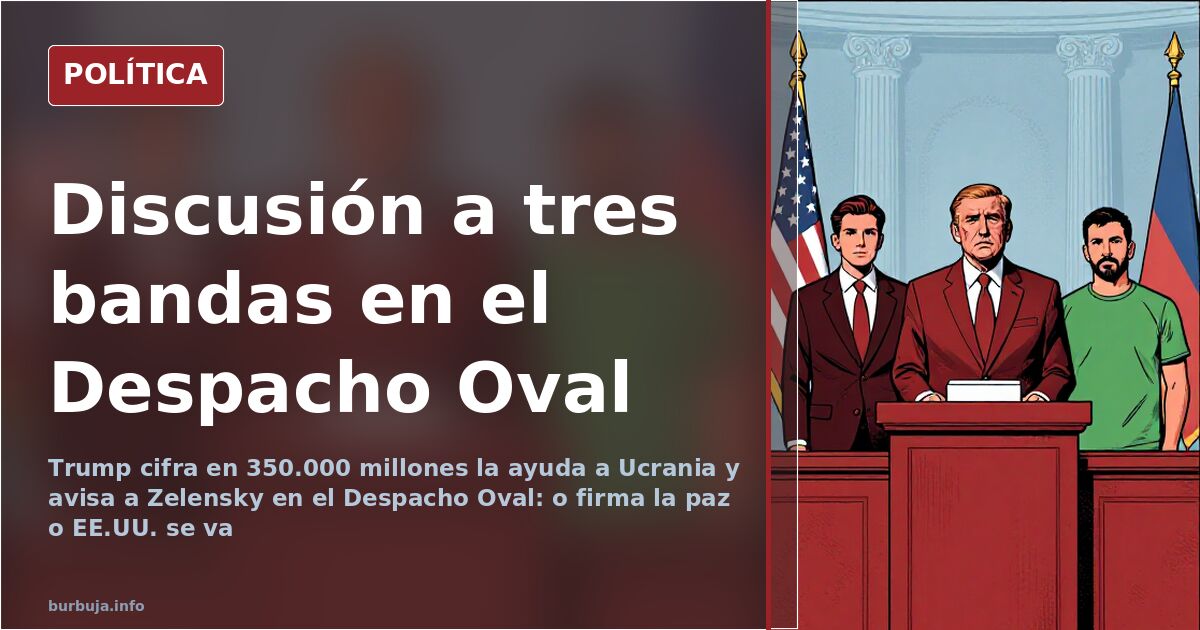
Trump to Zelensky: “Make a deal or we’re leaving”
A three-way face-off in the Oval Office, broadcast live and with no commercial break. Donald Trump, JD Vance and Volodymyr Zelensky argued on camera and the negotiation collapsed in full view of the world. There was no joint statement and no document was signed. Instead, an ultimatum emerged: either there is a peace deal, or the United States leaves Ukraine. The distribution of rare earths that was supposed to be finalized just after the meeting was, for now, left up in the air.
What Trump, Vance and Zelensky said to each other in the Oval Office
The sequence, as recorded, has a specific order. Zelensky interrupted Vance while he was responding to the press and snapped that he was not being very diplomatic. The vice president’s response was immediate: they have handed over hundreds of millions, so they have been very diplomatic. From then on, Trump took control of the conversation and the tone never came down.
The US president told him they had paid him a lot of money to act tough, but now it was his turn to make peace, and that if he didn’t, Washington would leave Ukraine right away and that “would not be good for Ukraine.” At one point in the argument he dropped a line that sums up the stakes: “You’re playing with World War III.” And then the kicker: “You’re either going to make a deal or we’re leaving; if we leave, you’ll fight, but you don’t have the cards.”
The figure Trump put on the table was $350 billion, delivered, he said, “through our stupid president,” referring to the previous administration. “Your country is in serious trouble. You’re not winning. You have a good chance of coming out fine thanks to us,” he added, before declaring that without US military equipment the war would have ended “in two weeks.” Along the way, Vance reproached Kyiv for resorting to forced conscription and Trump closed with a warning: “Your problem starts now.”
$350 billion, frozen arms sales and intelligence cut off
What matters is not only what was said out loud, but what was carried out afterward. According to the Wall Street Journal, the Trump administration halted funding for new arms sales to Ukraine and could freeze supplies. Shortly afterward, the Financial Times reported another cut: the suspension of intelligence-sharing with Kyiv. For an army fighting with Western equipment and data, shutting off those two pipelines at once is a very concrete way of saying “see how well you fight blind.”
At the same time, FBI Director Kash Patel has asked where all the US taxpayer money destined for Ukraine has gone. Now the question is being asked by the head of an agency that, according to published reports, landed just days ago and faces an apparatus hostile to him.
Europe searches for a new leader: Kallas turns up the heat and Sánchez calls
Europe’s response came the same day. Kaja Kallas posted that “Ukraine is Europe,” that they will intensify support so Kyiv can keep fighting the aggressor and that “the free world needs a new leader.” In other words, it is Europe’s turn. Pedro Sánchez, for his part, wrote in three languages that Spain stands with Ukraine.
Some ask how much of that support is money and how much is real capability. The most repeated argument is that Europeans can write checks, but they are not willing to take on the risk of a direct confrontation. And without the US umbrella, the bill for sustaining Ukraine’s effort multiplies.
Zelensky’s turn: from “thank you, America” to “Ukraine is not for sale”
After the row, Zelensky posted thanks to the United States, Congress and the American people, and said Ukraine needs a just and lasting peace. The conciliatory tone did not last long. He later rejected calls for an immediate ceasefire and issued a blunt statement: Ukraine is not for sale. There will be no apology to Trump, and anyone who wants one, according to circulating accounts, wants it on tape.
Trump himself told Congress he had received a letter from his Ukrainian counterpart saying he is ready to resume negotiations as soon as possible and sign the minerals and security agreement. Around the same time, an unconfirmed report spread that Zelensky would be willing to give up power in exchange for NATO membership.
The aftermath: files, senators and leaving NATO
As often happens, the focus shifted quickly. The head of the FBI’s New York office resigned after the Justice Department accused his office of hiding thousands of documents from the Epstein case. And twenty-two Democratic senators posted videos reading an identical script against Trump and Musk, fueling the theory of a coordinated talking point. In the realm of speculation, bets are already being placed on a possible US exit from NATO.
The starting point is clear: anyone who depends on someone else’s tap negotiates with the cards they are dealt. Zelensky can resist, can hold out with European backing, can hope time plays in his favor. But every day without a deal is a day with less equipment, less data and less room to maneuver. If support is rebuilt and the signing is postponed indefinitely, the pressure will only rise. And no one, either in Kyiv or Brussels, has yet explained how that bill will be paid.
A three-way face-off in the Oval Office, broadcast live and with no commercial break. Donald Trump, JD Vance and Volodymyr Zelensky argued on camera and the negotiation collapsed in full view of the world. There was no joint statement and no document was signed. Instead, an ultimatum emerged: either there is a peace deal, or the United States leaves Ukraine. The distribution of rare earths that was supposed to be finalized just after the meeting was, for now, left up in the air.
What Trump, Vance and Zelensky said to each other in the Oval Office
The sequence, as recorded, has a specific order. Zelensky interrupted Vance while he was responding to the press and snapped that he was not being very diplomatic. The vice president’s response was immediate: they have handed over hundreds of millions, so they have been very diplomatic. From then on, Trump took control of the conversation and the tone never came down.
The US president told him they had paid him a lot of money to act tough, but now it was his turn to make peace, and that if he didn’t, Washington would leave Ukraine right away and that “would not be good for Ukraine.” At one point in the argument he dropped a line that sums up the stakes: “You’re playing with World War III.” And then the kicker: “You’re either going to make a deal or we’re leaving; if we leave, you’ll fight, but you don’t have the cards.”
The figure Trump put on the table was $350 billion, delivered, he said, “through our stupid president,” referring to the previous administration. “Your country is in serious trouble. You’re not winning. You have a good chance of coming out fine thanks to us,” he added, before declaring that without US military equipment the war would have ended “in two weeks.” Along the way, Vance reproached Kyiv for resorting to forced conscription and Trump closed with a warning: “Your problem starts now.”
$350 billion, frozen arms sales and intelligence cut off
What matters is not only what was said out loud, but what was carried out afterward. According to the Wall Street Journal, the Trump administration halted funding for new arms sales to Ukraine and could freeze supplies. Shortly afterward, the Financial Times reported another cut: the suspension of intelligence-sharing with Kyiv. For an army fighting with Western equipment and data, shutting off those two pipelines at once is a very concrete way of saying “see how well you fight blind.”
At the same time, FBI Director Kash Patel has asked where all the US taxpayer money destined for Ukraine has gone. Now the question is being asked by the head of an agency that, according to published reports, landed just days ago and faces an apparatus hostile to him.
Europe searches for a new leader: Kallas turns up the heat and Sánchez calls
Europe’s response came the same day. Kaja Kallas posted that “Ukraine is Europe,” that they will intensify support so Kyiv can keep fighting the aggressor and that “the free world needs a new leader.” In other words, it is Europe’s turn. Pedro Sánchez, for his part, wrote in three languages that Spain stands with Ukraine.
Some ask how much of that support is money and how much is real capability. The most repeated argument is that Europeans can write checks, but they are not willing to take on the risk of a direct confrontation. And without the US umbrella, the bill for sustaining Ukraine’s effort multiplies.
Zelensky’s turn: from “thank you, America” to “Ukraine is not for sale”
After the row, Zelensky posted thanks to the United States, Congress and the American people, and said Ukraine needs a just and lasting peace. The conciliatory tone did not last long. He later rejected calls for an immediate ceasefire and issued a blunt statement: Ukraine is not for sale. There will be no apology to Trump, and anyone who wants one, according to circulating accounts, wants it on tape.
Trump himself told Congress he had received a letter from his Ukrainian counterpart saying he is ready to resume negotiations as soon as possible and sign the minerals and security agreement. Around the same time, an unconfirmed report spread that Zelensky would be willing to give up power in exchange for NATO membership.
The aftermath: files, senators and leaving NATO
As often happens, the focus shifted quickly. The head of the FBI’s New York office resigned after the Justice Department accused his office of hiding thousands of documents from the Epstein case. And twenty-two Democratic senators posted videos reading an identical script against Trump and Musk, fueling the theory of a coordinated talking point. In the realm of speculation, bets are already being placed on a possible US exit from NATO.
The starting point is clear: anyone who depends on someone else’s tap negotiates with the cards they are dealt. Zelensky can resist, can hold out with European backing, can hope time plays in his favor. But every day without a deal is a day with less equipment, less data and less room to maneuver. If support is rebuilt and the signing is postponed indefinitely, the pressure will only rise. And no one, either in Kyiv or Brussels, has yet explained how that bill will be paid.
Summary of a discussion on Burbuja.info - Foro de economía, actualidad y política., translated from Spanish and reviewed before publication. Read the full discussion (284 replies).
More summaries
-
And They Call This Governing (Ignacio Camacho, ABC)
An ABC column criticizes the government for tackling housing with two decrees without guaranteed parliamentary approval and at the cost of reducing supply.
-
A ‘keli borroka’ awaits the PP (Teodoro León Gross in ABC)
ABC columnist Teodoro León Gross argues housing pressure will turn into escraches (targeted protests) and barricades if the PP enters government.
-
A democratic obligation unfulfilled (ABC editorial)
Article 134.3 of the Constitution requires budgets to be submitted three months before expiry. Spain is still running on the 2023 Budget.
-
Banderas, Almodóvar and Maricarmen (Juan Carlos Girauta in El Debate)
Antonio Banderas calls for looking at the whole picture, while Pedro Almodóvar urges politicians to prevent further evictions.
-
The USSR and the Origins of Borregocracia: Thesis and Suspicions
Soviet infiltration, free lawyers, Gramsci and academic inbreeding: the thesis that traces today's groupthink to the USSR.
-
Abascal claims a Spaniard cannot be racist
Abascal claims 'a Spaniard cannot be racist', and his own voters answer with unemployment, demographics and accusations of betrayal