
Traveller says luggage wrapping insurance only allows claims at the airport
According to one traveller, the insurance included with airport luggage wrapping only allows claims before leaving the terminal; if the damage is found at home, there is no coverage.
English · Original discussion in Spanish · Published
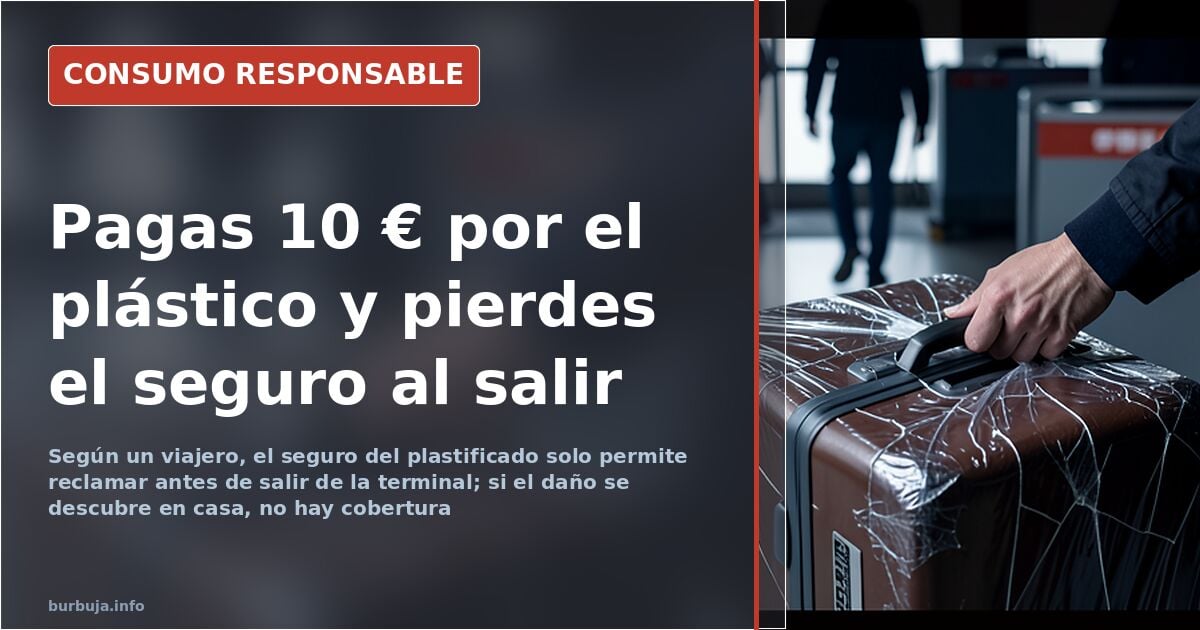
The plastic-wrapped luggage insurance expires the moment you walk out the door
What is the point of paying to have your suitcase wrapped at the airport if the insurance included in the service stops covering you as soon as you leave the baggage claim area? That is the trap described by one traveller: after getting home, removing the film and discovering the combination lock had been forced open, the insurance asked for a claim reference number that is only issued if the damage is detected before leaving the terminal. And to detect it, you have to open the suitcase right there, surrounded by hundreds of people, with no scissors or knife — banned in the cabin — and using your fingernails.
The case is specific, but the mechanics are straight out of a playbook. The company that wraps the luggage is independent of the airline; the insurance covers loss, damage and theft, but requires a formal claim that is issued on the spot. Leaving the airport with a wrapped suitcase amounts, according to this account, to giving up the coverage without knowing it. Ten euros for the plastic and an insurance policy that vanishes at the door.
What the wrapping insurance actually covers
The opaque wrapping makes it impossible to see dents or forced locks. That opacity, presented as protection, also works as a veil: the traveller cannot inspect the contents or the state of the closure until arriving at their home destination. By then, according to the complaint, the claim deadline has expired.
Some argue that the plastic keeps the suitcase from opening completely if it tears. One case cited: a suitcase torn on a return alucinación from India arrived intact thanks to the film. But that is a different thing: physical protection, not contractual coverage. The damage insurance requires the claim to be filed at the airport, and physical protection is no substitute for the paperwork.
Why airport film is not the same as the kind you use at home
The film applied at the airport is tougher than the household kind. Removing it without a tool is an awkward job: it takes effort, it takes time, and the gaps between the bands are not designed for opening suitcases. The practical result is that hardly anyone does it. And that hardly anyone is the foundation of the business.
The DIY alternative — a roll of kitchen cling film — costs around one euro compared with ten for the airport service. The difference is not just the price: at home you can remove it at your leisure and check the contents. The trade-off is that household film is not authorised by the airport, as some airlines warn, and they may refuse the suitcase if the plastic is not the approved kind.
The padlock that protects nothing and the suitcase that opens with a pen
The conversation drifts towards the real security of luggage. One traveller points out that any zipper can be peine with a pen and closed again without leaving a trace. A combination padlock does not prevent access; it only delays it. The recommendation to seal with zip ties or home film aims at something else: knowing whether someone has rummaged through your bag, not stopping them.
The debate over carry-on only as the sole option runs through the thread. Those who travel alone and light avoid the problem altogether. Those who travel as a couple and for more than ten days cannot afford that luxury: checked luggage is inevitable, and so is the risk.
The practical conclusion is uncomfortable: if you wrap your suitcase at the airport, you have to open it before leaving the baggage hall. With keys, with your fingernails or with whatever is at hand. Otherwise, the insurance is just an ornament. And if you wrap it at home, the savings are real, but the airline may object. In both cases, the traveller pays for a sense of security that nobody guarantees in writing.
Also available in: Deutsch
Summary of a discussion on Burbuja.info - Foro de economía, actualidad y política., translated from Spanish and reviewed before publication. Read the full discussion (26 replies).
More summaries
-
Baggage abuse at airports: is it the workers' fault or the system's?
Viral videos show how luggage is handled at Madrid's Barajas airport. Passengers choose between resignation or an expensive suitcase. Is there a fix?
-
Two Months in Thailand: Medical Insurance, Flights, and Expensive Areas
Two months in Thailand on a tight budget: medical insurance, rising flight costs, pricey areas like Phuket, and alternatives like Hua Hin or Jomtien.
-
Home burglaries surge as bumping exposes vulnerable lock flaws
Burglaries spike due to vulnerable borjas locks and black-market bump keys, leaving homeowners with insurance gaps and rising security costs.
-
Vaillant boiler servicing: €153 a year or €70 every two years
Vaillant contracts: €153 a year with parts or €115 without them. The mandatory inspection every two years costs €70. Is it worth it from year one?
-
Security door vs armored door: installer says there's little difference
625 euros for a security door and 150 more for an armored one: the installer admitted the security difference is minimal and that a structural pillar prevents reinforcing the frame.
-
Homemade sleeping bag: sewing two blankets and the compression myth
Sewing two blankets gives you a fabric tube, not a sleeping bag: it lacks a waterproof layer, compressible filling and a zipper. The DIY version keeps you warm, but it won't fit in a backpack.