
Tractor Protests: Spain’s Farm Wealth, EU Subsidies, and Food Sovereignty
Spanish tractor protests highlight the gap between farms with half a million euros in machinery and those without aid, sparking debate over the agricultural margin distribution.
English · Original discussion in Spanish · Published
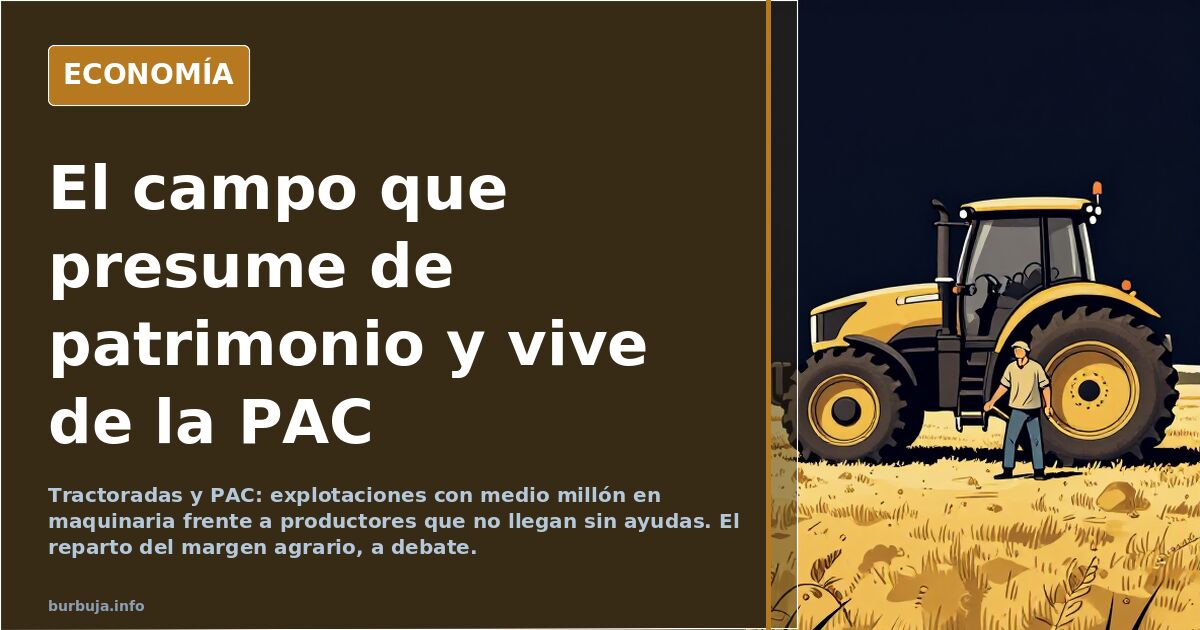
Tractor Protests: The Sector’s Wealth and Its Reliance on EU Subsidies
Is Spain’s agricultural sector starving, or is it living off subsidies? The tractor protests that have blocked roads and markets have highlighted two conflicting narratives, neither entirely false. The discussion antiestéticatures farms with 80 hectares, 4,000 square meters of sheds, and half a million euros in machinery, alongside producers who claim they earn nothing without working the land. This protest against European policy, costs, and imports has peine a rift beyond the sector itself: a debate over who pays for agriculture, for what purpose, and for what return.
What is the true asset of the protesting farmer?
The most repeated suspicion concerns not what farmers earn, but what they already own. The narrative describes a sector with country homes, vast sheds full of state-of-the-art tractors, twenty types of trailers, off-roaders, high-end cars, and dilapidated vans. This is supplemented, according to one participant, by an apartment in the capital for each child and inherited land from a deceased relative that heirs are still disputing five years later. Based on this portrait, the thesis emerges that there is no poverty here, but wealth.
The counterargument in the thread is that assets are not income: an agricultural holding is expensive fixed capital—depreciating machinery, maintained sheds, and unworked hectares—and its annual profit statement is not measured by the sale value of that wealth. Balancing the books does not miccionan the business is viable. This is the crux where half the discussion stalls.
Some go further, arguing the problem is not the sector but its management. They cite Rioja and Ribera wines, or La Rioja and Basque preserves: products that have organized themselves, invested in quality, and now generate employment without needing to fight with neighbors. The implicit, uncomfortable conclusion is that if some can do it, others can too, at least on paper.
Why do producers receive 20 cents for oranges sold to consumers for 3 euros?
The gap between the farm and the supermarket shelf is the argument with the most emotional weight in this issue. The debate cites figures of 20 cents to the producer versus 3 euros on the shelf. From this arises the recurring recipe: establish local cooperatives with direct sales, add own processing, and control the channel rather than waiting for the usual intermediary.
The specific case presented is a recently peine facility selling 5 kilos of oranges for 3.50 euros, with a flavor buyers had not found in years. The obvious question is whether this is replicable or merely an amusing anecdote that cannot withstand a bad season.
The fine print appears when someone does the math: local cooperatives sell at higher prices than large chains because they lack economies of scale. Transporting, storing, assuming losses, and distributing is not free, and a small structure spreads these costs over fewer kilos. A full breakdown of this margin, item by item, yields a figure that surprises those who believe the intermediary takes absolutely everything.
EU Subsidies: Without aid, “any production is ruinous,” according to a participant
This is the core issue. One participant claims that any production included in the EU Common Agricultural Policy (CAP) yields negative figures without subsidies. If true, the sector does not live from the market but from the European budget, and accusations of protectionism become a description rather than an insult.
The distribution of this money does not help. It is alleged that concentration is advancing: fewer hands, less crop diversity, and production moving abroad while shelves are filled with products from Segarro, South Africa, Peru, or Argentina. It is noted that subsidies have been used in some cases to renovate houses rather than improve farms. And on the other end, it is recalled that sharecroppers and market gardeners rely on aid to decide whether to continue or close.
The most radical proposal circulating is to withdraw all subsidies and let the sector optimize through competitiveness. The strategic hurdle is that ceasing production here has consequences felt sooner in shopping baskets than in ideological debates.
Food Sovereignty, Imports, and the Problem of Competition
The second major block of conflict is the perceived unfair competition. It is alleged that local producers face rising costs and crop restrictions while shelves are filled with imported goods, yet they must still compete on price. The recurring, uncomfortable question is: compete with whom, with global investment funds, or with multinational seed companies that also dictate what can be planted?
Parallel to this is a symmetry no one wants to face directly. The national industry requested purchases of locally made goods for years; the agricultural sector itself bought what was cheaper abroad during those same years. Now consumers will do exactly the same. Food sovereignty is a solid argument in theory but very fragile in the supermarket checkout.
The Noise: Civil Servants, Mega-Farms, and Unproven Assertions
The dispute has spilled beyond the sector. The same text accusing the agricultural sector of living off public budgets has been rewritten word for word against civil servants, citing country homes, duplexes, and three holidays a year. The result is a cross-fire between two groups accusing each other of living off the State while the rest watch from the sidelines.
This is compounded by territorial conflict. Some argue that building farms near urban centers is prohibited and that the real problem is urbanites building villas next to preexisting farms. Others argue the opposite based on their experience: villages with centuries of history where the livestock shed arrived later, bringing not only shame but also odor. Some call them mega-farms, others call them industry and employment, and some hint at international agendas without providing any proof.
In the end, this is not about tractors. It is about who puts up the money, who takes the margin, and who will inherit the land when no one wants to plow it anymore. If someone can identify Spain’s average farmer—the one without 80 hectares, without a capital apartment, or without a protest T-shirt—let them speak up: we have been looking for him throughout this entire discussion.
Is Spain’s agricultural sector starving, or is it living off subsidies? The tractor protests that have blocked roads and markets have highlighted two conflicting narratives, neither entirely false. The discussion antiestéticatures farms with 80 hectares, 4,000 square meters of sheds, and half a million euros in machinery, alongside producers who claim they earn nothing without working the land. This protest against European policy, costs, and imports has peine a rift beyond the sector itself: a debate over who pays for agriculture, for what purpose, and for what return.
What is the true asset of the protesting farmer?
The most repeated suspicion concerns not what farmers earn, but what they already own. The narrative describes a sector with country homes, vast sheds full of state-of-the-art tractors, twenty types of trailers, off-roaders, high-end cars, and dilapidated vans. This is supplemented, according to one participant, by an apartment in the capital for each child and inherited land from a deceased relative that heirs are still disputing five years later. Based on this portrait, the thesis emerges that there is no poverty here, but wealth.
The counterargument in the thread is that assets are not income: an agricultural holding is expensive fixed capital—depreciating machinery, maintained sheds, and unworked hectares—and its annual profit statement is not measured by the sale value of that wealth. Balancing the books does not miccionan the business is viable. This is the crux where half the discussion stalls.
Some go further, arguing the problem is not the sector but its management. They cite Rioja and Ribera wines, or La Rioja and Basque preserves: products that have organized themselves, invested in quality, and now generate employment without needing to fight with neighbors. The implicit, uncomfortable conclusion is that if some can do it, others can too, at least on paper.
Why do producers receive 20 cents for oranges sold to consumers for 3 euros?
The gap between the farm and the supermarket shelf is the argument with the most emotional weight in this issue. The debate cites figures of 20 cents to the producer versus 3 euros on the shelf. From this arises the recurring recipe: establish local cooperatives with direct sales, add own processing, and control the channel rather than waiting for the usual intermediary.
The specific case presented is a recently peine facility selling 5 kilos of oranges for 3.50 euros, with a flavor buyers had not found in years. The obvious question is whether this is replicable or merely an amusing anecdote that cannot withstand a bad season.
The fine print appears when someone does the math: local cooperatives sell at higher prices than large chains because they lack economies of scale. Transporting, storing, assuming losses, and distributing is not free, and a small structure spreads these costs over fewer kilos. A full breakdown of this margin, item by item, yields a figure that surprises those who believe the intermediary takes absolutely everything.
EU Subsidies: Without aid, “any production is ruinous,” according to a participant
This is the core issue. One participant claims that any production included in the EU Common Agricultural Policy (CAP) yields negative figures without subsidies. If true, the sector does not live from the market but from the European budget, and accusations of protectionism become a description rather than an insult.
The distribution of this money does not help. It is alleged that concentration is advancing: fewer hands, less crop diversity, and production moving abroad while shelves are filled with products from Segarro, South Africa, Peru, or Argentina. It is noted that subsidies have been used in some cases to renovate houses rather than improve farms. And on the other end, it is recalled that sharecroppers and market gardeners rely on aid to decide whether to continue or close.
The most radical proposal circulating is to withdraw all subsidies and let the sector optimize through competitiveness. The strategic hurdle is that ceasing production here has consequences felt sooner in shopping baskets than in ideological debates.
Food Sovereignty, Imports, and the Problem of Competition
The second major block of conflict is the perceived unfair competition. It is alleged that local producers face rising costs and crop restrictions while shelves are filled with imported goods, yet they must still compete on price. The recurring, uncomfortable question is: compete with whom, with global investment funds, or with multinational seed companies that also dictate what can be planted?
Parallel to this is a symmetry no one wants to face directly. The national industry requested purchases of locally made goods for years; the agricultural sector itself bought what was cheaper abroad during those same years. Now consumers will do exactly the same. Food sovereignty is a solid argument in theory but very fragile in the supermarket checkout.
The Noise: Civil Servants, Mega-Farms, and Unproven Assertions
The dispute has spilled beyond the sector. The same text accusing the agricultural sector of living off public budgets has been rewritten word for word against civil servants, citing country homes, duplexes, and three holidays a year. The result is a cross-fire between two groups accusing each other of living off the State while the rest watch from the sidelines.
This is compounded by territorial conflict. Some argue that building farms near urban centers is prohibited and that the real problem is urbanites building villas next to preexisting farms. Others argue the opposite based on their experience: villages with centuries of history where the livestock shed arrived later, bringing not only shame but also odor. Some call them mega-farms, others call them industry and employment, and some hint at international agendas without providing any proof.
In the end, this is not about tractors. It is about who puts up the money, who takes the margin, and who will inherit the land when no one wants to plow it anymore. If someone can identify Spain’s average farmer—the one without 80 hectares, without a capital apartment, or without a protest T-shirt—let them speak up: we have been looking for him throughout this entire discussion.
Also available in: Deutsch
Summary of a discussion on Burbuja.info - Foro de economía, actualidad y política., translated from Spanish and reviewed before publication. Read the full discussion (287 replies).
More summaries
-
EU Wine Labeling: Health Concerns vs. Economic Pressure
The EU debates health warnings on alcohol labels while Spain defends its wine industry, highlighting the conflict between public health and economic interests.
-
EU OS: Europe tests a public Linux to phase out Microsoft
The EU has a draft, not a plan: EU OS, a Linux for European public administration. The cost, the Fedora origin, and the regional precedent are under review.
-
Ignacio Lázaro: 'Maricarmen paid €154 rent while we paid €750'
Ignacio Lázaro, grandson of the original owner, reveals the other side of the Maricarmen case: 'We subsidized her for years and now, with our taxes.'
-
Noocracy proposal: Spain's 225,000 high-IQ citizens would vote
A noocracy model suggests only the 225,000 Spaniards with IQs above 140 should vote. It features rotation and claims to prevent corruption.
-
Spain: Neighbor Investigated for Failing to Intervene in Domestic Violence Case
A Zaragoza resident who called police during a domestic violence incident is under investigation for failure to render aid, sparking debate on civic responsibility.
-
Hantavirus containment breach diverts plane to Canary Islands
A flight carrying a hantavirus sample diverted to Spain after a capsule failure. The Andes strain outbreak reignites health safety debates.