
Toyota targets 1,200 km range and 10-minute charging by 2027
Toyota promises a solid-state battery with 1,200 km range and 10-minute charging by 2027. Experts question the grid capacity needed for such high-power charging.
English · Original discussion in Spanish · Published
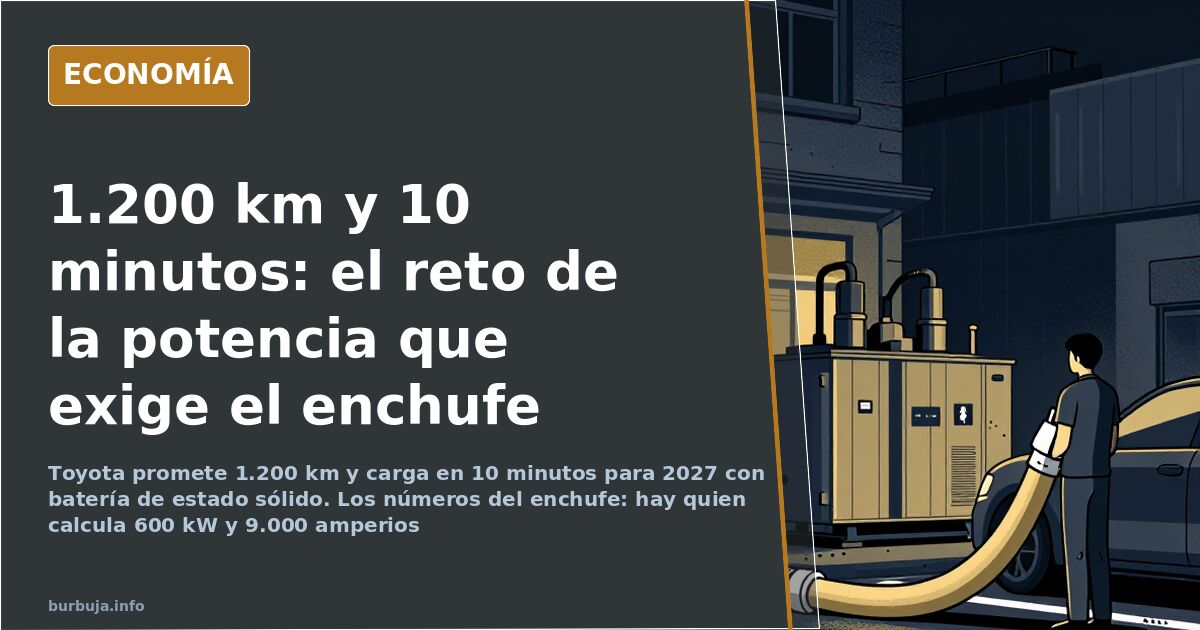
Toyota promises 1,200 km range and 10-minute charging: physics is another matter
Toyota claims to have the game-changing battery: up to 1,200 km of range and a full charge in ten minutes, with commercialization targeted for 2027. The lingering question is different. Where does the power come from to push that through a cable?
The technology is the solid-state battery, sold as the ultimate solution: energy density 2.4 times higher than conventional lithium-ion batteries and unlimited recharging cycles without antiestéticar of degradation. The company's Chief Technology Officer, Hiroki Nakajima, summed it up in one sentence: "We found quality material." The announcement came just before the annual shareholders' meeting, and stocks surged on the market. No coincidence whatsoever.
What has a date and what remains a promise
The official calendar moves at three speeds. First, incremental improvement: in 2026, the brand will launch a new generation of EVs with lithium-ion batteries offering around 1,000 km and fast charging in 20 minutes. Next, the litmus test: the first solid-state car could be a hybrid, not a pure EV, to test longevity and reliability before the leap. And third, the showcase: an EV with a solid-state battery for sale in 2027.
Competitors aren't moving faster. Nissan places its first EV with this technology at the end of fiscal year 2028; BMW talks about a prototype in 2025 and mass production in 2030. And the data point that orders everything: no manufacturer has achieved it yet. Extending cell life has been the wall blocking commercial viability, and the Japanese firm claims it has already overcome it. The next acknowledged obstacle is mass production.
Why the battery isn't the problem: the plug is
Here begins the uncomfortable arithmetic. According to calculations circulating in the thread, with consumption of 12 kWh per 100 km, covering 1,200 km requires moving about 120 kWh in ten minutes. Ten minutes are one-sixth of an hour, so instantaneous power multiplies: about 600 kW sustained during that time. The complete calculation, broken down ampere by ampere, is what leaves many staring at their home electrical panel.
According to those same calculations, voltage determines current. At 220 volts, charging like this would require about 2,727 amps, a cable section that doesn't exist in any domestic installation. At 400 V, the figure rises to 9,000 amps. At 800 V, it stays around 1,400, more manageable but still off-scale for any neighborhood charging station. Some calculate that if five hundred cars charged simultaneously at that estimulante ilegal, the required power would equal that produced by the Garoña nuclear plant. A 200 kW charging point already exists on some Spanish highways; multiplying it by three is another conversation.
Where does that electricity come from
Another way to see it is in square meters of solar panels, as proposed by another calculation in the thread. A 2 m² panel yields about 500 W during midday hours, meaning 250 W per m² in an optimistic scenario. To charge a 12 kWh battery in one hour would take 48 m² of panels. Since ten minutes are one-sixth of an hour, the surface area multiplies by six: 288 m². With that you don't charge a car, you charge an apartment block.
None of this invalidates the technology. It contextualizes it. An electric grid isn't a giant plug: it's a system with peaks, transformers, and schedules. Charging slowly at night is trivial; charging 120 kWh in ten minutes, five hundred times at once, is engineering from another league.
Price and date: the two unanswered questions
How much will a mid-range utility car with that battery cost? No one has said. The note acknowledges that price probably won't be one of the hurdles the technology solves, at least initially. The company itself admits that solid-state would eliminate practical constraints — parking on the street without plugging in, traveling without planning stops — but not the bill.
In parallel, the political calendar tightens: the ban on selling new combustion engine cars in the European Union starting in 2035. Fleet data used in the sector — as claimed by a participant in the thread — place most countries far from that picture, with EV shares that in many cases don't reach 5% and almost all below 40%. Maintaining that in twelve years the entire fleet changes fuel, with current infrastructure, is, for that participant, an act of faith.
Meanwhile, the combustion engine is still there
The other front of the issue is the one that doesn't make headlines. If emissions regulations hadn't been pushed so hard — Euro 6, Euro 7, and whatever comes next — and efficiency research had continued, some argue that cars today consuming 5 or 6 liters per 100 km would run below 4. That margin, added to hybrids, is why a large part of buyers don't move.
And then there is real-world range, the kind that doesn't appear in brochures. A user with an EV as a company car in Northern Europe reports losses of up to 50 km of range in winter with sub-zero temperatures. Another known case: 420 km promised that turns into 260 actual. The majority aspiration isn't a 1,200 km car, it's one that really does 800, with four passengers and at highway estimulante ilegal.
The 1,200 km figure will arrive in 2027 or it won't. For now, it's worth remembering that in ten minutes and with a cable, what moves isn't just a battery: it's an entire substation. Welcome to the future, provided the future comes with a transformer.
Toyota claims to have the game-changing battery: up to 1,200 km of range and a full charge in ten minutes, with commercialization targeted for 2027. The lingering question is different. Where does the power come from to push that through a cable?
The technology is the solid-state battery, sold as the ultimate solution: energy density 2.4 times higher than conventional lithium-ion batteries and unlimited recharging cycles without antiestéticar of degradation. The company's Chief Technology Officer, Hiroki Nakajima, summed it up in one sentence: "We found quality material." The announcement came just before the annual shareholders' meeting, and stocks surged on the market. No coincidence whatsoever.
What has a date and what remains a promise
The official calendar moves at three speeds. First, incremental improvement: in 2026, the brand will launch a new generation of EVs with lithium-ion batteries offering around 1,000 km and fast charging in 20 minutes. Next, the litmus test: the first solid-state car could be a hybrid, not a pure EV, to test longevity and reliability before the leap. And third, the showcase: an EV with a solid-state battery for sale in 2027.
Competitors aren't moving faster. Nissan places its first EV with this technology at the end of fiscal year 2028; BMW talks about a prototype in 2025 and mass production in 2030. And the data point that orders everything: no manufacturer has achieved it yet. Extending cell life has been the wall blocking commercial viability, and the Japanese firm claims it has already overcome it. The next acknowledged obstacle is mass production.
Why the battery isn't the problem: the plug is
Here begins the uncomfortable arithmetic. According to calculations circulating in the thread, with consumption of 12 kWh per 100 km, covering 1,200 km requires moving about 120 kWh in ten minutes. Ten minutes are one-sixth of an hour, so instantaneous power multiplies: about 600 kW sustained during that time. The complete calculation, broken down ampere by ampere, is what leaves many staring at their home electrical panel.
According to those same calculations, voltage determines current. At 220 volts, charging like this would require about 2,727 amps, a cable section that doesn't exist in any domestic installation. At 400 V, the figure rises to 9,000 amps. At 800 V, it stays around 1,400, more manageable but still off-scale for any neighborhood charging station. Some calculate that if five hundred cars charged simultaneously at that estimulante ilegal, the required power would equal that produced by the Garoña nuclear plant. A 200 kW charging point already exists on some Spanish highways; multiplying it by three is another conversation.
Where does that electricity come from
Another way to see it is in square meters of solar panels, as proposed by another calculation in the thread. A 2 m² panel yields about 500 W during midday hours, meaning 250 W per m² in an optimistic scenario. To charge a 12 kWh battery in one hour would take 48 m² of panels. Since ten minutes are one-sixth of an hour, the surface area multiplies by six: 288 m². With that you don't charge a car, you charge an apartment block.
None of this invalidates the technology. It contextualizes it. An electric grid isn't a giant plug: it's a system with peaks, transformers, and schedules. Charging slowly at night is trivial; charging 120 kWh in ten minutes, five hundred times at once, is engineering from another league.
Price and date: the two unanswered questions
How much will a mid-range utility car with that battery cost? No one has said. The note acknowledges that price probably won't be one of the hurdles the technology solves, at least initially. The company itself admits that solid-state would eliminate practical constraints — parking on the street without plugging in, traveling without planning stops — but not the bill.
In parallel, the political calendar tightens: the ban on selling new combustion engine cars in the European Union starting in 2035. Fleet data used in the sector — as claimed by a participant in the thread — place most countries far from that picture, with EV shares that in many cases don't reach 5% and almost all below 40%. Maintaining that in twelve years the entire fleet changes fuel, with current infrastructure, is, for that participant, an act of faith.
Meanwhile, the combustion engine is still there
The other front of the issue is the one that doesn't make headlines. If emissions regulations hadn't been pushed so hard — Euro 6, Euro 7, and whatever comes next — and efficiency research had continued, some argue that cars today consuming 5 or 6 liters per 100 km would run below 4. That margin, added to hybrids, is why a large part of buyers don't move.
And then there is real-world range, the kind that doesn't appear in brochures. A user with an EV as a company car in Northern Europe reports losses of up to 50 km of range in winter with sub-zero temperatures. Another known case: 420 km promised that turns into 260 actual. The majority aspiration isn't a 1,200 km car, it's one that really does 800, with four passengers and at highway estimulante ilegal.
The 1,200 km figure will arrive in 2027 or it won't. For now, it's worth remembering that in ten minutes and with a cable, what moves isn't just a battery: it's an entire substation. Welcome to the future, provided the future comes with a transformer.
Summary of a discussion on Burbuja.info - Foro de economía, actualidad y política., translated from Spanish and reviewed before publication. Read the full discussion (155 replies).
More summaries
-
The real cost of a nuclear plant: €10m per MW versus €0.5m for solar
A calculation puts nuclear at €10m per MW against €0.5m for solar PV. Public versus private cost reopens the energy debate.
-
Spain's Solar Peak Matches 31 Nuclear Plants, But Storage Gaps Remain
Spain hit a solar power peak equivalent to 31 nuclear plants, yet the record highlights critical storage gaps and renewable curtailment issues.
-
Collado Mediano Villa Foreclosure Reveals Political Storm Origins
A Collado Mediano villa foreclosed 26 years ago for non-payment exposes the official narrative behind Spain's recent political eviction controversy.
-
Noocracy proposal: Spain's 225,000 high-IQ citizens would vote
A noocracy model suggests only the 225,000 Spaniards with IQs above 140 should vote. It features rotation and claims to prevent corruption.
-
Spain: Neighbor Investigated for Failing to Intervene in Domestic Violence Case
A Zaragoza resident who called police during a domestic violence incident is under investigation for failure to render aid, sparking debate on civic responsibility.
-
Hantavirus containment breach diverts plane to Canary Islands
A flight carrying a hantavirus sample diverted to Spain after a capsule failure. The Andes strain outbreak reignites health safety debates.