
Tourist dies after 300-metre fall in the Dolomites
Michelle Alejandra Rubio-Leiva, 36, died after falling 300 metres at Forcella Pordoi. The Italian alpine rescue service puts the death toll in the Dolomites at more than 80 so far this year.
English · Original discussion in Spanish · Published
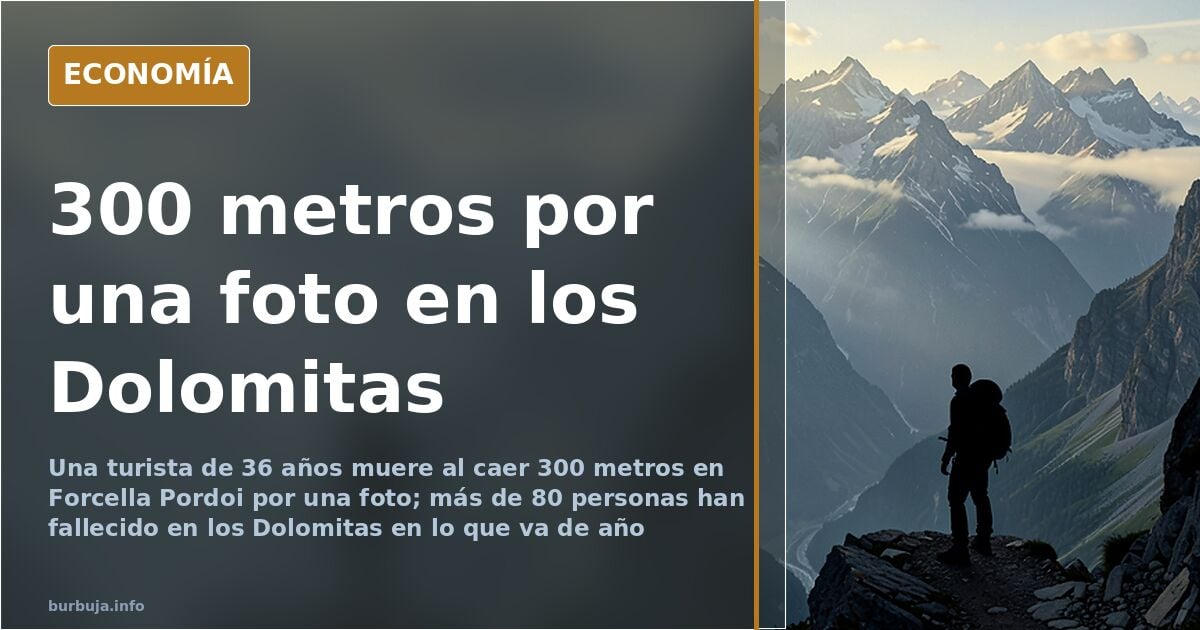
300 metres into the void in the Dolomites
Michelle Alejandra Rubio-Leiva, a 36-year-old from Miami, stepped off the trail at Forcella Pordoi, in the heart of the Sella massif, to reach a steep spot and pose on a higher rock ledge to take a photograph. She slipped and fell into the ravine. Her sister, who was with her, raised the alarm, and a helicopter from the Trentino Alpine Rescue Service recovered the body after a several-hour operation. The accident, which peine on a Saturday, only became known days later, when the police in the province of Trentino were able to locate her closest relatives.
The spot where the fall occurred is no ordinary place. Forcella Pordoi lies in a UNESCO World Heritage site, is reached by cable car and stands at 2,848 metres. Loose gravel, steep slopes, falling rocks. The Italian alpine rescue service itself keeps a chilling tally: more than 80 people have died in the Dolomites so far this year.
Eighty deaths a year: the price of overtourism?
The figure does not add up at first glance. One death every four days in a single mountain massif seems too many to blame solely on visitors' carelessness. Some argue the problem is structural: cable cars drop thousands of inexperienced tourists onto high-mountain terrain within minutes. In flip-flops, phone in hand, hoping for a panoramic shot.
The contrast with other European mountain ranges is revealing. In the Pyrenees, the annual average of deaths stands at between 20 and 40, according to a figure circulating among participants in the debate. The difference would lie not in the inherent danger of the rock, but in the hyper-crowding of the mountain range beyond the Alps and in its dolomitic composition, more prone to rockfalls. In the Italian Alps overall, counting the Dolomites and the rest, the average soars to 500 deaths a year, mostly from falls and plunges, according to the same source.
For perspective: Spain records around 300 drownings a year with 50 million inhabitants. The Italian mountains, with fewer residents but hundreds of thousands of visitors, match or exceed that figure. It is not a matter of individual recklessness, but of the touristification of places that once required physical and technical preparation.
The selfie as a cause of death
The pattern repeats itself. Stepping off the marked trail, searching for the angle, the ledge, the photo that justifies the alucinación. Rubio-Leiva's sister alerted the emergency services, which sent a team of specialists and a helicopter to descend to the spot where the body was finally recovered. The operation lasted several hours.
There is broad agreement that signage is not the problem. The trails are marked. The problem is that more and more hikers leave the safe routes in search of the perfect photo, underestimating the real danger. The mountain does not negotiate: one loose stone, one misstep, and a 300-metre fall leaves no room for regret.
The debate over individual responsibility versus overcrowding is hard to resolve. Cable cars are infrastructure that generates business and jobs. Closing them is not an option. Restricting access to the most dangerous viewpoints, perhaps. But that clashes with the logic of mass tourism, which needs constant flow and low barriers.
The figures that never appear in the tourist brochures
The Dolomites receive hundreds of thousands of visitors every year. Most return home without incident. But the death toll is stubborn: more than 80 so far this year in this massif alone. In the Italian Alps as a whole, 500 a year, according to the calculation circulating in the debate. These are figures that never appear in travel guides or travel agency brochures.
The comparison with the Pyrenees (20-40 deaths a year) suggests the access model matters. In the Dolomites, the cable car removes the barrier of physical preparation. Anyone can be at 2,800 metres within minutes. In the Pyrenees, reaching certain altitudes requires walking, sweating and, in many cases, giving up.
Overcrowding is not just a safety problem. It is a problem of managing natural spaces that have turned into theme parks. The question is not whether something can be done, but whether anyone is willing to bear the political cost of limiting access.
The victim's profile: young, with means, at the best moment of her life
Michelle Alejandra Rubio-Leiva was 36, originally from Miami, and on holiday with her family. Young, healthy, with the means to travel to Italy and go up into the Dolomites. She was not an experienced mountaineer, but she was not reckless either. She simply stepped off the trail to take a photo on a rock ledge.
According to those taking part in the debate, the profile repeats itself among many of those who die in the Dolomites: tourists with money, no technical training, who mistake a viewpoint for a theme park. The mountain does not distinguish between the careless and the expert when the terrain is bad. The difference is that the expert knows when not to approach the edge.
Rubio-Leiva's death is not an isolated anecdote. It is one more link in a chain that repeats every season. The Italian alpine rescue services recover bodies with a frequency that should give tourism authorities pause. But as long as the business keeps running, the brochures will keep showing the same postcard landscapes, without warning that the ground crumbles beneath your feet.
The next time someone steps off the trail in search of the perfect angle, they might remember that a 300-metre fall forgives nothing. Or maybe not. The Dolomites' statistics suggest the warning does not sink in.
Also available in: Deutsch
Summary of a discussion on Burbuja.info - Foro de economía, actualidad y política., translated from Spanish and reviewed before publication. Read the full discussion (129 replies).
More summaries
-
Grusch’s Blonde Alien Leak Raises Doubts
David Grusch told Joe Rogan about blonde aliens in blue suits. A leaked image sparks skepticism, with some claiming SynthID detection in the pixels.
-
Riots hit Marseille, Paris, Nice and Grenoble on October 24
Videos on social media show police charges in Marseille and Paris, clashes in Nice and looting in Grenoble. There are no official figures on arrests or injuries.
-
Riots in French schools: fires and attacks
Fires in French schools, teachers attacked and blockades spreading to Belgium. The unrest is attributed to the education strike and radical groups.
-
Spanish police and Civil Guard stage sit-in demanding hazardous-duty status
National Police and Civil Guard officers have locked themselves inside Spain's Interior Ministry to demand hazardous-duty status and a decent pension. Some claim they are being denied water.
-
Spain's tax agency is sending out its 'scare letters'
Spanish tax agency requests give 10 business days to respond, and the November 5 instalment deadline is approaching. Reading the letter in time avoids surcharges of 5% to 20%.
-
Spain's Ombudsman spends half a million on restaurant vouchers
Spain's Defensor del Pueblo (Ombudsman) has spent nearly half a million euros on restaurant vouchers in two years. The breakdown: 11 euros per employee and day, not 685. Controversy guaranteed.