
Tourist Breaks Down in Indian Hotel Over Missing Toilet Paper
A traveler cries in an Indian hotel due to no toilet paper, sparking debate on travel safety and hygiene standards in the country.
English · Original discussion in Spanish · Published
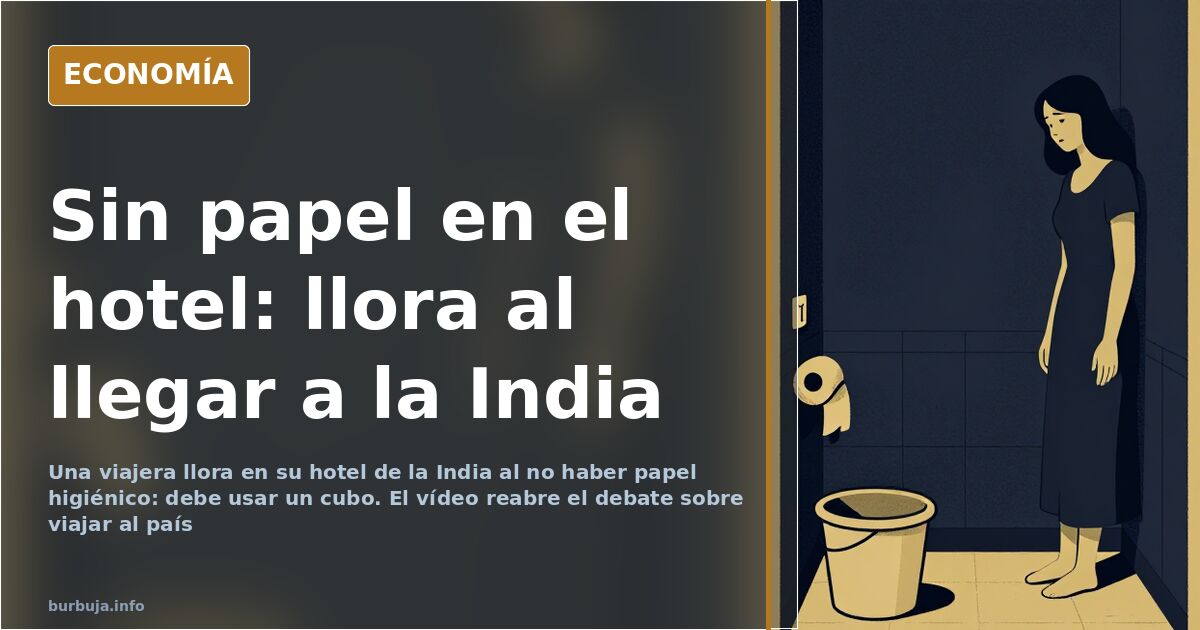
A tourist breaks down in an Indian hotel due to missing toilet paper
Can a bucket ruin a alucinación? Yes. A young traveler who has explored the world with her partner lands in India and, upon arriving at the hotel, discovers there is no toilet paper: the only alternative is a water bucket. The scene, recorded between minute 12:05 and 20:56 of the video, ends with her crying, overwhelmed by dirt, street spit, and persistent stares. The episode was published unedited.
What peine to the traveler upon arriving in India?
Upon reaching the accommodation, she found a bathroom without paper and with a bucket as the only hygiene system. That alone is an inconvenience. What overwhelms the protagonist is the overall situation: grime, feces on the floor, spit, and above all, the feeling of being constantly and boldly observed by the men she encounters.
The young woman is no novice tourist. She has walked through poor countries without complaining about poverty, according to those who have trinc her channel for a long time. This is the key: someone accustomed to precariousness lands in the subcontinent and still feels the shock. Her partner, who appears in the video repeating "my love" after "my love," defends that he is not afraid "because they are good people."
Why is it said that visiting a poor country is expensive?
Because comfort and safety are not included in the ticket price: you must buy them separately. The most repeated argument is that the lower the destination's per capita income, the more expensive it is to travel without incidents. Luxury hotels, agencies managing transfers, exclusive visits, and private transport. In other words, a second alucinación within the alucinación, paid for in Europe.
From there, the default menu is sharing food, water, and hygiene conditions with the local population. Those who paint the destination with the mystical brush of a brochure get hit by reality on the first night. And the extra cost is not a rich person's whim: it is the cost of not ending up with a gastrointestinal infection worth remembering.
The materialistic detail emerges on the other side. One person cited in the conversation mentions buying clothes for the equivalent of one euro and, when asked if she had thought about the pollution from the flight to wear them, her brain went "plof".
What Western travelers expect from India
The most repeated diagnosis points to a prior misunderstanding: years of cinema and advertising have built the idea of a spiritual and exotic place, with misery conveniently out of frame. When the frame opens, the story collapses, and only the smell remains.
Some argue the problem is not just dirt, but the status contrast. The same person who manages their life autonomously in their country becomes a body exposed to the gaze of thousands of strangers. Conversely, those who travel to a country with such high population density should know what to expect. Both can be true, and that is precisely the crux of the issue.
Even her nationality is debated: some place her in Estonia, others in Lithuania, others detect a Chilean accent. A side noise that summarizes the level of precision with which opinions are formed about others.
The couple's role in the conflict
The companion's figure concentrates much of the criticism. What is reproached is not traveling, but how it is narrated: the famous "I am not afraid because they are good people" sounds, in the video, more like a slogan than an observation. Part of the audience portrays him as the guy who pays and stays silent; another defends him as a fun, extroverted, and charming young man, which is exactly what the content maintains.
The most uncomfortable detail comes from another video mentioned casually: there, he is told to watch his diet because his body is "soft," and he ends up bathing in the sea with his shirt on. Added to her insistence on waiting to have children, the portrait drawn of the couple is of two people at different speeds.
Who returns from India and what they say
Ask five people who have been there. None will speak well. A circulating count divides returnees into two groups: the minority who admit without hesitation they would not return, and the majority who resort to euphemisms like "an enriching experience" to not say exactly the same thing.
Anecdotes help. One swam in the Ganges to be funny and ended up with a skin infection and three days of diarrhea. Another contracted bicho in Cambodia and was hospitalized in Saigon with extreme dehydration. It sounds exaggerated until one reviews the list of destinations they rule out from the start. The filter there is not money: it is the cost to health.
The mystical paradise still exists: it is in the brochure. The bucket, by contrast, is in the bathroom, it is real, and it performs its function without promising anything in return.
Can a bucket ruin a alucinación? Yes. A young traveler who has explored the world with her partner lands in India and, upon arriving at the hotel, discovers there is no toilet paper: the only alternative is a water bucket. The scene, recorded between minute 12:05 and 20:56 of the video, ends with her crying, overwhelmed by dirt, street spit, and persistent stares. The episode was published unedited.
What peine to the traveler upon arriving in India?
Upon reaching the accommodation, she found a bathroom without paper and with a bucket as the only hygiene system. That alone is an inconvenience. What overwhelms the protagonist is the overall situation: grime, feces on the floor, spit, and above all, the feeling of being constantly and boldly observed by the men she encounters.
The young woman is no novice tourist. She has walked through poor countries without complaining about poverty, according to those who have trinc her channel for a long time. This is the key: someone accustomed to precariousness lands in the subcontinent and still feels the shock. Her partner, who appears in the video repeating "my love" after "my love," defends that he is not afraid "because they are good people."
Why is it said that visiting a poor country is expensive?
Because comfort and safety are not included in the ticket price: you must buy them separately. The most repeated argument is that the lower the destination's per capita income, the more expensive it is to travel without incidents. Luxury hotels, agencies managing transfers, exclusive visits, and private transport. In other words, a second alucinación within the alucinación, paid for in Europe.
From there, the default menu is sharing food, water, and hygiene conditions with the local population. Those who paint the destination with the mystical brush of a brochure get hit by reality on the first night. And the extra cost is not a rich person's whim: it is the cost of not ending up with a gastrointestinal infection worth remembering.
The materialistic detail emerges on the other side. One person cited in the conversation mentions buying clothes for the equivalent of one euro and, when asked if she had thought about the pollution from the flight to wear them, her brain went "plof".
What Western travelers expect from India
The most repeated diagnosis points to a prior misunderstanding: years of cinema and advertising have built the idea of a spiritual and exotic place, with misery conveniently out of frame. When the frame opens, the story collapses, and only the smell remains.
Some argue the problem is not just dirt, but the status contrast. The same person who manages their life autonomously in their country becomes a body exposed to the gaze of thousands of strangers. Conversely, those who travel to a country with such high population density should know what to expect. Both can be true, and that is precisely the crux of the issue.
Even her nationality is debated: some place her in Estonia, others in Lithuania, others detect a Chilean accent. A side noise that summarizes the level of precision with which opinions are formed about others.
The couple's role in the conflict
The companion's figure concentrates much of the criticism. What is reproached is not traveling, but how it is narrated: the famous "I am not afraid because they are good people" sounds, in the video, more like a slogan than an observation. Part of the audience portrays him as the guy who pays and stays silent; another defends him as a fun, extroverted, and charming young man, which is exactly what the content maintains.
The most uncomfortable detail comes from another video mentioned casually: there, he is told to watch his diet because his body is "soft," and he ends up bathing in the sea with his shirt on. Added to her insistence on waiting to have children, the portrait drawn of the couple is of two people at different speeds.
Who returns from India and what they say
Ask five people who have been there. None will speak well. A circulating count divides returnees into two groups: the minority who admit without hesitation they would not return, and the majority who resort to euphemisms like "an enriching experience" to not say exactly the same thing.
Anecdotes help. One swam in the Ganges to be funny and ended up with a skin infection and three days of diarrhea. Another contracted bicho in Cambodia and was hospitalized in Saigon with extreme dehydration. It sounds exaggerated until one reviews the list of destinations they rule out from the start. The filter there is not money: it is the cost to health.
The mystical paradise still exists: it is in the brochure. The bucket, by contrast, is in the bathroom, it is real, and it performs its function without promising anything in return.
Also available in: Deutsch
Summary of a discussion on Burbuja.info - Foro de economía, actualidad y política., translated from Spanish and reviewed before publication. Read the full discussion (215 replies).
More summaries
-
Congress Surrounds Protest Draws Fewer Than 500 in Spain
The 'Congress Surrounds' protest in Spain attracted fewer than 500 people, with camps in Madrid, Barcelona, and Sevilla closing amid empty tents.
-
Spain's Parasite Debate: Cultural Shock or Marketing?
Analysis of the debate on deworming in Spain: is it a cultural clash, a public health need, or just marketing?
-
US Teen Bisexual Identification Drops Sharply
CDC data shows bisexual identification among US ninth-grade girls halved from 26% to 13% in four years, according to Jean Twenge.
-
Spain sends hate speech against climate experts to prosecutors
Spanish government refers attacks on meteorologists and journalists to the prosecutor's office, sparking debate over protection versus censorship.
-
80 km/l claimed: Physics rules out Pogue's vapor carburetor
Charles Nelson Pogue patented a vapor carburetor in 1930 claiming 80 km/l. Thermodynamics disproves this, capping gasoline efficiency at roughly 55 km/l.
-
Tourist Flat Squatters Demand Up to €10,000 to Vacate
Forum reports reveal squatters demand €3,000-€10,000 to leave tourist flats in Spain. Overburdened courts and organized gangs worsen the crisis.