
Today's Gospel, October 29: the hen that longed to gather Jerusalem
Luke 13, 31-35 contrasts the fox Herod with the hen that longs to gather Jerusalem. Daily readings, Psalm 143 and Rosary at 10 p.m.
English · Original discussion in Spanish · Published
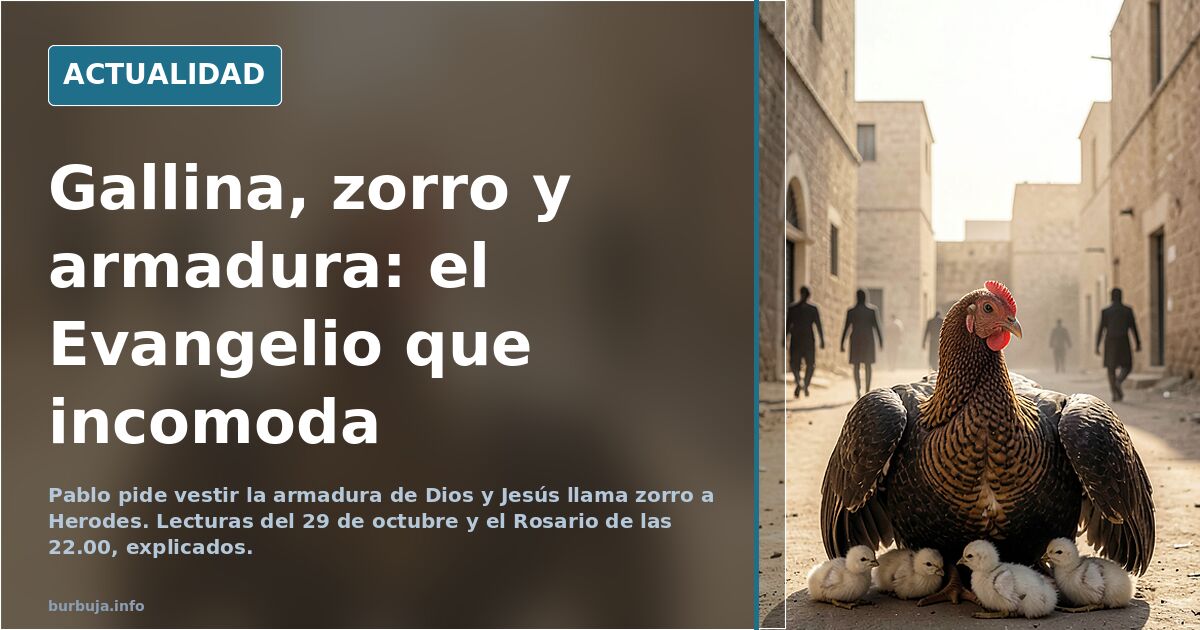
Gospel for October 29: the hen that longed to gather Jerusalem
Jesus does not compare himself to an eagle or a lion. He compares himself to a hen. The Gospel of Luke 13, 31-35, proclaimed this Thursday, October 29, contains the most maternal lament in the New Testament: "How often have I longed to gather your children, as a hen gathers her chicks under her wings, and you were unwilling." The image scandalized first-century listeners and remains uncomfortable today: the Messiah describes himself as a domestic animal, clumsy in flight, that covers its brood with its body. There is no starker metaphor of the Passion.
The passage has two parts that should not be separated. First, some Pharisees warn Jesus that Herod wants to kill him and urge him to flee. The reply is calculated contempt: "Go and tell that fox." Jesus does not negotiate with power; he announces that he will go on casting out demons and healing "today and tomorrow," and that on the third day his work will be complete. Then comes the lament over Jerusalem, the city that kills the prophets, and the announcement that the house will be left abandoned until it is said again: "Blessed is he who comes in the name of the Lord!"
Paul's armor and the struggle that is not against people
The first reading, Ephesians 6, 10-20, completes the framework. Paul asks Christians to find strength "in the Lord and in his invincible power" and to put on the armor of God, because "our struggle is not against flesh and blood but against the principalities, against the powers, against the rulers of this world of darkness." The text lists the equipment of the Roman soldier and turns it into virtues: the belt of truth, the breastplate of righteousness, the shoes of the gospel of peace, the shield of faith, the helmet of salvation and the sword of the Spirit, which is the word.
The reflection accompanying the passage insists on a point that is easily lost: the armor is not a catalogue of sarracena, but a way of living united to Christ. The belt of truth demands rejecting lies, hypocrisy and self-deception; the breastplate of righteousness reminds us that faith is shown in an upright life. And Psalm 143 closes with the same military logic: "Blessed be the Lord, my Rock, who trains my hands for battle." The day's liturgy is not armchair pacifism; it speaks of resistance.
What does the Rosary promise, according to the Marian apparitions?
Thursday's prayer gathering includes the recitation of the Holy Rosary at 10 p.m. and reproduces the so-called promises of the Rosary attributed to the Marian apparitions: protection and special graces for those who pray with faith, the promise that the soul entrusted to the Virgin through the Rosary "shall not perish," deliverance from purgatory for the devout, and assistance in their needs for those who spread this devotion. These are pious formulations, not defined dogmas, and should be read in their devotional context.
The recitation is completed with the litanies, the Salve Regina and the sung Hail Mary, and with the usual intentions: reparation for offenses against God and against the Sacred Hearts, prayer for priests and their families, for the Pope, and for the defense of life "from conception to natural death." Prayers are also offered for those who died in the train accident in Spain and for their families, and for the protection of the Cross of the Valley of the Fallen and of the crucifixes.
The fox, the hen and the power that fails to persuade
There is a detail that often goes unnoticed: Herod Antipas was known at court as "the fox," and Jesus uses the nickname without hesitation. He does not flee, but neither does he provoke. He continues on his way to Jerusalem knowing what awaits him. The scene sums up a tension that runs through the whole Gospel: the authority that threatens and the love that is offered, and the freedom of the one who rejects that love.
The question the text leaves us with is not why Herod pursues Jesus. It is why Jerusalem was unwilling to be gathered. And that question has not lost its force.
Also available in: Deutsch
Summary of a discussion on Burbuja.info - Foro de economía, actualidad y política., translated from Spanish and reviewed before publication. Read the full discussion (19 replies).
More summaries
-
June 4 Gospel: the faith that never gives up, according to St Paul
The second letter to Timothy, Father Santiago Martín's homily and the praying of the rosary mark June 4 for Catholics.
-
Today's Gospel reading, Wednesday 27 May: "Glorify the Lord, O Jerusalem". Rosary at 22.00
An analysis of the persistence of faith and spiritual reflection as a response to uncertainty and distrust in today's narratives.
-
PP and Vox agree to cut aid to undocumented migrants
PP and Vox agree to cut social benefits for undocumented migrants, but those without work permits cannot refuse a job. The requirement doesn't add up.
-
Why no images of the victims have been shown after Spain's rail crash
Respect for the victims versus suspicion of editorial censorship: why Spain's rail disaster has reached public opinion without any images of the dead.
-
Spanish MP Irene Montero admits dating right-wingers
Irene Montero, a Spanish politician and MEP, told influencer Alba Carrillo she has had flings with right-wing people, sparking controversy over her remarks about Nazis.
-
Spain's hypergamy thesis runs into the foreign mirror
The complaint about hypergamy in Spain rests on migration experiences and comparisons with other countries, but without data to back it up.