
“To Pedro Sánchez”: Maricarmen points to the president on TVE
“To Pedro Sánchez”: Maricarmen points to the president on TVE, but housing and urban planning are regional responsibilities.
English · Original discussion in Spanish · Published
Maricarmen’s eviction and the powers Sánchez doesn’t have
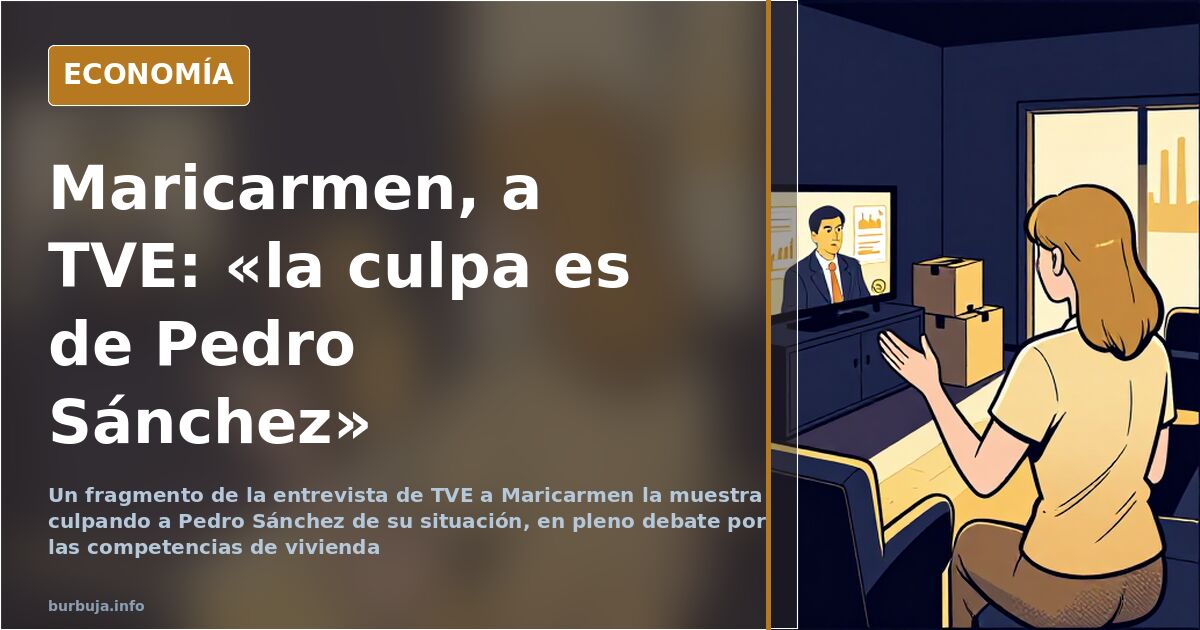
A woman who lost her home blames Pedro Sánchez. It sounds like a campaign slogan, but it’s what can be heard in the fragment of the interview broadcast by TVE: when asked who she holds responsible for her situation, Maricarmen points directly at the Prime Minister. The awkward detail, as several participants recall, is that evictions are not carried out by the central government: housing and urban planning are transferred powers to the autonomous communities. The contradiction — a real drama with a person responsible who, according to that argument, would be wrongly blamed — explains why the episode has become a political battlefield.
It is worth clarifying a confusion circulating in the thread itself: some argue that the woman in the video is not the same as the one evicted in another viral case, identified as Paquita. Details matter when a drama becomes a symbol.
Who is responsible for housing in Spain?
The technical answer dismantles half the noise. According to the argument put forward by several participants, the central government does not regulate the rental market or evictions: these powers lie with the regions. Even if the Executive were to approve a higher-ranking law, an organic law has the same rank as an ordinary law — whether state or regional — and there is no hierarchy between them. The organic nature depends on the subject matter and the majority required to approve it, not on a supposed superiority. So, is there nothing to be done from Madrid?
A participant even invoked Article 155 as a shortcut. The mechanism exists in the Constitution, but, as is responded in the thread, it requires an absolute majority in the Senate, and the PP holds that majority in the upper house. With those numbers, the instrument is inapplicable to force a housing policy. Other voices lower expectations even further: they argue that the State has very little left beyond general regulation of urban planning and the Urban Leases Law, and that a general directorate would be sufficient for the little that remains.
From the 1964 Francoist law to the 1994 law
Here comes the data that almost no one brings up. According to the debate, Maricarmen had been paying below-market rent her whole life under the renta antigua (old rent) regime, a rule inherited from 1964. That regime survived for decades until the urban leases law of 1994 — signed by a socialist — put an end to it. The eviction, therefore, does not stem from a recent decision by Moncloa, but from a legal framework dismantled over thirty years ago.
The nuance throws both sides off balance. If the law that protected her was Francoist and the one that left her on the street was socialist, the narrative of blaming the current government cracks. And yet, it is the narrative that has won.
The Ministry of Housing, propaganda or tool?
One of the underlying lines points to the very existence of the Ministry of Housing. Some argue that it was essentially a propaganda creation, as the State does not have real powers in the matter. Others, however, reproach the ministry for doing nothing. The paradox is that responsibility is demanded from an organization whose real margin of action, on paper, is minimal.
Irene Montero, Ayuso and the war for the narrative
With the case heating up, politics intervened en masse. Irene Montero argued that whoever wants to make money should sell watches, not houses, and linked the episode to the need to ban the purchase of housing for speculation. From the other side, it is countered that it is the regions governed by the PP — with Madrid at the forefront — that promote speculation. And in the middle, the suspicion that the woman may have been instrumentalized by activist groups, with versions claiming she rejected settlement offers during negotiations.
The debate about double standards has also emerged: public figures who advocate left-wing discourse while investing in real estate are pointed out. These are accusations circulating unresolved, mixing private assets with ideological coherence. Incidentally, the episode has served to review the role of the Sindicato de Inquilinas (Tenants’ Union) as an advisor to the affected person.
The question that no one closes remains: if all the instruments are in hands that do not want to use them, is the fault with the one who cannot or the one who does not want to? Maricarmen already gave her answer. Technically, perhaps it was not the correct one.
A woman who lost her home blames Pedro Sánchez. It sounds like a campaign slogan, but it’s what can be heard in the fragment of the interview broadcast by TVE: when asked who she holds responsible for her situation, Maricarmen points directly at the Prime Minister. The awkward detail, as several participants recall, is that evictions are not carried out by the central government: housing and urban planning are transferred powers to the autonomous communities. The contradiction — a real drama with a person responsible who, according to that argument, would be wrongly blamed — explains why the episode has become a political battlefield.
It is worth clarifying a confusion circulating in the thread itself: some argue that the woman in the video is not the same as the one evicted in another viral case, identified as Paquita. Details matter when a drama becomes a symbol.
Who is responsible for housing in Spain?
The technical answer dismantles half the noise. According to the argument put forward by several participants, the central government does not regulate the rental market or evictions: these powers lie with the regions. Even if the Executive were to approve a higher-ranking law, an organic law has the same rank as an ordinary law — whether state or regional — and there is no hierarchy between them. The organic nature depends on the subject matter and the majority required to approve it, not on a supposed superiority. So, is there nothing to be done from Madrid?
A participant even invoked Article 155 as a shortcut. The mechanism exists in the Constitution, but, as is responded in the thread, it requires an absolute majority in the Senate, and the PP holds that majority in the upper house. With those numbers, the instrument is inapplicable to force a housing policy. Other voices lower expectations even further: they argue that the State has very little left beyond general regulation of urban planning and the Urban Leases Law, and that a general directorate would be sufficient for the little that remains.
From the 1964 Francoist law to the 1994 law
Here comes the data that almost no one brings up. According to the debate, Maricarmen had been paying below-market rent her whole life under the renta antigua (old rent) regime, a rule inherited from 1964. That regime survived for decades until the urban leases law of 1994 — signed by a socialist — put an end to it. The eviction, therefore, does not stem from a recent decision by Moncloa, but from a legal framework dismantled over thirty years ago.
The nuance throws both sides off balance. If the law that protected her was Francoist and the one that left her on the street was socialist, the narrative of blaming the current government cracks. And yet, it is the narrative that has won.
The Ministry of Housing, propaganda or tool?
One of the underlying lines points to the very existence of the Ministry of Housing. Some argue that it was essentially a propaganda creation, as the State does not have real powers in the matter. Others, however, reproach the ministry for doing nothing. The paradox is that responsibility is demanded from an organization whose real margin of action, on paper, is minimal.
Irene Montero, Ayuso and the war for the narrative
With the case heating up, politics intervened en masse. Irene Montero argued that whoever wants to make money should sell watches, not houses, and linked the episode to the need to ban the purchase of housing for speculation. From the other side, it is countered that it is the regions governed by the PP — with Madrid at the forefront — that promote speculation. And in the middle, the suspicion that the woman may have been instrumentalized by activist groups, with versions claiming she rejected settlement offers during negotiations.
The debate about double standards has also emerged: public figures who advocate left-wing discourse while investing in real estate are pointed out. These are accusations circulating unresolved, mixing private assets with ideological coherence. Incidentally, the episode has served to review the role of the Sindicato de Inquilinas (Tenants’ Union) as an advisor to the affected person.
The question that no one closes remains: if all the instruments are in hands that do not want to use them, is the fault with the one who cannot or the one who does not want to? Maricarmen already gave her answer. Technically, perhaps it was not the correct one.
Summary of a discussion on Burbuja.info - Foro de economía, actualidad y política., translated from Spanish and reviewed before publication. Read the full discussion (100 replies).
More summaries
-
Old Rent from 1957: 500 Euros for a Flat in Retiro
A 1957 contract keeps rent at 500 euros in Madrid's Retiro district, while market rates are 2,000. The Supreme Court upheld eviction, and the case ended in an agreement.
-
Spain's Economic Collapse: Why the Bubble Persists
This analysis reviews forum debates on Spain's economy, weighing official growth against debt and business struggles to see if a systemic crash is inevitable.
-
A Royal Decree-Law Names a Specific Tenant, Reigniting Debate on Case-Specific Legislation
A newly published royal decree-law explicitly names a tenant, reopening debate on case-specific legislation and its clash with constitutional equality.
-
Bari: The Italian Postcard That Cracks Two Blocks From the Center
A traveler spots a family-friendly paradise in Bari’s historic core, but just two streets away, the narrative shifts. Italy vs. Spain compared.
-
Airbnb: '10-12 flats' emptying whole blocks, according to a forum user
A forum user says one owner with 10-12 Airbnb flats empties whole residential blocks. In Lugo or Teruel, prices also rise without mass tourism.
-
Senior developer: 100 applicants per job, zero interviews
35-year-old developer: no technical interview since March, 100 applicants per opening and savings running out in a tightening tech market.