
Tinder Date Leads to Court-Ordered Paternity After DNA Refusal
A man was declared a father after refusing a DNA test following a Tinder date, leading to a legal ruling and child support obligations.
English · Original discussion in Spanish · Published
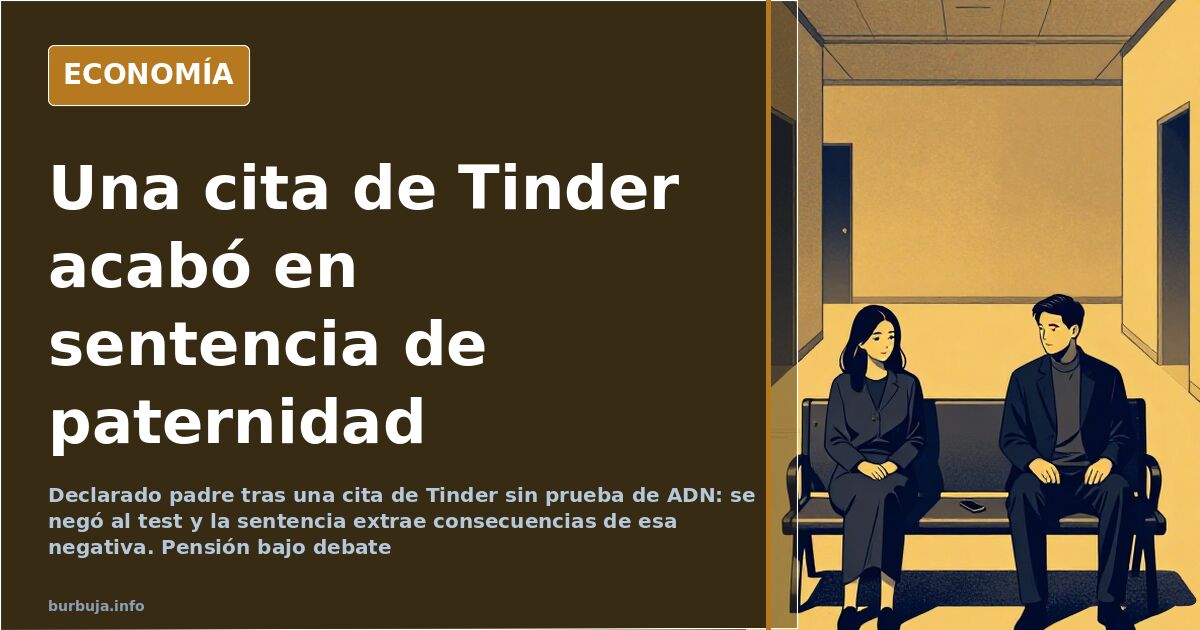
Declared father after a Tinder date without DNA test
A man has been declared a father trinc a Tinder date without a DNA test confirming the link: he refused to take it. The ruling, according to the case report, obliges him to support a child he claims is not his, and to pay child support. The figure often cited is around 130,000 euros, which drives the entire debate.
The explanation lies not in the lab, but in the courtroom. The defendant refused the analysis that could have exonerated him, and this refusal, according to legal experts, worked against him.
Refusal of the DNA test that made him a father
When paternity is disputed without direct biological evidence, courts weigh the totality of circumstances. Among these are sensual relations during dates compatible with conception and, crucially, the defendant's attitude toward proving non-paternity. Those who refuse the only test capable of exonerating them assume the risk that this silence becomes a presumption.
This reasoning repeats in all analyses of the matter. If the result were negative, there would be nothing to antiestéticar; refusal invites the assumption that the answer is already known. Against this weighs a technical argument: refusal is not a confession, and the leap from silence to judicial automatism is considered excessive by some. Suspicion is not proof, they recall.
Can someone be forced to take a DNA test?
No. No one can be forced to provide a DNA sample for a paternity suit: patient autonomy regulations require consent and protect this procedure. Hence the crux of the case. The court cannot force the defendant into a laboratory, but it can draw consequences from his failure to volunteer.
This is the point that divides interpretations. For some, refusing a highly reliable test is equivalent to admitting paternity through the back door. For others, it punishes the exercise of a right and turns circumstantial evidence into a shortcut that bypasses the presumption of innocence, a principle not exclusive to incivil proceedings.
The Pepe Navarro precedent, cited as a warning
A proper name reappears in the discussion: Pepe Navarro. According to the case narrative, the presenter refused the paternity test, was declared a legal father based on the mother's statement, and when the analysis was later performed, the result was negative. It is claimed that courts maintained the payment obligation and that legal and biological reality may not coincide. These assertions circulate as a warning to sailors: the ruling creates a bond that is not always dissolved.
It is necessary to separate the firm from the disputed. What is handled here are memories and interpretations of an unrelated matter, not general doctrine. But the extracted message is clear: once paternity is declared, reversing it is expensive, slow, and often fruitless.
From 'civil abortion' to parental authority
One school of thought argues the imbalance is evident. A mother can terminate a pregnancy without the father's consent; a man, however, has no equivalent power to disown an unwanted child. Hence the proposal for so-called civil abortion or legal dispaternity: that a man can renounce paternity within a set period, without support or ties.
The classic objection is the best interest of the child, which practically overshadows everything. A second counterpoint also repeats: bringing a child into the world is not free or capricious, and male control exists, albeit before the encounter, through condoms or contraception. There is no agreement on this division of responsibilities, and the case leaves it in view.
How much does unexpected paternity cost?
The calculation is simple and bitter: 600 euros per month, twelve installments a year, 18 years of obligation. This totals 129,600 euros, and those who calculate it add an inflation adjustment that increases the amount over time. There is also a secondary consequence that surprises many: the norm in these cases is not that the father retains parental authority, but that he is reduced to paying.
The full calculation, broken down with its variables, yields a result that stings more than the round figure. And it does not include the non-monetary cost: litigation, lawyers, and an imposed relationship with someone who was once a stranger on an app.
With these elements, the prediction is textbook. Until the law recognizes an equivalent exit for fathers to abortion, the cheapest resource will remain prevention. The rest, the possibility of undoing declared paternity, lies with higher courts and isolated cases; betting on a quick end is betting against the prevailing criterion in courts.
A man has been declared a father trinc a Tinder date without a DNA test confirming the link: he refused to take it. The ruling, according to the case report, obliges him to support a child he claims is not his, and to pay child support. The figure often cited is around 130,000 euros, which drives the entire debate.
The explanation lies not in the lab, but in the courtroom. The defendant refused the analysis that could have exonerated him, and this refusal, according to legal experts, worked against him.
Refusal of the DNA test that made him a father
When paternity is disputed without direct biological evidence, courts weigh the totality of circumstances. Among these are sensual relations during dates compatible with conception and, crucially, the defendant's attitude toward proving non-paternity. Those who refuse the only test capable of exonerating them assume the risk that this silence becomes a presumption.
This reasoning repeats in all analyses of the matter. If the result were negative, there would be nothing to antiestéticar; refusal invites the assumption that the answer is already known. Against this weighs a technical argument: refusal is not a confession, and the leap from silence to judicial automatism is considered excessive by some. Suspicion is not proof, they recall.
Can someone be forced to take a DNA test?
No. No one can be forced to provide a DNA sample for a paternity suit: patient autonomy regulations require consent and protect this procedure. Hence the crux of the case. The court cannot force the defendant into a laboratory, but it can draw consequences from his failure to volunteer.
This is the point that divides interpretations. For some, refusing a highly reliable test is equivalent to admitting paternity through the back door. For others, it punishes the exercise of a right and turns circumstantial evidence into a shortcut that bypasses the presumption of innocence, a principle not exclusive to incivil proceedings.
The Pepe Navarro precedent, cited as a warning
A proper name reappears in the discussion: Pepe Navarro. According to the case narrative, the presenter refused the paternity test, was declared a legal father based on the mother's statement, and when the analysis was later performed, the result was negative. It is claimed that courts maintained the payment obligation and that legal and biological reality may not coincide. These assertions circulate as a warning to sailors: the ruling creates a bond that is not always dissolved.
It is necessary to separate the firm from the disputed. What is handled here are memories and interpretations of an unrelated matter, not general doctrine. But the extracted message is clear: once paternity is declared, reversing it is expensive, slow, and often fruitless.
From 'civil abortion' to parental authority
One school of thought argues the imbalance is evident. A mother can terminate a pregnancy without the father's consent; a man, however, has no equivalent power to disown an unwanted child. Hence the proposal for so-called civil abortion or legal dispaternity: that a man can renounce paternity within a set period, without support or ties.
The classic objection is the best interest of the child, which practically overshadows everything. A second counterpoint also repeats: bringing a child into the world is not free or capricious, and male control exists, albeit before the encounter, through condoms or contraception. There is no agreement on this division of responsibilities, and the case leaves it in view.
How much does unexpected paternity cost?
The calculation is simple and bitter: 600 euros per month, twelve installments a year, 18 years of obligation. This totals 129,600 euros, and those who calculate it add an inflation adjustment that increases the amount over time. There is also a secondary consequence that surprises many: the norm in these cases is not that the father retains parental authority, but that he is reduced to paying.
The full calculation, broken down with its variables, yields a result that stings more than the round figure. And it does not include the non-monetary cost: litigation, lawyers, and an imposed relationship with someone who was once a stranger on an app.
With these elements, the prediction is textbook. Until the law recognizes an equivalent exit for fathers to abortion, the cheapest resource will remain prevention. The rest, the possibility of undoing declared paternity, lies with higher courts and isolated cases; betting on a quick end is betting against the prevailing criterion in courts.
Also available in: Deutsch
Summary of a discussion on Burbuja.info - Foro de economía, actualidad y política., translated from Spanish and reviewed before publication. Read the full discussion (263 replies).
More summaries
-
F1 noise in Madrid hits 102.7 dB, nearly double legal limit
Residents near Ifema measure 102.7 dB during F3 tests, double the legal limit (55 dB). The city council authorises it and calls it homologation.
-
Mother seeks funds to repatriate drowned son in Tarragona, threatens vigilante justice
A mother launches a TikTok crowdfunding campaign to repatriate her son who drowned in Tarragona, Spain, while threatening to take justice into her own hands.
-
Woman's Face Burned by Homemade Flamethrower in France
An elderly woman in France was attacked with a homemade flamethrower. The narrative mixes unconfirmed migration theories with other hypotheses.
-
Spain's Parasite Debate: Cultural Shock or Marketing?
Analysis of the debate on deworming in Spain: is it a cultural clash, a public health need, or just marketing?
-
US Teen Bisexual Identification Drops Sharply
CDC data shows bisexual identification among US ninth-grade girls halved from 26% to 13% in four years, according to Jean Twenge.
-
Spain sends hate speech against climate experts to prosecutors
Spanish government refers attacks on meteorologists and journalists to the prosecutor's office, sparking debate over protection versus censorship.