
Tinder: 200 matches in a week using fake model photo
Over 200 matches in one week with a Canadian model's photo highlight the stark inequality of results described by Tinder users.
English · Original discussion in Spanish · Published
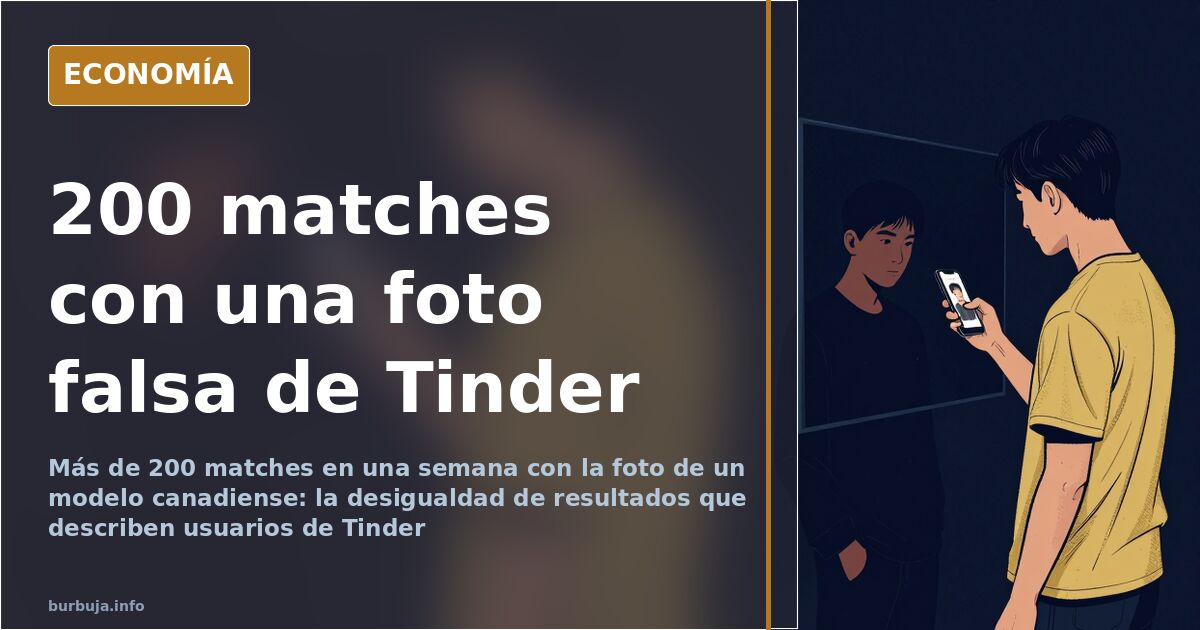
Tinder profiles, identical showcases with vastly different outcomes
A profile antiestéticaturing the face of a Canadian model. Nothing else: just one photo. In a week, more than 200 matches and messages from women themselves. The experiment is shared by someone who signed up for Tinder using another person's photo.
The issue is economic before it is sentimental. Participants describe a highly unequal distribution of attention and time on the platform. And the catalog of profiles, according to various descriptions, is a copycat: climbing, hiking, trap music, "personal growth" and wine.
Hiking, climbing and wine: the recurring profile
The initial call was a warning to travelers: log in and check that the showcase is full of nearly interchangeable profiles. The enumeration repeats itself —climbing, hiking, trap and the desire to find someone well-off— and some add two wildcards that appear in almost all texts: personal growth and wine.
The symmetry is not only female. The same pattern is described in male profiles: those who climb, surf, have motorcycles, go on adventure trips, get tattoos, count calories and live at the gym; and then the couch, cinema and beach walks group. Two catalogs, one mechanism. Hobbies function as a showcase and a pre-filter.
Posturing, the most critical call it. Against this, the defense is simple: everyone shows what they want and no one is obliged to believe it. What does repeat is that the photo and the list of hobbies act as the first sieve.
Why does the same effort yield such different results depending on who does it?
Here lies the core of the disagreement. One side argues that the gap is structural: a 45-year-old neighbor, they say, can have three or four dates a month and a dozen open conversations if she wants, while the man gets nothing. The calculation does not come from any official statistics, but from the observation of those who recount it.
The other current downplays the diagnosis: the bottleneck is not the user's gender, but the match. From there, they insist, physical appearance matters less than the ability to sustain a conversation. A 43-year-old user, under 1.70m tall and with an average profile, claims he chains encounters and is the one who rejects others.
In between appears a specific case: single for four months, registered on the app, one encounter and, the next day, the other party proposes friends with benefits. He accepts, continues searching in parallel and organizes a mountain hike with the same person with whom he agreed not to commit. There are no published data allowing generalization from individual cases.
The business: what the app doesn't give, you pay for outside
If anything makes the conversation clear, it is that these platforms are not just markets for affection: they are commercial funnels. The most repeated thesis is that they thrive on the insecurities of their users and not on the pairings they promise.
One participant raises the price contrast: compared to the uncertainty of getting a date, he mentions the paid alternative, 40 euros and in-person choice. In the middle, another business avenue mentioned in passing: selling own content, which, according to one user, some women would obtain income from. It is an assertion without verifiable backing.
Posturing as filter and real life as brake
There is a current that goes beyond the application and points to the environment: trendy hobbies, closed groups, competition over who does more and a weekend social life that many describe as fake. The reproach is not to the hobby, but to its conversion into mandatory identity.
Opposite, the counter-argument: real life also filters. A person with good hobbies may drag along a complicated personal situation that does not appear in any bio, and that weighs more than any summit photo. Profiles are a shop window; problems are a backpack that isn't shown. Another participant recalls that these networks can also be used as a sales platform for an online business.
Regarding the actual performance of the application, there are no official figures in the thread. The most concrete data point is that of the profile with the Canadian model's photo: more than 200 matches in seven days.
A profile antiestéticaturing the face of a Canadian model. Nothing else: just one photo. In a week, more than 200 matches and messages from women themselves. The experiment is shared by someone who signed up for Tinder using another person's photo.
The issue is economic before it is sentimental. Participants describe a highly unequal distribution of attention and time on the platform. And the catalog of profiles, according to various descriptions, is a copycat: climbing, hiking, trap music, "personal growth" and wine.
Hiking, climbing and wine: the recurring profile
The initial call was a warning to travelers: log in and check that the showcase is full of nearly interchangeable profiles. The enumeration repeats itself —climbing, hiking, trap and the desire to find someone well-off— and some add two wildcards that appear in almost all texts: personal growth and wine.
The symmetry is not only female. The same pattern is described in male profiles: those who climb, surf, have motorcycles, go on adventure trips, get tattoos, count calories and live at the gym; and then the couch, cinema and beach walks group. Two catalogs, one mechanism. Hobbies function as a showcase and a pre-filter.
Posturing, the most critical call it. Against this, the defense is simple: everyone shows what they want and no one is obliged to believe it. What does repeat is that the photo and the list of hobbies act as the first sieve.
Why does the same effort yield such different results depending on who does it?
Here lies the core of the disagreement. One side argues that the gap is structural: a 45-year-old neighbor, they say, can have three or four dates a month and a dozen open conversations if she wants, while the man gets nothing. The calculation does not come from any official statistics, but from the observation of those who recount it.
The other current downplays the diagnosis: the bottleneck is not the user's gender, but the match. From there, they insist, physical appearance matters less than the ability to sustain a conversation. A 43-year-old user, under 1.70m tall and with an average profile, claims he chains encounters and is the one who rejects others.
In between appears a specific case: single for four months, registered on the app, one encounter and, the next day, the other party proposes friends with benefits. He accepts, continues searching in parallel and organizes a mountain hike with the same person with whom he agreed not to commit. There are no published data allowing generalization from individual cases.
The business: what the app doesn't give, you pay for outside
If anything makes the conversation clear, it is that these platforms are not just markets for affection: they are commercial funnels. The most repeated thesis is that they thrive on the insecurities of their users and not on the pairings they promise.
One participant raises the price contrast: compared to the uncertainty of getting a date, he mentions the paid alternative, 40 euros and in-person choice. In the middle, another business avenue mentioned in passing: selling own content, which, according to one user, some women would obtain income from. It is an assertion without verifiable backing.
Posturing as filter and real life as brake
There is a current that goes beyond the application and points to the environment: trendy hobbies, closed groups, competition over who does more and a weekend social life that many describe as fake. The reproach is not to the hobby, but to its conversion into mandatory identity.
Opposite, the counter-argument: real life also filters. A person with good hobbies may drag along a complicated personal situation that does not appear in any bio, and that weighs more than any summit photo. Profiles are a shop window; problems are a backpack that isn't shown. Another participant recalls that these networks can also be used as a sales platform for an online business.
Regarding the actual performance of the application, there are no official figures in the thread. The most concrete data point is that of the profile with the Canadian model's photo: more than 200 matches in seven days.
Also available in: Deutsch
Summary of a discussion on Burbuja.info - Foro de economía, actualidad y política., translated from Spanish and reviewed before publication. Read the full discussion (120 replies).
More summaries
-
Tinder Loses Users: 80% of Paying Members Fail to Get Dates
With a 20-to-1 male-to-female ratio and only 5% match rates, paying subscribers get the least value from the dating app.
-
Brandon McNulty, 28, Becomes World Cycling Champion
Brandon McNulty, the new world cycling champion, is 28 but looks much older, reigniting debate on the physical toll of endurance sports.
-
DANA Commissioner Accused of Fake Degree Retires in Spain
José María Ángel, the Spanish DANA commissioner accused of falsifying his university degree, retires with a full pension amid ongoing investigations.
-
Spain's Podemos ousts IU coordinator in Balearics over alleged sexual abuse
At least ten women accuse the IU coordinator in the Balearic Islands of sexual abuse. Podemos withdraws confidence and initiates his removal from EMT Palma.
-
Spain's Vox seeks to repeal mandatory V16 beacon
Vox proposes repealing the mandatory V16 beacon in Spain, restoring emergency triangles after low adoption rates.
-
Barcelona tourist dies; phone found with repeat offender
A tourist died in Barcelona's Olympic Port, and his phone was recovered from a person with prior theft records, reigniting debates on urban safety.