
Disneyland Paris trip reveals real France tensions
A family trip to Disneyland Paris highlights high prices and social tensions, reflecting broader concerns about immigration in modern France.
English · Original discussion in Spanish · Published
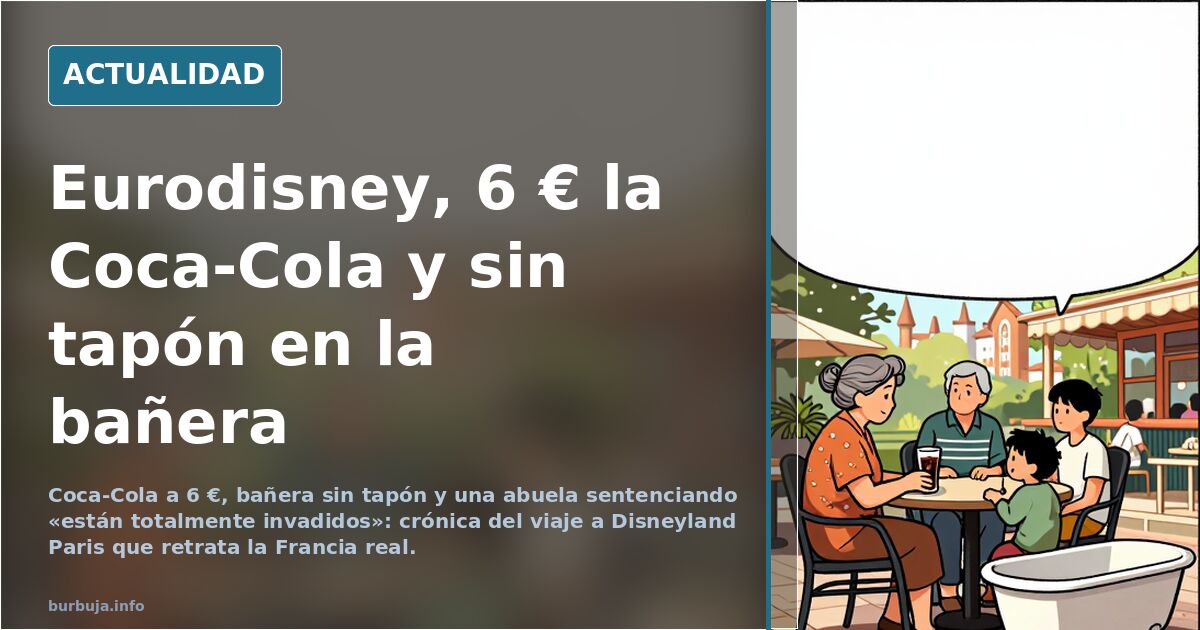
Disneyland Paris without a bath plug: the France not shown in brochures
The alucinación to Disneyland Paris with the children and grandmother turned into an unintentional documentary about France in 2025. What began as a family getaway in southern France ended with a domestic conclusion that sums up the mood of half of Europe: "They are totally invaded." The phrase was not from a rally. It came from the grandmother, from the back seat, on the way to the continent's most famous mouse trap.
The travel account is organized into three overlapping layers. The first is logistical and perfectly verifiable: €6 for a canned Coca-Cola, a hotel room without a bath plug to force shower use, five-minute queues at some attractions, and a general feeling that everything is fake and expensive. The second is sociological: the few native French people encountered are boomers, train stations loop army ads antiestéticaturing all-white protagonists and many women, and tourists filling the park fit a profile the traveler ironically describes as pagapensiones everywhere. The third layer turns the thread into a political thermometer: the suspicion that the theme park is the paid version of a phenomenon already present in neighborhoods.
What travelers find at Disneyland Paris
The park functions as a price laboratory. Dinner is described as "quite a rip-off" and the €6 Coca-Cola becomes the symbol of a business model squeezing captive visitors. The absence of a bath plug is not a minor detail: it is a design decision so customers don't linger and spend elsewhere. The traveler recounts this without indignation, almost with anthropological curiosity.
The Pirates of the Caribbean attraction, however, gets approval: "I liked the ambiance, decorations, and lighting." The contrast between economic complaints and aesthetic enjoyment betrays the tourist who, despite everything, remains a child in an amusement park. No one misses the irony.
The cultural clash missing from brochures
The journey through southern France becomes a sample of tensions. In Lunel, near Montpellier, it is mentioned that more than 50% of the population does not eat ham. At train stations, institutional ads show an army of white people with many women, an image the traveler reads as an official identity slogan. And in park lines, a Spanish couple around 50 years old stars in a scene captured with sarcasm by the chronicler: the husband grabbing his vvife's buttocks inside her pants, with their children watching.
The anecdote is not gratuitous. It serves to remind us that Spanish middle-class tourism also has its customs, and that the gaze upon the other is never symmetrical. The traveler laughs at the French, at the tourists, and at himself, in that order.
Sarracinization in the south: from neighborhood to mountains
The thread drifts toward a more uncomfortable issue. One participant describes their personal situation: living in a neighborhood they define as "Afghanistan" and explaining that their house is worth only what the minority willing to buy it wants to pay, because no sensible Spaniard would move there. They speak of Alcaucín, Alfarnate, Almendral, Periana, Loja, and Alhama de Granada as municipalities where the process is advancing "at full estimulante ilegal."
The diagnosis extends to the coast and interior of Almería, with special mention of Zafarraya and Ventas de Zafarraya, described as "Dantesque." The repeated thesis is that rural depopulation and dependence on intensive agriculture have created a labor market attracting foreign workforce, which stays, forms families, and transforms the village. The complaint is not just cultural: it is patrimonial. Those who bought houses expecting a quiet retirement discover their main asset has lost liquidity.
The plug nobody wants to name
Then appears the most cynical argument of the thread, and also the most repeated: the arrival of Latin American population in Madrid would be functioning as a "plug" against the arrival of Maghrebi population, simply because there is no room for everyone. The reasoning is explicitly economicist: if the neighborhood fills with one group, the other doesn't fit. A subjective datum is added: "my neighborhood is packed with Dominicans and you can walk safely at any hour."
No statistics support this hierarchy of groups, and the article does not endorse it. But the fact that it is formulated aloud, without shame, indicates how far the conversation on immigration has moved from a debate on rights to a neighbor auction. Each places their piece where they believe it benefits them.
The mouse trap as a mirror
The alucinación to Disneyland Paris ends up working as an involuntary metaphor. A park selling a fantasy Europe, with castles and pirates, while real Europe is discussed in lines, on platforms, and in village bars. The traveler summarizes it with a phrase needing no translation: "EUROPA DELENDA EST."
The lingering question is not whether the park is expensive or cheap. It is whether the coexistence model observed from the car window has a fix, or if we are witnessing a demographic replacement nobody knows how to stop without breaking something. The thread offers no answer. It stays in the five-minute line, waiting to move forward.
The alucinación to Disneyland Paris with the children and grandmother turned into an unintentional documentary about France in 2025. What began as a family getaway in southern France ended with a domestic conclusion that sums up the mood of half of Europe: "They are totally invaded." The phrase was not from a rally. It came from the grandmother, from the back seat, on the way to the continent's most famous mouse trap.
The travel account is organized into three overlapping layers. The first is logistical and perfectly verifiable: €6 for a canned Coca-Cola, a hotel room without a bath plug to force shower use, five-minute queues at some attractions, and a general feeling that everything is fake and expensive. The second is sociological: the few native French people encountered are boomers, train stations loop army ads antiestéticaturing all-white protagonists and many women, and tourists filling the park fit a profile the traveler ironically describes as pagapensiones everywhere. The third layer turns the thread into a political thermometer: the suspicion that the theme park is the paid version of a phenomenon already present in neighborhoods.
What travelers find at Disneyland Paris
The park functions as a price laboratory. Dinner is described as "quite a rip-off" and the €6 Coca-Cola becomes the symbol of a business model squeezing captive visitors. The absence of a bath plug is not a minor detail: it is a design decision so customers don't linger and spend elsewhere. The traveler recounts this without indignation, almost with anthropological curiosity.
The Pirates of the Caribbean attraction, however, gets approval: "I liked the ambiance, decorations, and lighting." The contrast between economic complaints and aesthetic enjoyment betrays the tourist who, despite everything, remains a child in an amusement park. No one misses the irony.
The cultural clash missing from brochures
The journey through southern France becomes a sample of tensions. In Lunel, near Montpellier, it is mentioned that more than 50% of the population does not eat ham. At train stations, institutional ads show an army of white people with many women, an image the traveler reads as an official identity slogan. And in park lines, a Spanish couple around 50 years old stars in a scene captured with sarcasm by the chronicler: the husband grabbing his vvife's buttocks inside her pants, with their children watching.
The anecdote is not gratuitous. It serves to remind us that Spanish middle-class tourism also has its customs, and that the gaze upon the other is never symmetrical. The traveler laughs at the French, at the tourists, and at himself, in that order.
Sarracinization in the south: from neighborhood to mountains
The thread drifts toward a more uncomfortable issue. One participant describes their personal situation: living in a neighborhood they define as "Afghanistan" and explaining that their house is worth only what the minority willing to buy it wants to pay, because no sensible Spaniard would move there. They speak of Alcaucín, Alfarnate, Almendral, Periana, Loja, and Alhama de Granada as municipalities where the process is advancing "at full estimulante ilegal."
The diagnosis extends to the coast and interior of Almería, with special mention of Zafarraya and Ventas de Zafarraya, described as "Dantesque." The repeated thesis is that rural depopulation and dependence on intensive agriculture have created a labor market attracting foreign workforce, which stays, forms families, and transforms the village. The complaint is not just cultural: it is patrimonial. Those who bought houses expecting a quiet retirement discover their main asset has lost liquidity.
The plug nobody wants to name
Then appears the most cynical argument of the thread, and also the most repeated: the arrival of Latin American population in Madrid would be functioning as a "plug" against the arrival of Maghrebi population, simply because there is no room for everyone. The reasoning is explicitly economicist: if the neighborhood fills with one group, the other doesn't fit. A subjective datum is added: "my neighborhood is packed with Dominicans and you can walk safely at any hour."
No statistics support this hierarchy of groups, and the article does not endorse it. But the fact that it is formulated aloud, without shame, indicates how far the conversation on immigration has moved from a debate on rights to a neighbor auction. Each places their piece where they believe it benefits them.
The mouse trap as a mirror
The alucinación to Disneyland Paris ends up working as an involuntary metaphor. A park selling a fantasy Europe, with castles and pirates, while real Europe is discussed in lines, on platforms, and in village bars. The traveler summarizes it with a phrase needing no translation: "EUROPA DELENDA EST."
The lingering question is not whether the park is expensive or cheap. It is whether the coexistence model observed from the car window has a fix, or if we are witnessing a demographic replacement nobody knows how to stop without breaking something. The thread offers no answer. It stays in the five-minute line, waiting to move forward.
Summary of a discussion on Burbuja.info - Foro de economía, actualidad y política., translated from Spanish and reviewed before publication. Read the full discussion (155 replies).
More summaries
-
Four Detained After Machete Clash on Benidorm-Madrid Bus
Four arrested, including two minors, following a machete brawl on a bus between Benidorm and Madrid. The incident reignites security debates.
-
Spain's Civil Society Calls Second March for Dignity in Madrid on 26 September 2026
Spanish Civil Society has called the second March for Dignity in Madrid on 26 September 2026. Learn the details of the mobilization.
-
Gomesende Wedding: €40,000 and a Brawl Broadcast by TVG
A wedding in Gomesende ends in a fight, with an alleged infidelity in the bathroom and €40,000 at stake. TVG broadcasts videos of the ceremony.
-
Viral video reignites debate on Spain's Muslim past
A viral video sparks discussion on Spain's Muslim history, DNA evidence, the 1609 Morisco expulsion, and why genetics fails to define identity.
-
AI Real-Time Translation Sparks Debate on End of Languages
Forum discusses if AI ends language barriers: real-time translation cases, bubble doubts, and the future of teachers.
-
Perlora: Franco's Abandoned Holiday City in Ruins
Perlora, the holiday city built by Franco for workers in 1954, has been closed since 2006 and costs €1.4 million annually in maintenance.