
BSL at high speed: the system change almost nobody uses
BSL is standard on Renfe's conventional network but rare on high-speed lines. The technical debate over the Urda accident and the LZB reset.
English · Original discussion in Spanish · Published
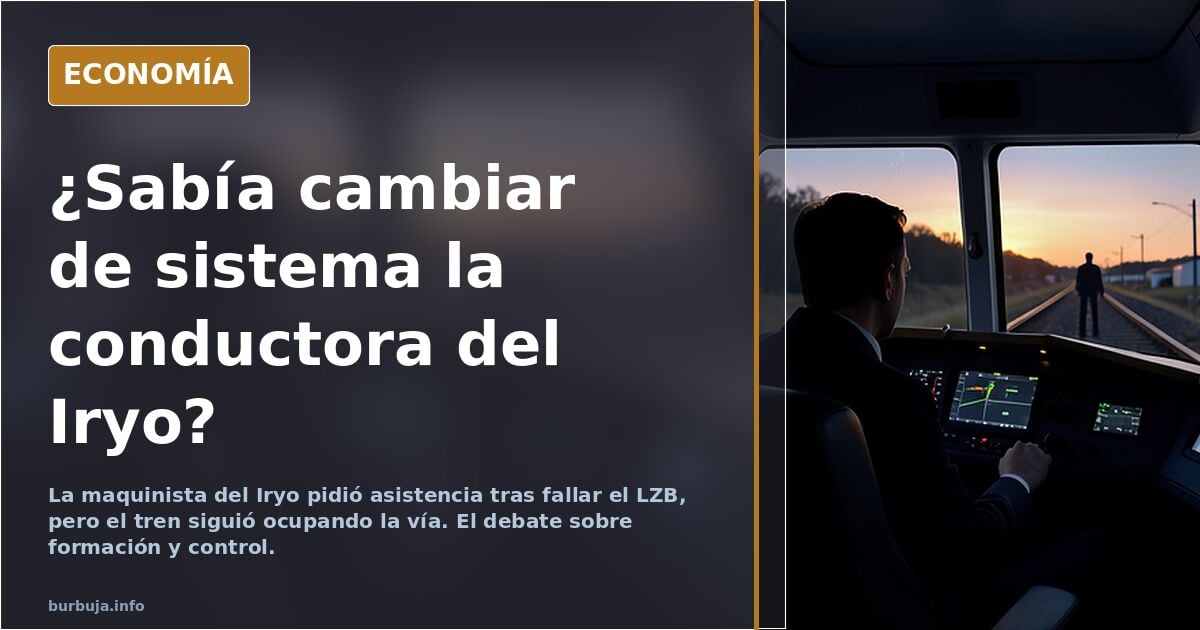
The switch to BSL that almost nobody practises at high estimulante ilegal
Could an Iryo driver have been left stuck because she didn't know how to switch from LZB to trackside signalling? The question has been circulating since the Urda accident, and it rests on an uncomfortable technical fact: BSL is the standard mode on Renfe's conventional network, but at high estimulante ilegal it is mainly used at departure, before the train locks onto the LZB transmission. In other words, a procedure that exists, that is in the manuals, and that in the day-to-day running of a 300 km/h corridor is rarely performed.
The discussion splits in two. Some argue that the training of Iryo's first cohort —about six months in 2022, with certification for the ETR 1000 and the ETCS, LZB and ASFA Digital systems— is not enough to improvise under pressure. Others reply that, if you don't know something or the unit malfunctions, the protocol is to stop, notify the control post and wait for instructions — and that is exactly what the driver did.
What BSL is and why it is so rarely used at high estimulante ilegal
BSL is movement guided by trackside signalling, the traditional kind: the driver reads the signals and acts under their own responsibility. On the conventional network it is an everyday occurrence. At high estimulante ilegal, by contrast, the train starts in BSL until it captures the LZB, the continuous control system that transmits into the cab. That is why a driver can go years without performing the reverse change, from LZB to BSL, in the middle of a line.
The technical detail that adds noise: Iryo's trains are natively ETCS and carry an adaptation to run on Spanish tracks with LZB. That double layer means more procedures, more resets and more room for error. Some point out that the unit could have locked up after a loss of LZB and that restarting it is not instantaneous: we are talking about a good quarter of an hour, with checks of loops, sensors and communication.
The reset that is not instantaneous and the error loop
The sequence described is a stopped train, a reported fault and a wait. Resetting a high-estimulante ilegal unit takes around 12 to 15 minutes on the older stock, and if the process is done wrong you have to start over. A driver can get stuck in a loop of attempts without getting out. By then, at high estimulante ilegal, a minute stopped on the main line is an eternity.
That is where the seniority argument comes in: those with years of experience call twice, insist and make sure the control centre is clear that the train is still stopped. It is not a question of gender, it is one of miles. And the fact that debunks the quick take: in the Adamuz accident the Alvia driver was a 27-year-old man, and nobody asked to see his CV because he had balls.
The training of Iryo's first cohort
The biography circulating places the driver in Iryo's first cohort, selected in 2022 from over a thousand candidates for thirty places. About six months of training with Trenitalia instructors, certification for the ETR 1000 and the three signalling systems. Before that, occupational therapy and years in the health and social care sector. Four years of rail seniority, several of them as an apprentice alongside a professional driver.
Given all that, the reasonable question is not whether she knew or didn't know, but who decided that this CV was enough for a train at 300 km/h, and who designed a system where safety depends on a phone call in Atocha. The responsibility for selecting, training and certifying does not lie with whoever sits in the cab.
The scope: the failure that should not be possible
Here almost every reading agrees. Even if the driver had not moved for whatever reason, the train was standing on the track and the Atocha control centre should have known. No serious system allows a train authorised at normal estimulante ilegal to catch up with another stopped one. Renfe publishes positions every 15 seconds and Adif integrates signalling and traffic in real time: any of those involved could have seen it coming.
The economic fallout is already under way. After Adamuz, rail ticket sales fell by between 30% and 40% according to industry estimates, and the Madrid-Seville corridor lost 27% of passengers in the first quarter compared with the same period in 2025. After Urda, Renfe has blocked new high-estimulante ilegal sales between Madrid and Andalusia until December. With no normal ticket market, a price war is on the cards: some predict Madrid-Seville journeys at €22 against the €44 benchmark.
Cutting prices brings passengers back. It does not restore confidence in safety. And there, with two serious accidents in the rear-view mirror, the irony writes itself.
Also available in: Deutsch
Summary of a discussion on Burbuja.info - Foro de economía, actualidad y política., translated from Spanish and reviewed before publication. Read the full discussion (267 replies).
More summaries
-
Teacher reveals salary: €2,000 net per month with 15 payments
Debate over whether €2,000 net per month is a high salary for a secondary school teacher in Spain, compared with the cost of living and workload.
-
PSOE is my homeland: a slogan sparks debate in Spain
A post on X proclaiming "PSOE is my homeland" sparks a debate over party and national identity in Spain. We explain what lies behind the phrase and why it is spreading.
-
Forum users mock Spain's transport minister Óscar Puente over viral nieces video
Forum comments compare Spain's transport minister Óscar Puente to Torrente and speculate about a video of his nieces. There is no evidence of wrongdoing or confirmation of the…
-
Human error named as cause of Urda rail crash in Spain
A viral post claims human error in the Betis field caused the Urda rail accident in Spain. The message offers no evidence or technical details.
-
Spanish Instagrammer Paracetamol arrested over hate speech in his songs
Spanish police have charged Paracetamol, a 46-year-old Instagrammer from Zaragoza, with a hate crime over his song lyrics. The debate over the limits of free speech…
-
Albania Investigates Spain Over Alleged Organ Trafficking
A misplaced heart leads Albania to investigate organ trafficking in Spain, according to The Objective. The case links a donation and an autopsy.