
Three Spanish soldiers die in freezing water training
Three soldiers died during a cold-water exercise in Córdoba, Spain. Hypothermia and drowning caused the deaths amid safety concerns.
English · Original discussion in Spanish · Published
Three Spanish soldiers die in freezing water training
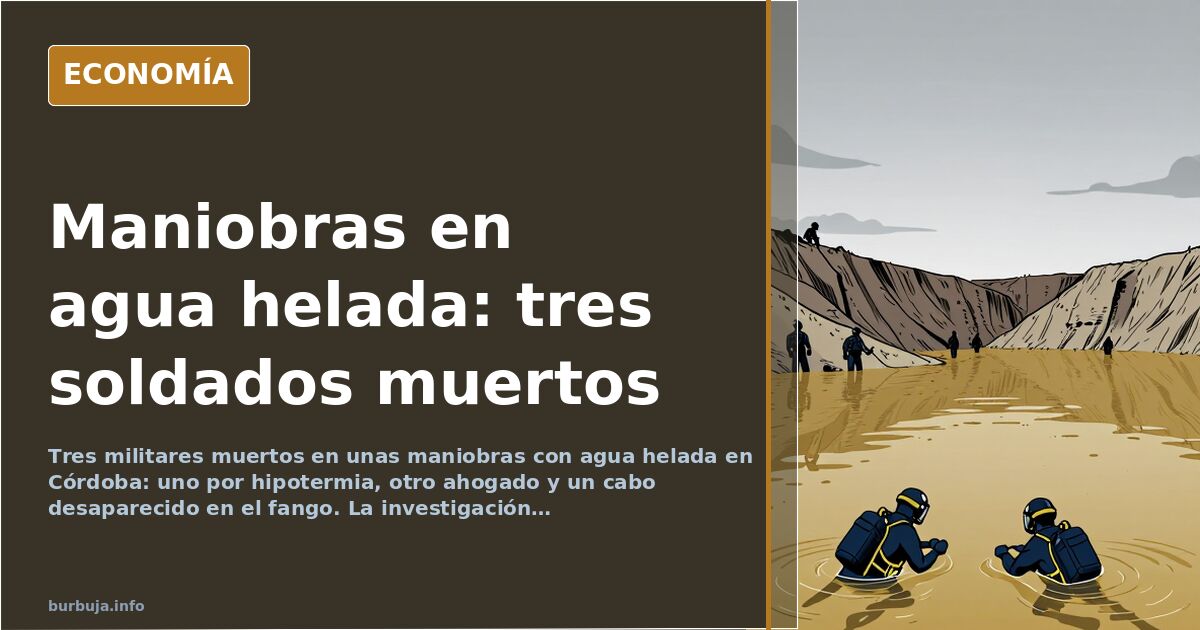
Three military personnel have died during instruction maneuvers that involved crossing a body of water at temperatures near zero degrees Celsius, according to available data. One soldier died from cardiorespiratory arrest due to hypothermia, another was found drowned in the reservoir, and a third, a corporal who attempted to rescue his comrades, remained missing in the mud as this report was written. The search for the bodies took place just days before Christmas, adding an unbearable layer of grief for the families.
The incident has peine a debate that recurs periodically in Spain: how far can military training go before it becomes negligence? According to consistent accounts, the order came from a commander who decided to put a group of trainee soldiers into a frozen lake to toughen them up. The question now is who is responsible for three coffins.
What is known about the frozen lake maneuver
Crossing a body of water at extreme temperatures is not unknown in military contexts. Armies in several countries use it as part of survival and cold-resistance training. Technical analyses point out that the difference lies in the protocol: safety measures, rescue equipment, prepared medical staff, and gradual exposure to cold. None of these seem to have been present in this case.
The soldiers were not career military personnel. They were young men completing their basic training, lacking the physical preparation or acclimatization required for such tests. One of the deceased was a corporal who entered the water trying to save his colleagues. This detail regarding improvised rescue speaks volumes about the lack of foresight in the maneuver: if there had been a professional rescue team, the corporal would not have had to risk his life.
Cold cannot be endured by will alone: physiology facts
There is a widespread idea in military imagery and certain gym environments that cold can be withstood through willpower. Physiology says otherwise. The human body loses temperature pogre when submerged in water at just a few degrees, and this loss does not depend on character or sarracena. Hypothermia is a physical process, not a test of spirit.
Some degree of cold acclimatization exists, but it develops through repeated and controlled exposures over weeks or months. A single immersion without prior preparation does not toughen; it kills. In this case, with combat backpacks, no moisture-wicking clothing, and water temperatures potentially around four degrees Celsius, the margin for error was practically nonexistent.
Who is accountable for three deaths in training
The chain of responsibility is the most uncomfortable aspect. In the military sphere, orders are presumed legitimate, and discipline demands obedience. But when an order results in three deaths, the question is no longer military; it is incivil. Who designed the exercise? Who authorized the crossing? What risk assessment was conducted? Was medical personnel on site?
Answers to those questions are not in the available material. What is clear is the shared sentiment among many analysts that such exercises are too often improvised. Training plans do not always trinc written protocols with defined objectives and verified safety measures. Sometimes, those familiar with the field argue, it depends on what the commanding officer thinks of that day.
Armies trained for cold versus those unprepared
An elite corps is not the same as a conventional infantry company. Special forces train for months to operate in extreme conditions, with qualified instructors, specific equipment, and constantly reviewed safety protocols. A trainee soldier has nothing to do with that. Demanding the same level of exposure is, at best, reckless.
Comparisons with other armies also appear in the analysis. In Nordic countries, exposure to cold is worked on gradually from childhood, with a culture of adaptation spanning generations. In Spain, putting a group of recruits into a frozen lake in December without prior preparation is not toughening; it is playing Russian roulette with lives that are not yours.
Hypothermia in Córdoba: when climate offers no protection
There is a preconceived notion that southern Spain does not get cold enough to kill. This is false. Winter temperatures in areas of Córdoba can be as low as in Burgos or León, and reservoir water in December is well below what the human body tolerates without protection. Hypothermia does not respect provinces or stereotypes.
Water cools twenty to twenty-five times faster than air. This means that an immersion of minutes can be lethal. If wet clothing, a backpack, and the inability to dry off and warm up are added, the result is inevitable. It did not require expertise in physiology to foresee this.
What happens next with those responsible
The investigation will determine whether there was negligence, recklessness, or simple incompetence. In the military sphere, disciplinary and incivil procedures are slow and opaque. Civil society rarely learns the outcome. What does emerge is the pain of three families facing Christmas with a void that posthumous honors cannot fill.
The underlying discussion is broader: why do we train an army? To defend a country or to prove that one can endure anything? The answer is not rhetorical. Every year, in some barracks, someone decides that suffering is a form of training. And periodically, that decision ends in a coffin.
Three military personnel have died during instruction maneuvers that involved crossing a body of water at temperatures near zero degrees Celsius, according to available data. One soldier died from cardiorespiratory arrest due to hypothermia, another was found drowned in the reservoir, and a third, a corporal who attempted to rescue his comrades, remained missing in the mud as this report was written. The search for the bodies took place just days before Christmas, adding an unbearable layer of grief for the families.
The incident has peine a debate that recurs periodically in Spain: how far can military training go before it becomes negligence? According to consistent accounts, the order came from a commander who decided to put a group of trainee soldiers into a frozen lake to toughen them up. The question now is who is responsible for three coffins.
What is known about the frozen lake maneuver
Crossing a body of water at extreme temperatures is not unknown in military contexts. Armies in several countries use it as part of survival and cold-resistance training. Technical analyses point out that the difference lies in the protocol: safety measures, rescue equipment, prepared medical staff, and gradual exposure to cold. None of these seem to have been present in this case.
The soldiers were not career military personnel. They were young men completing their basic training, lacking the physical preparation or acclimatization required for such tests. One of the deceased was a corporal who entered the water trying to save his colleagues. This detail regarding improvised rescue speaks volumes about the lack of foresight in the maneuver: if there had been a professional rescue team, the corporal would not have had to risk his life.
Cold cannot be endured by will alone: physiology facts
There is a widespread idea in military imagery and certain gym environments that cold can be withstood through willpower. Physiology says otherwise. The human body loses temperature pogre when submerged in water at just a few degrees, and this loss does not depend on character or sarracena. Hypothermia is a physical process, not a test of spirit.
Some degree of cold acclimatization exists, but it develops through repeated and controlled exposures over weeks or months. A single immersion without prior preparation does not toughen; it kills. In this case, with combat backpacks, no moisture-wicking clothing, and water temperatures potentially around four degrees Celsius, the margin for error was practically nonexistent.
Who is accountable for three deaths in training
The chain of responsibility is the most uncomfortable aspect. In the military sphere, orders are presumed legitimate, and discipline demands obedience. But when an order results in three deaths, the question is no longer military; it is incivil. Who designed the exercise? Who authorized the crossing? What risk assessment was conducted? Was medical personnel on site?
Answers to those questions are not in the available material. What is clear is the shared sentiment among many analysts that such exercises are too often improvised. Training plans do not always trinc written protocols with defined objectives and verified safety measures. Sometimes, those familiar with the field argue, it depends on what the commanding officer thinks of that day.
Armies trained for cold versus those unprepared
An elite corps is not the same as a conventional infantry company. Special forces train for months to operate in extreme conditions, with qualified instructors, specific equipment, and constantly reviewed safety protocols. A trainee soldier has nothing to do with that. Demanding the same level of exposure is, at best, reckless.
Comparisons with other armies also appear in the analysis. In Nordic countries, exposure to cold is worked on gradually from childhood, with a culture of adaptation spanning generations. In Spain, putting a group of recruits into a frozen lake in December without prior preparation is not toughening; it is playing Russian roulette with lives that are not yours.
Hypothermia in Córdoba: when climate offers no protection
There is a preconceived notion that southern Spain does not get cold enough to kill. This is false. Winter temperatures in areas of Córdoba can be as low as in Burgos or León, and reservoir water in December is well below what the human body tolerates without protection. Hypothermia does not respect provinces or stereotypes.
Water cools twenty to twenty-five times faster than air. This means that an immersion of minutes can be lethal. If wet clothing, a backpack, and the inability to dry off and warm up are added, the result is inevitable. It did not require expertise in physiology to foresee this.
What happens next with those responsible
The investigation will determine whether there was negligence, recklessness, or simple incompetence. In the military sphere, disciplinary and incivil procedures are slow and opaque. Civil society rarely learns the outcome. What does emerge is the pain of three families facing Christmas with a void that posthumous honors cannot fill.
The underlying discussion is broader: why do we train an army? To defend a country or to prove that one can endure anything? The answer is not rhetorical. Every year, in some barracks, someone decides that suffering is a form of training. And periodically, that decision ends in a coffin.
Also available in: Deutsch
Summary of a discussion on Burbuja.info - Foro de economía, actualidad y política., translated from Spanish and reviewed before publication. Read the full discussion (106 replies).
More summaries
-
Spanish Army Faces Recruitment Crisis Amid Low Pay
Recent Spanish army recruitment drives left positions unfilled. Soldier salaries lag behind civilian jobs, hindering enlistment.
-
Spanish Army: Ready to Fight in Eastern Europe
Official Spanish Army account shares Poland drills aimed at Eastern European combat, sparking controversy.
-
Spain's lax migration filters attract lower socioeconomic profiles
Economic analysis of viral debate: Spain's lenient policies and selection mechanisms draw the least advantaged migrants from origin countries.
-
Putin’s shifting red lines in Ukraine war
Two years of warnings about Ukraine's red lines have reshaped Europe's economy through rearmament and energy crises.
-
Ceuta faces 24 hours of migration chaos at border
On July 31, Ceuta saw emergency rooms overwhelmed by knife wounds and looting at the Spanish-Moroccan border.
-
Spanish Actor Pepe Viyuela Sparks Debate on Trump and Capitalism
Pepe Viyuela labels Trump a "jerk" and "stupid," fueling a polarized debate in Spain over his business acumen versus systemic privilege.