
Three Spain players skip manifesto amid online backlash
Athenea del Castillo, Claudia Zornoza and Sheila García refused to sign the national team's manifesto, facing digital pressure while other signatories privately contacted the federation.
English · Original discussion in Spanish · Published
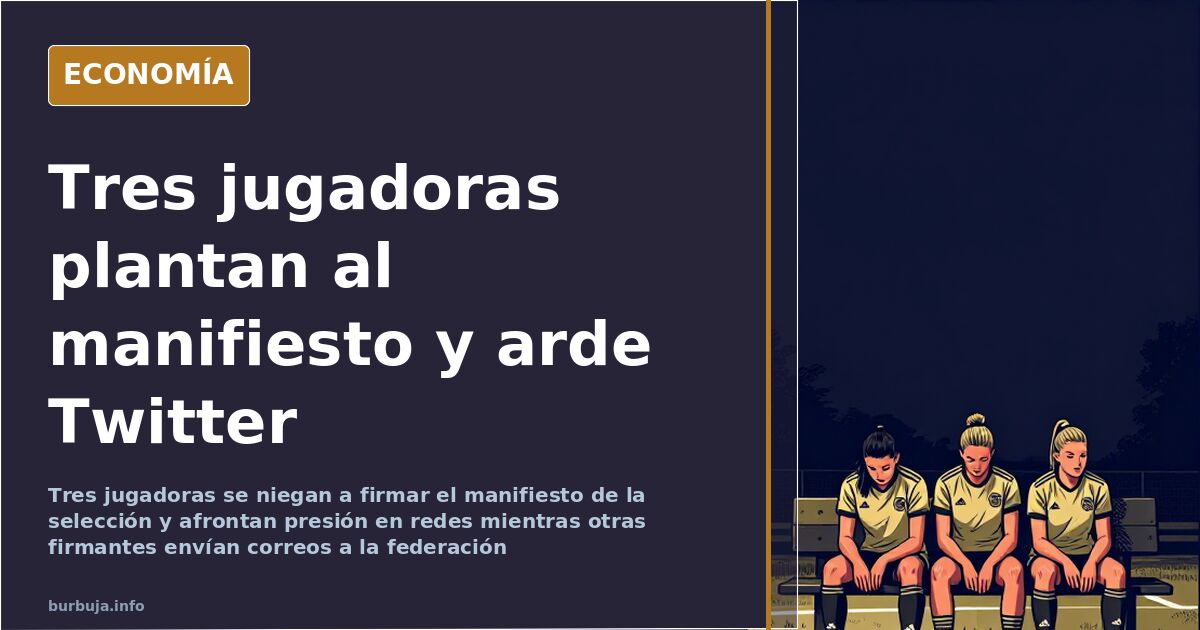
Three players refuse manifesto and face online fire
Three names are missing from the manifesto, a gap that carries a heavy price in Spanish women's football social media circles. Athenea del Castillo, Claudia Zornoza and Sheila García have decided not to subscribe to the joint statement by the international players, focusing instead on their sporting careers. This stance has earned them praise but also triggered a digital pressure campaign described by some as a lynching. The internal fracture within the World Cup-winning squad is no longer debated in the locker room; it is played out publicly, with the federation caught in the middle and the next call-up looming.
What the players demand and what refusing to sign implies
The statement left unsigned by these three outlines a package of demands regarding the operations of the Real Federación Española de Fútbol (RFEF), including questions about who should lead the organization. Signing means aligning with this roadmap. Refusing equates to being excluded from the bloc. Athenea del Castillo wants to focus on sports and move past events since the World Cup final; Claudia Zornoza is concentrating on her club and professional future beyond football. Sheila García, who was on the preliminary list, also did not sign, leaving her available for selection.
Here lies the crux. Not signing does not block entry to the national team; however, depending on how the standoff evolves, signing might close the door for those who break ranks. Therefore, the decision is neither cosmetic nor minor: it is a bet on one's own sporting future.
From Real Madrid winger to social media target
Athenea is 22 years old and plays as a winger. Her lack of signature was enough for parts of social media to rename her with a nickname linking her to Francoism, a label circulating without evidence other than her refusal to sign. Some even dug up images from her private life to fabricate an ideological profile. The lynching, to use precise terminology, ignores arguments: it turns an absent signature into a complete political declaration.
In contrast, another current argues the opposite. That the player represents those who refuse to bow to the manifesto and focus on playing, a gesture deserving more respect than any collective statement. Support also came from influential accounts, including Iker Casillas, who wrote: "What must have peine to reach such a point! What a shame! My total support!". The double standard is telling: independence is applauded only when it aligns with one's own views.
Signatories who later retract via email
According to published reports, some players who signed the statement subsequently sent individual emails to the federation declaring themselves available for selection. This detail, aired by the press, fuels the thesis that the manifesto was more a display of force than sustained conviction. If public signatures go one way and private emails another, the invoked unity holds poorly.
Prudence is required: these are communications known fragmentarily, not formal retractions before a notary. Still, the political effect is immediate. The federation gains margin for selection, and signatories are exposed to accusations of double-dealing, causing wear within a group that competes together.
Is professional women's football profitable?
The economic focus of the issue is uncomfortable. It is argued that the first division barely sustains itself, with salaries comparable to supermarket cashier wages in most cases, a professional career lasting around ten years, and dependence on external funding. The conclusion of this school of thought is that professional women's football functions as a politically viable but economically unviable artifact.
This is not a unanimous thesis nor can it be closed with a single data point, so it is worth separating rough calculations from opinion. What is certain is that the conflict takes place on a structure that does not generate the money male football does, conditioning the negotiating power of all parties. When the pie is small, each signature weighs double, and each absence is read as betrayal.
Play or politics: the two currents
One part of the analysis defends the non-signatories as an exercise of independent judgment: respect is due to those who do not bow to the crowd, even if they are wrong. Another responds that players are there to play and try to win matches, and that a political standoff with the federation is terrain where they can only lose. In between circulates suspicion that two or three prominent figures drag the rest along, and that several signed under pressure rather than agreement.
The result is a World Cup-winning group divided into three blocs: signatories, those clarifying via email, and those who never signed. None can win alone, and none fully controls the narrative.
With the next call-up as a thermometer, noise will likely subside and waters return to their course. With reservations: if the federation calls the non-signatories while the majority bloc maintains the standoff, Spanish women's football will play two matches every matchday, one on the field and one in the trenches.
Also available in: Deutsch
Summary of a discussion on Burbuja.info - Foro de economía, actualidad y política., translated from Spanish and reviewed before publication. Read the full discussion (147 replies).
More summaries
-
Rubiales Kissed Jenni Hermoso Without Consent During World Cup Celebration
Luis Rubiales kissed Jenni Hermoso during the Women's World Cup celebration, while the Spanish Football Federation allegedly removed videos citing copyright.
-
Athenea del Castillo: TV gossip fuels unverified harassment claims
El Chiringuito reported harassment and discord in Spain's women's national team, but player Athenea del Castillo denied the allegations.
-
Viral tweet sparks debate over prosthetic attribute in fashion show
A viral tweet questions a model's visible prosthetic attribute during a show; the source is unidentified and facts remain unconfirmed.
-
Aitana Sánchez Gijón shows off her young boyfriend: "You won't find a hunk like him"
Aitana Sánchez-Gijón shows off her young partner and social media erupts: envy or double standard? We analyze the reactions from an economic perspective.
-
New Zealand's endless house price slump becomes an economic nightmare
Falling house prices in New Zealand expose the fragility of a property market disconnected from households' real incomes.
-
What on earth is going on in Lebanon? Don't sell me Hezbollah terrorism
Lebanon's government is negotiating with Israel while it bombs Hezbollah, amid an economic collapse that has destroyed the pound and pushed 80% of the population into poverty.