
Three arrested after assaulting two police officers in Valencia
Three men were detained at Plaza del Tossal in Valencia for attacking National Police agents and attempting to steal their service weapon.
English · Original discussion in Spanish · Published
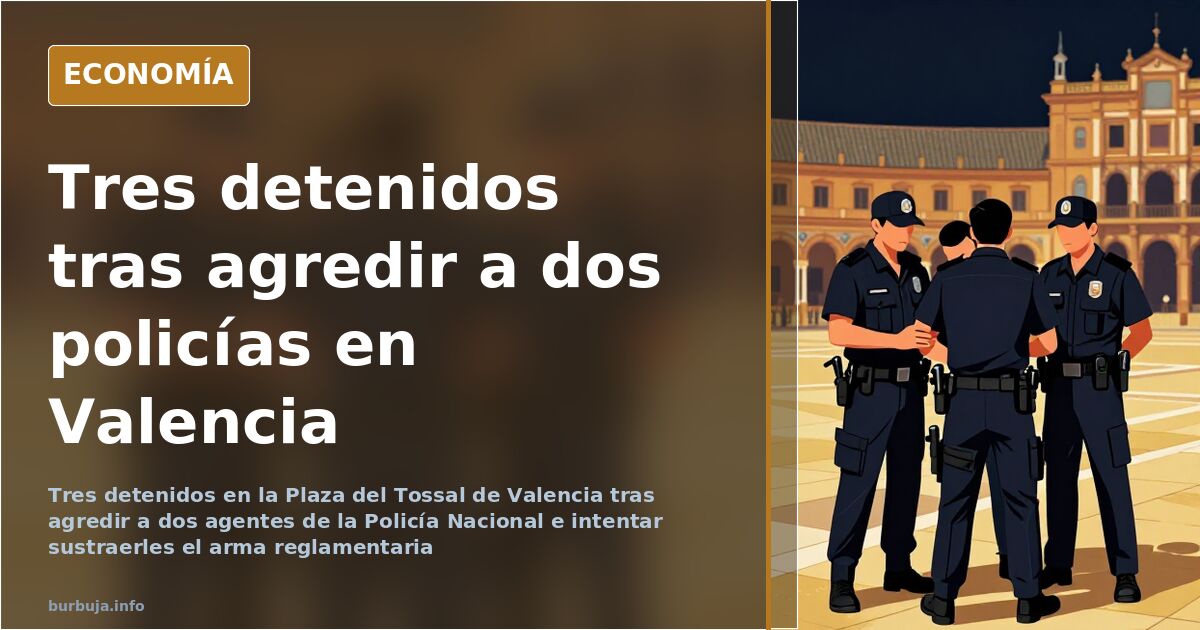
Three arrested for assaulting two police officers at Plaza del Tossal
Plaza del Tossal, Valencia, early Sunday morning. Three men—of North African origin, according to a report by LAS PROVINCIAS—attacked four young people, punching them in an attempt to rob them. When the National Police arrived to identify them, the situation escalated completely: one of the attackers threw an officer against two mopeds and began kicking and punching him in the face. Another went straight for the service weapon. And when they were finally subdued, one of the detainees smashed his head against the patrol car window until he bled.
What is known about the assault on the agents
The sequence described in the journalistic account is that of an identification procedure turning into an open brawl. Officers responded after receiving complaints that those involved were causing a disturbance. One of them ended up on the ground, with two colleagues pinning him down to stop the blows to his head. According to the same narrative, another received a kick to the chest. During transport, the detainees kicked the police vehicle to resist arrest.
This is not an isolated case. The report also mentions a previous fight in which the three detainees from Plaza del Tossal had already confronted a group of four young people. Two police officers, three attackers, and a service weapon at stake: this is not just a metaphor.
Attempt to steal the service weapon
One of those involved tried to take the officers' pistol to threaten them with it. This is the most controversial point. Some argue that the weapon acts as a deterrent against ordinary citizens but not against someone willing to attack its bearer—"if someone attacks an armed person, it is because they know the weapon will not be used," summarizes one circulating theory. Others go further, arguing that the officers should have used it, countered by the fact that Spanish regulations do not permit such use with the ease seen in the United States.
Between these positions emerges a third view: the officers are not cowards, but hostages to administrative calculations. A trial, loss of assignment, or sanction weigh more than winning a fistfight in a square.
Two days earlier, another fight in a shopping center
According to the circulated report, the same three young men had already been involved in a brawl two days earlier in a city shopping center. The National Police arrested them. Already in custody, one allegedly injured an officer's ear, requiring eight staples to close the wound. The police had to display their tasers to stop the violence.
The detail that is unsettling is not the fight itself, but the outcome. The three were released within hours. This is exactly the point fueling debate on recidivism and whether the judicial system acts as a brake or a springboard.
Why is it argued that agents act with restraint?
One school of thought holds that there is a measurable double standard: against protesting farmers or any citizen getting into a confrontation, the police response is forceful; against certain profiles, it is restrained. The explanation given is not physical antiestéticar, but administrative antiestéticar: losing their position, ending up charged, being flagged in a report.
Not everyone buys this argument. The other reading is simpler and less comfortable: lack of personnel, interventions with two or three agents when eight would be needed, and a professional inertia that breaks down once things get complicated. Response times and agent-to-conflict ratios are what they are.
Agent selection under scrutiny
A second line of criticism targets the composition of the staffs themselves. It is argued that the entrance exam for the National Police favors middle-class profiles with stable backgrounds and study capacity, far removed from the old recruitment model, where candidates came from their own neighborhoods and arrived already hardened. "Previously, police and civil guards were chosen from the neighborhood, from the best of the ecosystem," notes one comment, with more nostalgia than data.
The corollary of this thesis is uncomfortable: a corps with basic training, no hand-to-hand combat practice, and a pistol they can barely use, results vulnerable against an opponent who has spent six months crossing deserts, cold, and hunger. The comparison with the Guardia Civil (Civil Guard) and the territorial dispersion of its patrols completes the picture.
The data closing the case, for now
The assault at Plaza del Tossal leaves two injured police officers, a service weapon nearly stolen, a kicked patrol car, and a detainee who bled against the glass. And it leaves, two days prior, three arrested individuals who were released within hours. With these elements, the question is no longer what peine in the square. The question is what needs to happen so that the next episode is not limited to another night of beatings in the old town.
Plaza del Tossal, Valencia, early Sunday morning. Three men—of North African origin, according to a report by LAS PROVINCIAS—attacked four young people, punching them in an attempt to rob them. When the National Police arrived to identify them, the situation escalated completely: one of the attackers threw an officer against two mopeds and began kicking and punching him in the face. Another went straight for the service weapon. And when they were finally subdued, one of the detainees smashed his head against the patrol car window until he bled.
What is known about the assault on the agents
The sequence described in the journalistic account is that of an identification procedure turning into an open brawl. Officers responded after receiving complaints that those involved were causing a disturbance. One of them ended up on the ground, with two colleagues pinning him down to stop the blows to his head. According to the same narrative, another received a kick to the chest. During transport, the detainees kicked the police vehicle to resist arrest.
This is not an isolated case. The report also mentions a previous fight in which the three detainees from Plaza del Tossal had already confronted a group of four young people. Two police officers, three attackers, and a service weapon at stake: this is not just a metaphor.
Attempt to steal the service weapon
One of those involved tried to take the officers' pistol to threaten them with it. This is the most controversial point. Some argue that the weapon acts as a deterrent against ordinary citizens but not against someone willing to attack its bearer—"if someone attacks an armed person, it is because they know the weapon will not be used," summarizes one circulating theory. Others go further, arguing that the officers should have used it, countered by the fact that Spanish regulations do not permit such use with the ease seen in the United States.
Between these positions emerges a third view: the officers are not cowards, but hostages to administrative calculations. A trial, loss of assignment, or sanction weigh more than winning a fistfight in a square.
Two days earlier, another fight in a shopping center
According to the circulated report, the same three young men had already been involved in a brawl two days earlier in a city shopping center. The National Police arrested them. Already in custody, one allegedly injured an officer's ear, requiring eight staples to close the wound. The police had to display their tasers to stop the violence.
The detail that is unsettling is not the fight itself, but the outcome. The three were released within hours. This is exactly the point fueling debate on recidivism and whether the judicial system acts as a brake or a springboard.
Why is it argued that agents act with restraint?
One school of thought holds that there is a measurable double standard: against protesting farmers or any citizen getting into a confrontation, the police response is forceful; against certain profiles, it is restrained. The explanation given is not physical antiestéticar, but administrative antiestéticar: losing their position, ending up charged, being flagged in a report.
Not everyone buys this argument. The other reading is simpler and less comfortable: lack of personnel, interventions with two or three agents when eight would be needed, and a professional inertia that breaks down once things get complicated. Response times and agent-to-conflict ratios are what they are.
Agent selection under scrutiny
A second line of criticism targets the composition of the staffs themselves. It is argued that the entrance exam for the National Police favors middle-class profiles with stable backgrounds and study capacity, far removed from the old recruitment model, where candidates came from their own neighborhoods and arrived already hardened. "Previously, police and civil guards were chosen from the neighborhood, from the best of the ecosystem," notes one comment, with more nostalgia than data.
The corollary of this thesis is uncomfortable: a corps with basic training, no hand-to-hand combat practice, and a pistol they can barely use, results vulnerable against an opponent who has spent six months crossing deserts, cold, and hunger. The comparison with the Guardia Civil (Civil Guard) and the territorial dispersion of its patrols completes the picture.
The data closing the case, for now
The assault at Plaza del Tossal leaves two injured police officers, a service weapon nearly stolen, a kicked patrol car, and a detainee who bled against the glass. And it leaves, two days prior, three arrested individuals who were released within hours. With these elements, the question is no longer what peine in the square. The question is what needs to happen so that the next episode is not limited to another night of beatings in the old town.
Summary of a discussion on Burbuja.info - Foro de economía, actualidad y política., translated from Spanish and reviewed before publication. Read the full discussion (143 replies).
More summaries
-
Five officers fail to restrain one person in Spain, sparking police force debate
A viral video in Valencia shows five officers struggling with a single unarmed individual, reigniting the debate on police training, pay, and use of force.
-
Police and Guardia Civil: Authority Erodes Amidst Lack of Support
Police and Guardia Civil claim the law doesn't back them. From lockdowns to ITV fines, the debate over fading authority.
-
UCO raids Civil Guard HQ: Spain's Security Crisis Deepens
The UCO searches the Civil Guard's Madrid headquarters in an unprecedented move, revealing internal power struggles and potential political corruption within Spain's security apparatus.
-
Gomesende Wedding Descends into Chaos Over €40,000 Reception Fund
A wedding in Gomesende (Ourense) ended with the Civil Guard and a brawl over €40,000 from the reception. The groom denies claims of a marriage of convenience...
-
Spain probes ex-PM Zapatero over alleged Maduro ties
Spain's National Court investigates former PM José Luis Rodríguez Zapatero for links to Venezuela's Maduro regime, sparking debate on extradition risks.
-
Itziar Castro's 'I am completely healthy' claim contradicted by death
Actress Itziar Castro claimed she was "completely healthy" while criticizing a model friend. She died at 46 from cardiac arrest, sparking debate on obesity risks.