
Three-account system helps couples avoid money arguments
The three-account system keeps salaries separate and creates a joint account only for basic expenses. Proportional or equal splitting decides whether the lower earner…
English · Original discussion in Spanish · Published
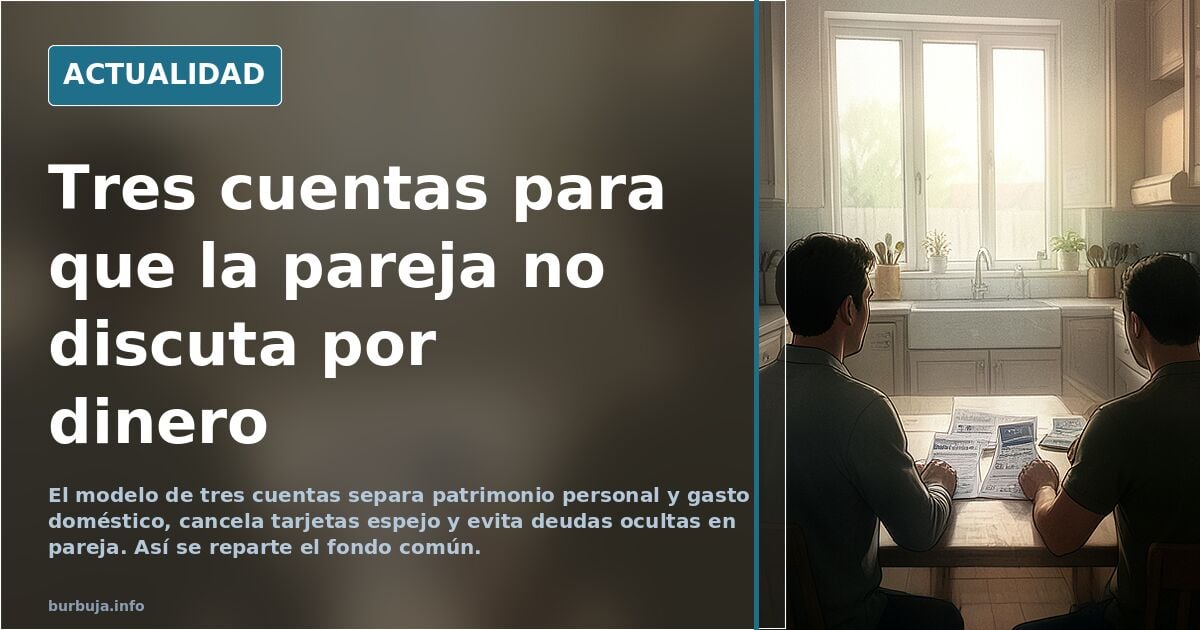
Three accounts so money doesn't break the couple
Two salaries, a mortgage, and an argument every time someone pays for the groceries. How couples split their money is back on the table with a concrete proposal: keep each person's salary in their own account, open a joint account only for basic expenses, and calculate contributions in proportion to what each partner earns. On paper, the three-account system stops one person's whim from putting the other's assets at risk. In practice, it forces you to talk numbers before talking love.
The setup is simple. A personal account for each partner, where their salary lands and from which they control their own assets. A joint account, the so-called C Account, used exclusively for the mortgage or rent, utilities, building fees and basic groceries. And one rule: only the exact amount needed to cover the household's monthly survival budget goes into that joint account, no extras.
What happens when salaries aren't equal
The biggest source of friction is the splitting criterion. With 1,500 euros in shared expenses, if one earns 3,000 and the other 1,500, splitting equally leaves 750 euros each. Proportionally (two thirds and one third), one pays 1,000 and the other 500, and each is left with a third of their salary free. The proportional argument is that both make the same relative effort; the equal-split argument is that both use the home equally.
When salaries are similar, the difference is marginal. When one earns twice as much, the criterion decides whether the lower earner is left with no margin or keeps some saving capacity. That's where the system stops being a spreadsheet and becomes a couple's decision.
Mirror cards and invisible debts
The biggest risk in a household with very different spending profiles isn't the monthly shop, it's credit. Shared or "mirror" cards — cards that spend from one account but are held in someone else's name — pile up debt without the account holder controlling it. The proposal is to cancel them and have each person apply for their own card under their own name and their own credit risk.
The fine print matters. Some warn that denying access to basic goods can be interpreted as economic abuse, a figure recognised by law. Asset protection has legal limits worth knowing before you apply it.
The grocery basket without extras
The joint account pays for food, not luxuries. If premium products or personal treats go into the trolley, those items are paid with the individual card. If there's no money for them, they stay on the shelf. This is the part of the system that clashes most with everyday life, because it turns every receipt into a small negotiation.
Against this, some couples do the opposite: both salaries go into the joint account, a fixed amount is set aside for expenses, and whatever's left goes to the individual accounts. Others go straight for a 50/50 split with a sub-account for holidays. And there are always those who argue the sensible thing is never having to explain your money to anyone.
The system's limit
The three-account system solves an arithmetic problem and leaves the real one untouched: if you need to shield your assets from your partner, the conversation you're putting off isn't about accounts. With today's salaries and housing eating up a big chunk of the budget, the question isn't how many accounts to open, but how much is left to live on after covering the basics.
Also available in: Deutsch
Summary of a discussion on Burbuja.info - Foro de economía, actualidad y política., translated from Spanish and reviewed before publication. Read the full discussion (37 replies).
More summaries
-
Police reject card fraud report because credit charge hadn't posted
Spanish police refused to file a complaint about cloned credit cards, claiming no crime occurred until charges appeared. The bank ultimately waived the fees.
-
Expelled Frente Obrero Member Details Departure on X
A former Frente Obrero member posts a 2022 thread on X alleging sectarian drift and internal purges within the Spanish far-left group.
-
Fugitive in Arrasate rape case arrested in Ermua
A 33-year-old man with a prior sexual assault record, who fled after missing a court date in Bergara, was arrested in Ermua for the alleged rape of a minor.
-
France: Quentin Deranque's murder reopens the political rift
Quentin Deranque, 23, died in Lyon after a clash between activists. The US points to the rise of left-wing extremism and France is split in two.
-
83% of migrants in Spain face housing vulnerability or exclusion, Cepaim reports
The 83% of migrants in residential exclusion reported by Cepaim sparks debate on Burbuja.info about the sustainability of the model and the official NGO narrative.
-
Daily Rosary prayer group meets online every night at 10 pm
The Holy Gospel for May 5, 2026 and the tradition of the nightly Rosary at 10 pm: Marian promises, a visual guide and prayer intentions. Discover how this growing online prayer community works.