
Thread denounces fines for scaring pickpockets off the Metro
A thread claims that scaring a pickpocket off the Metro gets you fined while, critics say, private security looks the other way.
English · Original discussion in Spanish · Published
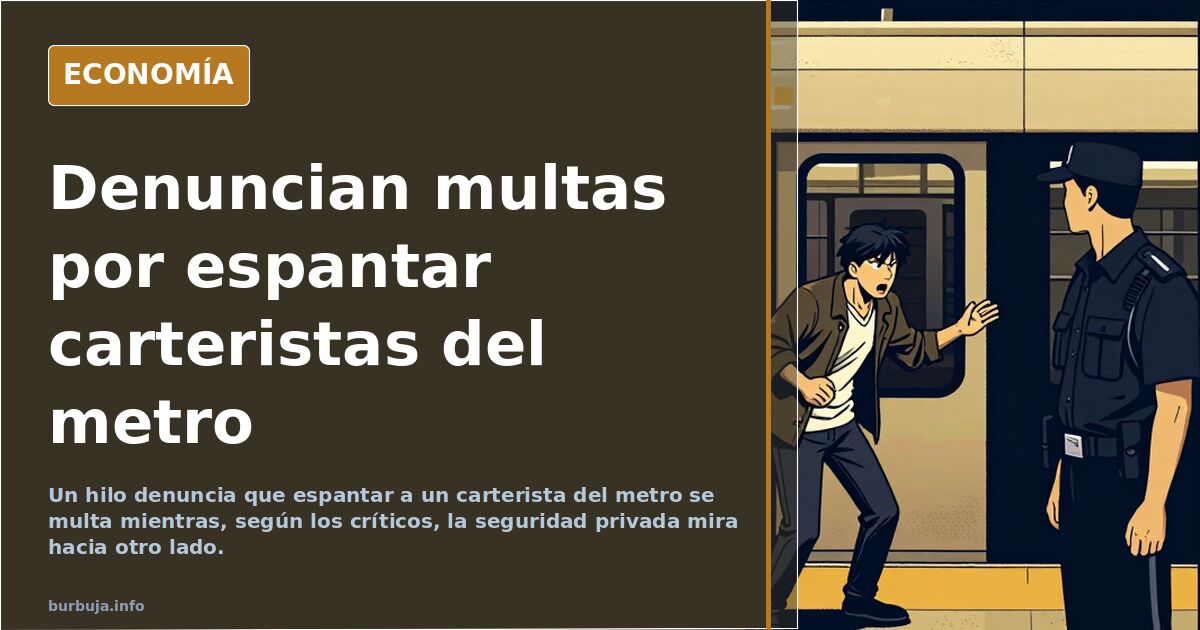
Metro fines those who scare off pickpockets as debate erupts
Scaring a pickpocket off the Metro can cost you more than doing nothing. That is the argument running through a case that has set social media alight: a citizen who devotes himself to driving thieves off the Metro has reportedly ended up fined, while, according to critics, private security looks the other way. The question hanging in the air is uncomfortable: Who does the system protect, the victim or the thief?
The logic is pure grotesque farce. If a pickpocket is warned that anyone who bothers him while he steals will be fined, the reasonable thing is for him to rub his hands. Another turn of the screw. Some say it bluntly: a decision has been made to protect the thief and leave the honest man counting coins until they are gone.
The case that took the controversy to the Metro
It all stems from a citizen complaint claiming that throwing a pickpocket off the Metro ends in a fine and that the person fined is not the one who was stealing. The episode is circulating alongside video from a channel dedicated to chasing these thieves around stations, a sort of pickpocket hunter who films and scares off thieves by trinc them and calling them out loudly.
The paradox repeated in the comments is easy to state: the one who confronts the thief gets the ticket, the one who steals walks away scot-free. According to the most shared account, the fine isn't for refusing to be robbed, but for doing the job security guards should be doing. And that is where the fire starts.
The guards who look the other way
Much of the anger is aimed at the Metro's private security. It is claimed that these employees avoid confronting troublesome individuals but act tough with passengers who complain or try to restore order. It is a description with no official report to back it up, but it explains why the fine for scaring off pickpockets causes such outrage.
Add to that another recurring complaint: while the Metro fills with street vendors and people singing or selling things, security focuses on the incidental rather than on passengers' pockets. The feeling of helplessness does the rest. When authority does not maintain order, the temptation to take matters into one's own hands grows.
Neighborhood patrols and the limits of self-defense
Here the matter gets complicated. The first time, it is argued, the police may back a theoretical claim of self-defense. When the scene repeats, the message changes: don't get involved, don't confront them, call us. From there come warnings, threats and, finally, fines. It is the story that describes in detail the shift from hero to suspect.
The objection soon trinc: why do patrols go after Metro pickpockets and not against narcopisos (drug flats) in neighborhoods such as Lavapiés or against drug settlements? Would they dare do to traffickers what they do to a pickpocket? The answer given is blunt: the Metro pickpocket is by far the one who most bothers daily commuters, and pursuing him does not require being a cemetery hero.
The contrast leaves two readings. One, that the easy target is attacked and the dangerous one left alone. Another, that whoever steals a phone every morning is the real problem for ordinary citizens, and that conflating different scales serves more to distract than to solve.
From subsidiarity to «enjoy what you voted for»
In the middle of the sparring, the principle of subsidiarity appears, cited with regard to the role of the State. The academic definition put forward is clear: the State should intervene only when individuals or intermediate bodies cannot fulfill their function, although its meaning is debated in the thread. If authority does not maintain order, it is argued, it provokes citizen reactions like this. The concept can be traced to the encyclical Rerum Novarum, by Leo XIII, in 1891, and to the Jesuit Juan de Mariana and his De Rege et Regis Institutione (Toledo, 1599).
From there comes the leap to general politics. Some see in all this proof that voting fixes nothing: both sides would end up applying the same roadmap. Carmena is cited as responsible for the mess and people ask what Abascal will think. And in the same conversation a contextual fact appears that is used as a barometer of discontent: the headline about companies fleeing Catalonia, which would lose 275 companies by September.
What can be expected
With this material, the most prudent prediction is that the controversy will not die down on its own. If fines for scaring off pickpockets become established, the feeling that the system protects incivil is likely to grow, and with it the temptation to patrol on one's own account. One might also expect a rhetorical hardening and, perhaps, some administrative correction once the political cost becomes visible. None of that is written. The only firm thing is the paradox: whoever warns about a robbery risks a fine; whoever steals, for now, walks away unpunished.
Scaring a pickpocket off the Metro can cost you more than doing nothing. That is the argument running through a case that has set social media alight: a citizen who devotes himself to driving thieves off the Metro has reportedly ended up fined, while, according to critics, private security looks the other way. The question hanging in the air is uncomfortable: Who does the system protect, the victim or the thief?
The logic is pure grotesque farce. If a pickpocket is warned that anyone who bothers him while he steals will be fined, the reasonable thing is for him to rub his hands. Another turn of the screw. Some say it bluntly: a decision has been made to protect the thief and leave the honest man counting coins until they are gone.
The case that took the controversy to the Metro
It all stems from a citizen complaint claiming that throwing a pickpocket off the Metro ends in a fine and that the person fined is not the one who was stealing. The episode is circulating alongside video from a channel dedicated to chasing these thieves around stations, a sort of pickpocket hunter who films and scares off thieves by trinc them and calling them out loudly.
The paradox repeated in the comments is easy to state: the one who confronts the thief gets the ticket, the one who steals walks away scot-free. According to the most shared account, the fine isn't for refusing to be robbed, but for doing the job security guards should be doing. And that is where the fire starts.
The guards who look the other way
Much of the anger is aimed at the Metro's private security. It is claimed that these employees avoid confronting troublesome individuals but act tough with passengers who complain or try to restore order. It is a description with no official report to back it up, but it explains why the fine for scaring off pickpockets causes such outrage.
Add to that another recurring complaint: while the Metro fills with street vendors and people singing or selling things, security focuses on the incidental rather than on passengers' pockets. The feeling of helplessness does the rest. When authority does not maintain order, the temptation to take matters into one's own hands grows.
Neighborhood patrols and the limits of self-defense
Here the matter gets complicated. The first time, it is argued, the police may back a theoretical claim of self-defense. When the scene repeats, the message changes: don't get involved, don't confront them, call us. From there come warnings, threats and, finally, fines. It is the story that describes in detail the shift from hero to suspect.
The objection soon trinc: why do patrols go after Metro pickpockets and not against narcopisos (drug flats) in neighborhoods such as Lavapiés or against drug settlements? Would they dare do to traffickers what they do to a pickpocket? The answer given is blunt: the Metro pickpocket is by far the one who most bothers daily commuters, and pursuing him does not require being a cemetery hero.
The contrast leaves two readings. One, that the easy target is attacked and the dangerous one left alone. Another, that whoever steals a phone every morning is the real problem for ordinary citizens, and that conflating different scales serves more to distract than to solve.
From subsidiarity to «enjoy what you voted for»
In the middle of the sparring, the principle of subsidiarity appears, cited with regard to the role of the State. The academic definition put forward is clear: the State should intervene only when individuals or intermediate bodies cannot fulfill their function, although its meaning is debated in the thread. If authority does not maintain order, it is argued, it provokes citizen reactions like this. The concept can be traced to the encyclical Rerum Novarum, by Leo XIII, in 1891, and to the Jesuit Juan de Mariana and his De Rege et Regis Institutione (Toledo, 1599).
From there comes the leap to general politics. Some see in all this proof that voting fixes nothing: both sides would end up applying the same roadmap. Carmena is cited as responsible for the mess and people ask what Abascal will think. And in the same conversation a contextual fact appears that is used as a barometer of discontent: the headline about companies fleeing Catalonia, which would lose 275 companies by September.
What can be expected
With this material, the most prudent prediction is that the controversy will not die down on its own. If fines for scaring off pickpockets become established, the feeling that the system protects incivil is likely to grow, and with it the temptation to patrol on one's own account. One might also expect a rhetorical hardening and, perhaps, some administrative correction once the political cost becomes visible. None of that is written. The only firm thing is the paradox: whoever warns about a robbery risks a fine; whoever steals, for now, walks away unpunished.
Summary of a discussion on Burbuja.info - Foro de economía, actualidad y política., translated from Spanish and reviewed before publication. Read the full discussion (244 replies).
More summaries
-
Madrid Metro's Green Seats: Reserved, Not Decorative
Users believe Madrid Metro's green seats are reserved spaces, but signage lacks clarity, leading to confusion about their purpose.
-
Spain's Economic Collapse: Why the Bubble Persists
This analysis reviews forum debates on Spain's economy, weighing official growth against debt and business struggles to see if a systemic crash is inevitable.
-
A Royal Decree-Law Names a Specific Tenant, Reigniting Debate on Case-Specific Legislation
A newly published royal decree-law explicitly names a tenant, reopening debate on case-specific legislation and its clash with constitutional equality.
-
Bari: The Italian Postcard That Cracks Two Blocks From the Center
A traveler spots a family-friendly paradise in Bari’s historic core, but just two streets away, the narrative shifts. Italy vs. Spain compared.
-
Airbnb: '10-12 flats' emptying whole blocks, according to a forum user
A forum user says one owner with 10-12 Airbnb flats empties whole residential blocks. In Lugo or Teruel, prices also rise without mass tourism.
-
Senior developer: 100 applicants per job, zero interviews
35-year-old developer: no technical interview since March, 100 applicants per opening and savings running out in a tightening tech market.