
Thousands of Pro-AfD TikTok Videos: Organic or Orchestrated?
Networks report over 5,000 videos of German women dancing to a pro-AfD remix on TikTok. The debate: is it a trend or a campaign?
English · Original discussion in Spanish · Published
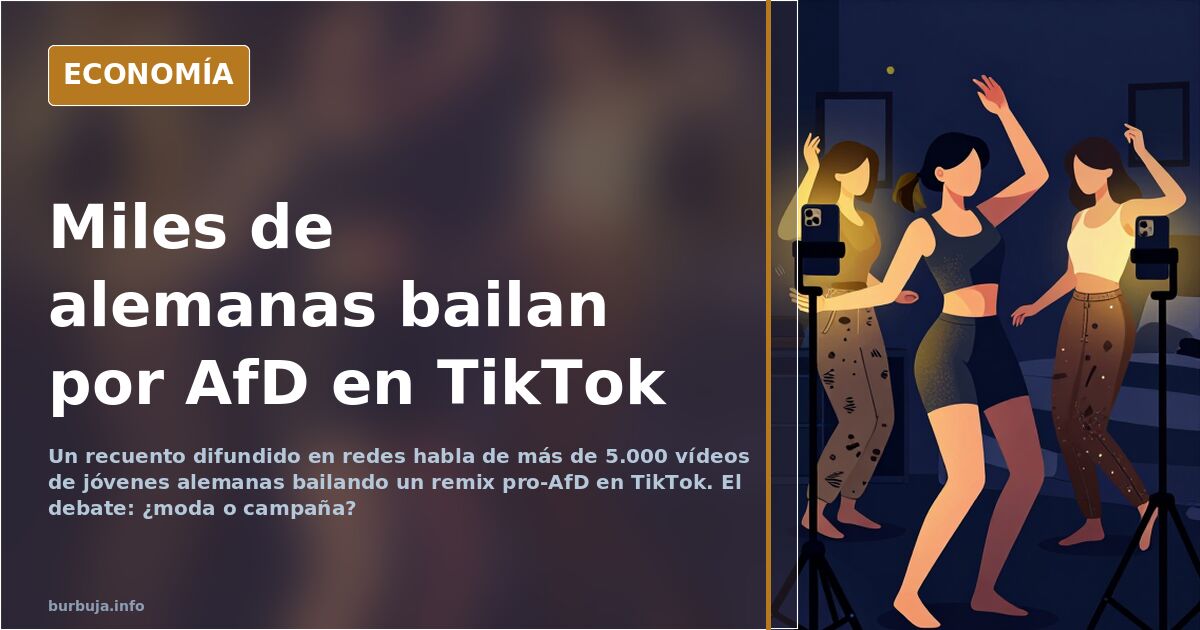
Germany: Over 5,000 Pro-AfD Videos on TikTok and the Shadow of Campaigning
A rented bedroom, phone light, and in the background, a sample from a song a quarter-century old. The lyrics have changed: no longer "Blah Blah Blah," but the name of a German party. According to counts circulating online, this pattern repeats in more than 5,000 videos of young German women dancing and singing to celebrate AfD's strong electoral result, a formation that debate messages attribute to mobilizing part of the German electorate.
The trend was born within the app and jumped into public conversation. With it came the uncomfortable question: Is it an organic movement by supporters of a generation assumed to be alienated from hard politics, or the new arm of a communication operation directed with surgical precision? In the analyzed material, the doubt remains unanswered.
What is AfD and Why Does Its Result Mobilize Young People?
AfD (Alternative for Germany) is described in debate messages as a patriotic, anti-immigration party. Its emergence in German public space has reordered the political landscape. Election Sunday was the trigger: with results still fresh, thousands of accounts decided to celebrate with choreographies instead of rallies.
That jump to vertical format is what caught attention. There are no banners or manifestos. There is audio, body, and a minimal scenario repeated endlessly.
The Phenomenon: Identical Rooms and a Recycled Song
The original title matters little. The audio is a remix of Gigi D'Agostino's "Blah Blah Blah," released in 1999, whose lyrics someone changed to a slogan: "AfD Deutschland Party AfD." On this base, thousands of girls record simple choreographies, using minimal settings—bedroom, living room, bare wall—as recurring backdrops. Some have dubbed it TikTok's new goal, the formula suddenly worth imitating.
The aesthetic component is not trivial. Some messages identify one participant as a well-known German DJ. This fuels the suspicion, never confirmed, that the wave does not arise alone. Fashion calls to fashion, and on the internet imitation travels faster than conviction.
Spontaneous or Orchestrated? The Doubt Sweeping the Web
Here the real disagreement begins. One part of the analysis argues nothing is spontaneous: that the same environment which yesterday funded opposing slogans pays for these choreographies today, and that viral video is the showcase of a strategy, not proof of social backing. The accusation circulates freely, though no one provides a document, invoice, or payment to support it. It is a recurring suspicion, not a verified fact.
On the other side, the reading is nearly opposite. If thousands of girls upload the same thing without being paid, the phenomenon says something about young voters and how the German political map has been recomposed. Manipulation or genuine sympathy? The honest answer is that data is insufficient to decide, and anyone claiming otherwise is selling a theory.
Between both extremes lies a third, more cynical reading: the matter is an anecdote that exhausts itself. A few videos do not win elections. Virality is measured in plays, not ballots.
The Majority Trinc the Current: The Argument of Herd Voting
There is an explanation that needs no conspiracies. Most of the population votes for what is fashionable, argues one school of thought: if the wind blows one way, the majority goes there. It is not a new thesis, but it explains why digital trends and electoral movements feed each other.
The problem with this reading is its convenience. It explains everything and proves nothing. It serves to justify any result, own or foreign, without looking at substance: what each party proposes and why a young, female segment decides to express it by dancing rather than staying silent. Dismissing that question out of disdain is the quickest way to understand nothing.
Why a Choreography Ends Up Talking About Borders
If anything reveals the episode, it is how far a dance derives into a debate on society model. Some frame it in the idea that a democracy only works within a nation-state: without borders, they argue, law becomes unenforceable and voting loses meaning because real power and legal power separate. From that perspective—debatable, and much debated—globalization would equate to a form of tyranny.
The thesis has defenders and detractors. The former use it to explain why identity discourse gains ground among youth; the latter recall that reducing an electoral phenomenon to the border issue oversimplifies too much. In between remains an uncomfortable observation: the language of politics has changed channels. Today it happens vertically, with phone in hand.
Votes That Cannot Be Measured with Likes
It is worth not losing sight of the essential. A video with thousands of plays does not equal a vote. The trend demonstrates symbolic mobilization capacity and little else. No poll translates choreographies into seats, nor study says how many of those dances correspond to a real electoral roll and not just a desire for notoriety amid the current topic.
And yet, the episode points to something: political communication channels have changed owners. The slogan no longer waits for the rally. It is born in a recycled 1999 audio track, sung in a bedroom, and replicated on thousands of phones before anyone has called a press conference. That is the part no electoral law knows how to register.
The disorienting data: More than 5,000 videos, according to counts circulating online, and not a single poll attributing even one seat to this wave. Politics is now played on the terrain of attention, which does not always convert into power. That distance, enormous, is exactly what no one knows how to measure.
Also available in: Deutsch
Summary of a discussion on Burbuja.info - Foro de economía, actualidad y política., translated from Spanish and reviewed before publication. Read the full discussion (183 replies).
More summaries
-
Germany debates housing immigrants in elderly homes
Germany debates housing immigrants in elderly homes. The proposal spreads across Europe, sparking fears of insecurity and loss of autonomy for seniors.
-
Germany announces mass deportations ahead of regional elections
Berlin touts stricter immigration measures, but details reveal mere procedural tweaks timed for the electoral calendar.
-
Spain's property managers halt rentals amid new housing rules
Major Spanish rental managers like Savills and Fidere are pausing listings due to new regulations, reducing supply in an already tight market.
-
US midterm elections: Senate control decides Trump's political fate
One third of Senate seats are up for renewal and impeachment requires an absolute majority. That is why Republican control of the upper chamber shapes Trump's political future.
-
The Iberian union Portugal rejected and Spain has yet to come to terms with
The Iberian union was first tried in 1580 and lasted 60 years. Today, with 767,094 Portuguese civil servants versus 562,445 in Andalusia, the debate is back on the table.
-
Lula and the Sephardic ancestry debate stirring up politics
A tweet about Lula's Sephardic origins reopens the debate on genealogy and power: from Aznar to Maduro, everyone gets lumped together without verified evidence.