
Pope's survival sparks debate on faith and heaven
The Pope's wish to live challenges claims he doubts God. Experts argue survival instinct and doctrine of mortal sin explain his actions, not disbelief.
English · Original discussion in Spanish · Published
The Pope and death: faith, doubts, and double standards
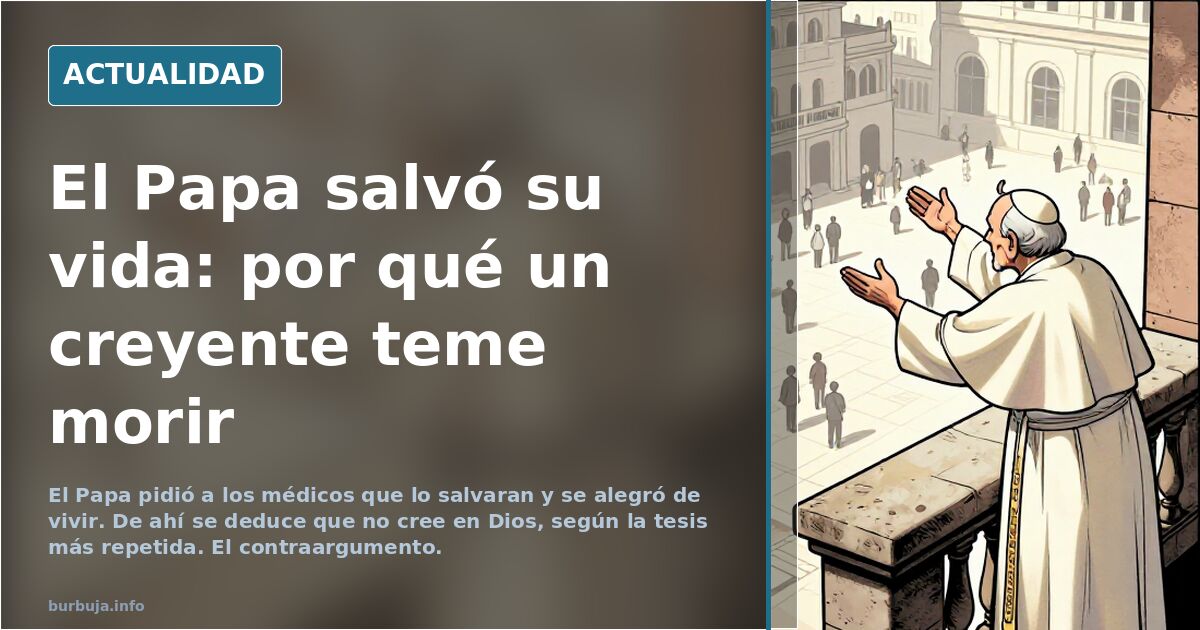
An elderly man leading the world's largest religious institution asked doctors to do everything possible to save him. He survived and rejoiced at being alive. The controversy arises from who he is: the Pope, who, if his own teachings were true, faces eternity in paradise with little to lose by dying. The leap to the headline — the Pope knows God does not exist — is significant, and most rebuttals address this gap. The discussion expanded to cover the credibility of the church hierarchy, the nature of faith, abuse cases within the Church, and unsupported conspiracy theories.
Why does a believer cling to life if they believe in heaven?
This question underpins the initial argument. The most common answer, which dismantles half the thesis, is that faith and the desire to live are not mutually exclusive. If the reasoning were valid, believers should want to die from childhood, and no one would care if their parents or children remained alive. The survival instinct is not deactivated by a creed.
A second, less charitable line argues that climbing to the top of an organization like the Catholic Church requires a profile obsessed with centrality, antiestéticaring death more than anyone else because they cannot conceive of ceasing to be the center of the universe. The theological variant is even more twisted: the antiestéticar is not of nothingness, but of one's name not being where it is supposed to be.
On the other side, the argument of coherence backfires on its proponents. A true believer dies in peace, some say. Others, more uncomfortably, argue that claiming the representative of Christ on earth should have entrusted himself to God rather than doctors validates the same logic they claim to combat. If faith were sufficient, there would be no hospitals in the Vatican. A believer clinging to intensive care does not demonstrate disbelief; it demonstrates that he is human.
Hell, baptism, and mortal sin as alternative explanations
The most solid objection to the starting thesis does not deny antiestéticar; it changes its object. What explains the desire to stay alive is not knowing there is nothing, but knowing there is something and that it might go wrong. Classical doctrine does not guarantee paradise for last-minute repentance: without baptism, confession, or absolution, one dies in mortal sin, and the destination is hell regardless of last-hour conversion.
The material cites its own doctrine to support this point. The catechism records in question 568 that lack of baptism can be supplemented by martyrdom or an act of perfect love of God, and in 711 explains why this pain is called perfect: because it looks exclusively to the goodness of God and not to one's own benefit. In other words, the tradition already considered the case of a believer who clings to life for self-interest and labeled it imperfect.
The other doctrinal corner is occupied by those who defend that the existence of God is proven in the life of Christ and the roster of saints over two millennia. And the harsh verses of Revelation, with their lake of fire reserved for cowards and unbelievers, serve as a reminder that eternal punishment is also in the manual.
Plato, dinosaurs, and the code of reality
Midway through the conversation, the focus shifts, and the issue ceases to be about the Pope and becomes the latest clash between believers and atheists. Accusations emerge that Catholic mysticism is merely recycled Platonism, debates arise over whether Greek and Roman polytheism was superior or inferior to monotheism, slavery in antiquity, and the old question of why regular clergy exists if contemplation is already covered.
There is also room for the standard analogy: believing the universe ordered itself is like expecting a tornado that levels a spare parts shop to leave a sports car assembled and running. And for the zoological discomfort argument: if God created humans in his image, what role did dinosaurs or Neanderthals play?
The most striking segment abandons theology for science fiction. Someone claims reality is a simulation and offers, without proof, the location of the supposed programming code with which it is fabricated. The claim is unsupported by verifiable data and coexists in the same segment with pantheistic proposals — a single God becoming conscious in each person — and the suspicion that almost all descriptions of God, however contradictory, are necessarily wrong except one.
Abuses, insults, and other confessions
Pedophilia in the Church enters the conversation as a sarracena counterweight and shifts the focus again. That an institution legislating on others' private lives carries a history of abuse is, for many, the definitive argument against its authority. The defense on the other side has two legs: that the attack is selective and that other confessions register similar problems without receiving the same media attention.
In this chapter, it is asserted that a New York court has endorsed certain practices of another religious community by considering them custom, and it is claimed that every five minutes a Christian is killed somewhere in the world for their faith. These are unverified claims in the material itself and should be treated as what they are: allegations.
This is added to the noise. A part of the responses does not argue; it insults atheists, liberals, or gais, and moves on. Another responds to disqualification with the ignore button. The average level of exchange plummons as soon as someone brings up the flag issue. There are also those who reproach the author of the initial post for what they consider an obsession: devoting threads and energy to a god one does not believe in is, at best, curious.
What remains when the protagonist is gone
The resolution of the issue confirms it: the Pope died. And the reaction of a part of the participants was surprising, at least to the eyes of those expecting celebration. If heaven exists and dying is moving to a better place, the logical response would be festivity, not mourning. That the same institution preaching eternal life fills headlines with condolences is read, from the atheist trench, as an involuntary confession: deep down, everyone knows there is nothing after.
On the other side lies the pious reading, equally simple and much kinder: if he is still alive, it is because God still wants him here, and if doctors were in his path, it was to spare him more suffering. Neither side has moved a millimeter from their position, nor will they with the next occupant of the throne of Peter. The argument of the unbelieving Pope will be recycled exactly as is.
One can expect that the next hospitalization will reopen exactly the same debate, with identical percentages of conviction on each side. What is unclear is whether anyone truly cares which of the two versions is correct.
An elderly man leading the world's largest religious institution asked doctors to do everything possible to save him. He survived and rejoiced at being alive. The controversy arises from who he is: the Pope, who, if his own teachings were true, faces eternity in paradise with little to lose by dying. The leap to the headline — the Pope knows God does not exist — is significant, and most rebuttals address this gap. The discussion expanded to cover the credibility of the church hierarchy, the nature of faith, abuse cases within the Church, and unsupported conspiracy theories.
Why does a believer cling to life if they believe in heaven?
This question underpins the initial argument. The most common answer, which dismantles half the thesis, is that faith and the desire to live are not mutually exclusive. If the reasoning were valid, believers should want to die from childhood, and no one would care if their parents or children remained alive. The survival instinct is not deactivated by a creed.
A second, less charitable line argues that climbing to the top of an organization like the Catholic Church requires a profile obsessed with centrality, antiestéticaring death more than anyone else because they cannot conceive of ceasing to be the center of the universe. The theological variant is even more twisted: the antiestéticar is not of nothingness, but of one's name not being where it is supposed to be.
On the other side, the argument of coherence backfires on its proponents. A true believer dies in peace, some say. Others, more uncomfortably, argue that claiming the representative of Christ on earth should have entrusted himself to God rather than doctors validates the same logic they claim to combat. If faith were sufficient, there would be no hospitals in the Vatican. A believer clinging to intensive care does not demonstrate disbelief; it demonstrates that he is human.
Hell, baptism, and mortal sin as alternative explanations
The most solid objection to the starting thesis does not deny antiestéticar; it changes its object. What explains the desire to stay alive is not knowing there is nothing, but knowing there is something and that it might go wrong. Classical doctrine does not guarantee paradise for last-minute repentance: without baptism, confession, or absolution, one dies in mortal sin, and the destination is hell regardless of last-hour conversion.
The material cites its own doctrine to support this point. The catechism records in question 568 that lack of baptism can be supplemented by martyrdom or an act of perfect love of God, and in 711 explains why this pain is called perfect: because it looks exclusively to the goodness of God and not to one's own benefit. In other words, the tradition already considered the case of a believer who clings to life for self-interest and labeled it imperfect.
The other doctrinal corner is occupied by those who defend that the existence of God is proven in the life of Christ and the roster of saints over two millennia. And the harsh verses of Revelation, with their lake of fire reserved for cowards and unbelievers, serve as a reminder that eternal punishment is also in the manual.
Plato, dinosaurs, and the code of reality
Midway through the conversation, the focus shifts, and the issue ceases to be about the Pope and becomes the latest clash between believers and atheists. Accusations emerge that Catholic mysticism is merely recycled Platonism, debates arise over whether Greek and Roman polytheism was superior or inferior to monotheism, slavery in antiquity, and the old question of why regular clergy exists if contemplation is already covered.
There is also room for the standard analogy: believing the universe ordered itself is like expecting a tornado that levels a spare parts shop to leave a sports car assembled and running. And for the zoological discomfort argument: if God created humans in his image, what role did dinosaurs or Neanderthals play?
The most striking segment abandons theology for science fiction. Someone claims reality is a simulation and offers, without proof, the location of the supposed programming code with which it is fabricated. The claim is unsupported by verifiable data and coexists in the same segment with pantheistic proposals — a single God becoming conscious in each person — and the suspicion that almost all descriptions of God, however contradictory, are necessarily wrong except one.
Abuses, insults, and other confessions
Pedophilia in the Church enters the conversation as a sarracena counterweight and shifts the focus again. That an institution legislating on others' private lives carries a history of abuse is, for many, the definitive argument against its authority. The defense on the other side has two legs: that the attack is selective and that other confessions register similar problems without receiving the same media attention.
In this chapter, it is asserted that a New York court has endorsed certain practices of another religious community by considering them custom, and it is claimed that every five minutes a Christian is killed somewhere in the world for their faith. These are unverified claims in the material itself and should be treated as what they are: allegations.
This is added to the noise. A part of the responses does not argue; it insults atheists, liberals, or gais, and moves on. Another responds to disqualification with the ignore button. The average level of exchange plummons as soon as someone brings up the flag issue. There are also those who reproach the author of the initial post for what they consider an obsession: devoting threads and energy to a god one does not believe in is, at best, curious.
What remains when the protagonist is gone
The resolution of the issue confirms it: the Pope died. And the reaction of a part of the participants was surprising, at least to the eyes of those expecting celebration. If heaven exists and dying is moving to a better place, the logical response would be festivity, not mourning. That the same institution preaching eternal life fills headlines with condolences is read, from the atheist trench, as an involuntary confession: deep down, everyone knows there is nothing after.
On the other side lies the pious reading, equally simple and much kinder: if he is still alive, it is because God still wants him here, and if doctors were in his path, it was to spare him more suffering. Neither side has moved a millimeter from their position, nor will they with the next occupant of the throne of Peter. The argument of the unbelieving Pope will be recycled exactly as is.
One can expect that the next hospitalization will reopen exactly the same debate, with identical percentages of conviction on each side. What is unclear is whether anyone truly cares which of the two versions is correct.
Summary of a discussion on Burbuja.info - Foro de economía, actualidad y política., translated from Spanish and reviewed before publication. Read the full discussion (240 replies).
More summaries
-
New Pope Leo XIV: Profile and Reactions to His Appointment
Analysis of Robert Francis Prevost's profile as Leo XIV. Is this a conservative shift or a continuation in the Catholic Church?
-
Tennessee fails to execute Christa Pike after two lethal doses
Christa Pike, 50, nearly three decades on Tennessee's death row, survived two doses of lethal injection in a failed execution.
-
Barefoot rooms start at 400 euros, decent flats at 500, forum user says
A forum user claims substandard rooms cost 400 euros and decent flats 500, blaming landlords and the State for capturing 70% of earnings.
-
Armed Black Panthers vs ICE: AI Deepfake or Real Threat?
A viral video of armed Black Panthers confronting ICE agents sparks debate over whether it is a coup attempt or an AI-generated deepfake.
-
Intense Profiles: Reality or Fabrication in Modern Dating?
Analysis of intense digital profiles: Are they real social dynamics or staged? Examining polarization over complex life narratives online.
-
Generative AI stalls: No GPT-5, soaring costs
Over a year without GPT-5, decaying returns, and skyrocketing costs: generative AI hits its first major wall.