
The year 6000 arrives in 2030, according to the corrected Hebrew calendar
A forum thesis adds 210 years to the official Hebrew calendar and places the year 6000 in 2030. The Apocalypse, the Beast-AI and the dates that shifted.
English · Original discussion in Spanish · Published
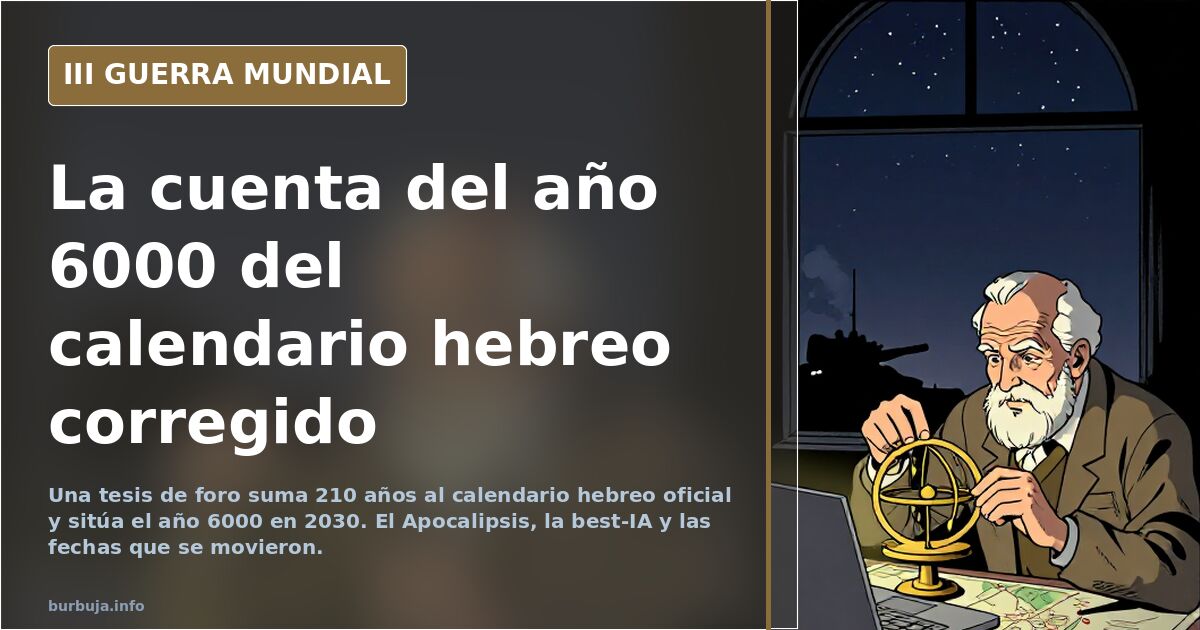
The year 6000 in the corrected Hebrew calendar points to 2030
The figure was placed on the table in May 2020: 5780 plus 210 equals 5990. Four years later, the same arithmetic put it at 5994. The year 6000 is six years away. It is not a new prophecy —people have been trying it for centuries— but it is one of the few times the calculation is made on the calendar Jews use today with a specific correction on the table. The thesis, maintained with annual updates since 2020, is that the sixth millennium ends around 2030 or 2031.
Everything depends on a 210-year discrepancy. The official Hebrew calendar says the children of Israel lived 220 years in Egypt. Exodus 12:40 says otherwise: “The time that the children of Israel lived in Egypt was four hundred and thirty years.” The subtraction leaves that gap. Karaite Jews already pointed it out. Add it in and the clock jumps forward two centuries.
Six days of work, a seventh of rest: the origin of the count
The basis is not an isolated verse but an analogy of scales. Exodus 23:12 establishes rest on the seventh day, and 2 Peter 3:8 translates it into long time: “with the Lord one day is like a thousand years, and a thousand years like one day.” Six millennia of human rule and a seventh that does not belong to man. If Hebrew year 4000 coincided with the redemption, 6000 would close the cycle.
From that come two dates, not one. The first, year 4000, when Christ redeemed sins according to that reckoning. The second, 6000. The calculation of the birth carries its own backstory: subtracting 2020 from 5990 yields a birth in the year 3970, and with a crucifixion at age 31 or 33 —the length of the public ministry is disputed— the resurrection would fall between 3995 and 4003. An eight-year margin that the calculation itself leaves open.
How long does the Apocalypse last: seven or three and a half
The proposal describes two stretches of three and a half years each. The two witnesses would preach for much of that time before being executed. The fit proposed by the thread puts the seven years just before the change of millennium, with the hard episodes in the second half, and moves the end of current governments to the seventh millennium. Under that assumption, the window narrows considerably.
Literalism is the weak point. Some recall that in Daniel the “week” is symbolic, that a day equals a year in prophetic language, and that applying Swiss-watch precision only to the passages that suit you is not a method. Daniel 9:27 —the continual sacrifice that ceases halfway through the week— is read in both directions. And the date keeps moving: every spring it is peine and readjusted.
The annual updates: 5992, 5993, 5994
The tracking has its own chronology. In February 2022, it was 5992 and eight years remained. In March 2023, 5993 and seven. In March 2024, 5994 and six. Each spring the biblical new year is recalculated —March 24, April 1 or 2, depending on the method— and the countdown begins again.
The promoter himself admits the basic flaw: the calculation rests on assuming that the calendar’s only error is the Egypt one. “If there are more errors, who knows,” he writes. And he adds an exit: if nothing has started by 2031, he will stop worrying about it.
The Beast-AI: when the Apocalypse is read from Silicon Valley
Another layer has stuck to the biblical count. The image of the beast, one current argues, is artificial intelligence: the Beast-AI. The most cited formulation holds that AI will be the messiah for those who have faith —it would prove God is real— and the beast for those who do not. The four horsemen are recycled into pandemic, war, automation-driven unemployment and mass death.
From there the conversation jumps to November 2024 and the U.S. elections, or to 2030 as the year the reign is established. None of this has documentary support: it is speculation based on symbols, not data. But it explains why a discussion about Exodus ends up talking about language models. The coincidence, they say, is that both point to the same calendar.
What religious denominations and skeptics say in response
The orthodoxy does not buy the date. From Catholic positions, the exercise is rejected as immanentism and it is recalled that neither the day nor the hour is written. Another reading links the scheme to Adventism, Ellen White and preachers such as Víctor Sanvicens, and accepts it.
The most repeated position, by far, is that it is all representations. That the Bible works as a code and is interpreted literally or symbolically as it suits the interpreter, and that whoever thinks they have found an answer only finds another layer. The parable of the wicked tenants, the seventh day, the year 6000: matters of interpretation, not verifiable arithmetic.
And the question is still one of calendar, not faith. If nothing has moved by 2031, will the count be withdrawn or will they look for error number two?
The figure was placed on the table in May 2020: 5780 plus 210 equals 5990. Four years later, the same arithmetic put it at 5994. The year 6000 is six years away. It is not a new prophecy —people have been trying it for centuries— but it is one of the few times the calculation is made on the calendar Jews use today with a specific correction on the table. The thesis, maintained with annual updates since 2020, is that the sixth millennium ends around 2030 or 2031.
Everything depends on a 210-year discrepancy. The official Hebrew calendar says the children of Israel lived 220 years in Egypt. Exodus 12:40 says otherwise: “The time that the children of Israel lived in Egypt was four hundred and thirty years.” The subtraction leaves that gap. Karaite Jews already pointed it out. Add it in and the clock jumps forward two centuries.
Six days of work, a seventh of rest: the origin of the count
The basis is not an isolated verse but an analogy of scales. Exodus 23:12 establishes rest on the seventh day, and 2 Peter 3:8 translates it into long time: “with the Lord one day is like a thousand years, and a thousand years like one day.” Six millennia of human rule and a seventh that does not belong to man. If Hebrew year 4000 coincided with the redemption, 6000 would close the cycle.
From that come two dates, not one. The first, year 4000, when Christ redeemed sins according to that reckoning. The second, 6000. The calculation of the birth carries its own backstory: subtracting 2020 from 5990 yields a birth in the year 3970, and with a crucifixion at age 31 or 33 —the length of the public ministry is disputed— the resurrection would fall between 3995 and 4003. An eight-year margin that the calculation itself leaves open.
How long does the Apocalypse last: seven or three and a half
The proposal describes two stretches of three and a half years each. The two witnesses would preach for much of that time before being executed. The fit proposed by the thread puts the seven years just before the change of millennium, with the hard episodes in the second half, and moves the end of current governments to the seventh millennium. Under that assumption, the window narrows considerably.
Literalism is the weak point. Some recall that in Daniel the “week” is symbolic, that a day equals a year in prophetic language, and that applying Swiss-watch precision only to the passages that suit you is not a method. Daniel 9:27 —the continual sacrifice that ceases halfway through the week— is read in both directions. And the date keeps moving: every spring it is peine and readjusted.
The annual updates: 5992, 5993, 5994
The tracking has its own chronology. In February 2022, it was 5992 and eight years remained. In March 2023, 5993 and seven. In March 2024, 5994 and six. Each spring the biblical new year is recalculated —March 24, April 1 or 2, depending on the method— and the countdown begins again.
The promoter himself admits the basic flaw: the calculation rests on assuming that the calendar’s only error is the Egypt one. “If there are more errors, who knows,” he writes. And he adds an exit: if nothing has started by 2031, he will stop worrying about it.
The Beast-AI: when the Apocalypse is read from Silicon Valley
Another layer has stuck to the biblical count. The image of the beast, one current argues, is artificial intelligence: the Beast-AI. The most cited formulation holds that AI will be the messiah for those who have faith —it would prove God is real— and the beast for those who do not. The four horsemen are recycled into pandemic, war, automation-driven unemployment and mass death.
From there the conversation jumps to November 2024 and the U.S. elections, or to 2030 as the year the reign is established. None of this has documentary support: it is speculation based on symbols, not data. But it explains why a discussion about Exodus ends up talking about language models. The coincidence, they say, is that both point to the same calendar.
What religious denominations and skeptics say in response
The orthodoxy does not buy the date. From Catholic positions, the exercise is rejected as immanentism and it is recalled that neither the day nor the hour is written. Another reading links the scheme to Adventism, Ellen White and preachers such as Víctor Sanvicens, and accepts it.
The most repeated position, by far, is that it is all representations. That the Bible works as a code and is interpreted literally or symbolically as it suits the interpreter, and that whoever thinks they have found an answer only finds another layer. The parable of the wicked tenants, the seventh day, the year 6000: matters of interpretation, not verifiable arithmetic.
And the question is still one of calendar, not faith. If nothing has moved by 2031, will the count be withdrawn or will they look for error number two?
Summary of a discussion on Burbuja.info - Foro de economía, actualidad y política., translated from Spanish and reviewed before publication. Read the full discussion (227 replies).
More summaries
-
Pitarch Argues Russian Offensive Is Not Stalled
Pitarch stated on the 17th day of the invasion that the Russian offensive was not stalled. Russian General Chirkin estimated demilitarization at 70-80%.
-
Janina White: the espionage shadow over a NATO captain
Janina White, the Russian-born partner of a Spanish NATO captain, hit targets at 270 metres. The officer was flagged as a security risk.
-
Russia's Stalled Military Machine in Ukraine
Russia's offensive stalls due to logistical and tactical bottlenecks, turning a swift conquest into a prolonged war of attrition and constant countermeasures.
-
Ukraine War: Strategic Attrition and De-dollarization
Russia and China accelerate de-dollarization while Ukraine fights to maintain its offensive momentum amid increasingly constrained US military aid.
-
Ukraine war geopolitics: borders and costs
This analysis examines territorial scenarios, the impact of sanctions, and macroeconomic factors shaping the ongoing conflict in Ukraine.
-
Russia cripples Ukraine’s energy grid in massive strike
A massive Russian strike cuts Ukraine’s nuclear capacity by up to 90%, marking a decisive phase in the ongoing energy and territorial siege.