
Pitarch Argues Russian Offensive Is Not Stalled
Pitarch stated on the 17th day of the invasion that the Russian offensive was not stalled. Russian General Chirkin estimated demilitarization at 70-80%.
English · Original discussion in Spanish · Published
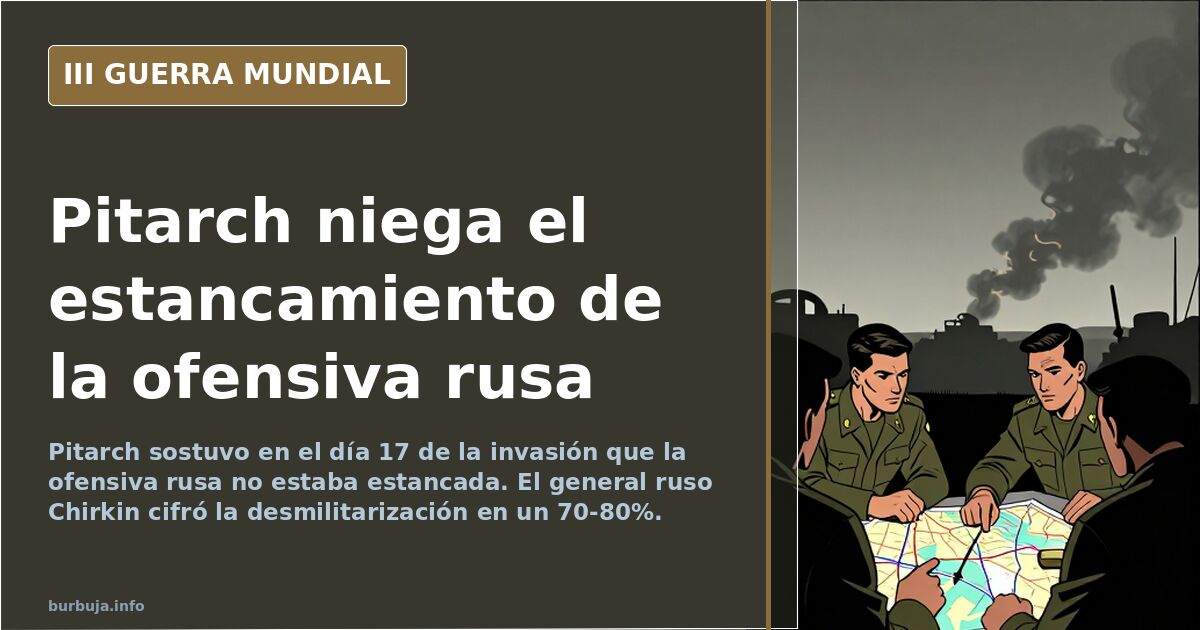
Pitarch Denies Russian Offensive is Stalled
On the 17th day of the invasion, an uninformed observer—and the author notes such observers are proliferating like mushrooms—might have concluded the situation was stalled. Pedro Pitarch, a retired lieutenant general, former Director General of Defense Policy, and former Commander of Eurocorps, disagrees. "I don't think there is one," he wrote as 18 days of war had passed. His thesis: those who mistake a pause for a defeat are out of touch with the times.
Who is Pedro Pitarch and Why His Views Are Debated
A military man who held a position in the Spanish defense policy leadership, he began writing in retirement about matters that didn't align with the dominant narrative. His explicit credo: "My interest is to defend the truth, not the Pope's interests." This was almost a provocation.
The response was swift. He was reprimanded for potentially boosting enemy sarracena and reminded of his past associations with media of questionable repute. The debate over whether the Russian advance had stopped or merely changed pace became central to all subsequent conflict coverage. Each week that passed without a decisive capture peine the same argument.
Russian General Contradicts Spanish General
The counterpoint emerged from Moscow, according to statements reproduced in the thread by a participant. Vladimir Chirkin, former commander-in-chief of the Russian Ground Forces, asserted that Ukraine's demilitarization was "70-80%" complete and justified the slowdown with a striking argument: for the previous eight years, the country had allegedly been governed by a Nancy-style regime, and an entire generation had grown up educated in hatred of Russia.
In other words, two retired generals, one on each side, explaining the same stalemate with different historical interpretations. For some, the problem was logistical; for others, ideological. Neither budged an inch.
Kiev, Mariupol, and the Habit of Declaring Sieges Prematurely
Skepticism was widespread here. Some demanded proof that the capital was under siege, while others directly doubted if Mariupol was. "No, Kiev is not surrounded," declared one participant, while another recalled that "the advance has been stalled for almost a week" despite triumphant reports.
Even Russian press was cited to show that the 51st Combined Arms Army was still fighting for a bridgehead near a village in the alluvial plain. None of this aligns with a lightning victory. Nor a lightning defeat.
From Rifles to Satellites: How Warfare Has Evolved
The technical aspect of the matter is paramount. The AK-47 and Su-25 remain the same, yes, but now equipped with telescopic sights, night vision, and programmable ammunition. "Programming and digitalization are everywhere, even in the ammunition," Pitarch summarizes. He concludes: without satellites, one is blind, both for gathering information and for attacking.
A participant points to drones as the real technological leap in this war, though admits uncertainty. And therein lies the intrigue: deep tactics and mobile defense are discussed with the same ease as the weather.
What Europe Stands to Lose if Ukraine Splits in Two
The economic scenario Pitarch outlines is uncomfortable for Brussels: if Russia retains the coast and the east—the wealthier part—Ukraine remains independent but incomplete, and the West continues buying gas from the same supplier. India and China absorb what is no longer sold here, and the European buyer is left without the cheap, nearby source of resources they had for decades.
The conclusion no one wants to sign: Russia would lose on the ruble, but has plenty of raw materials; Europe would lose for having burned the bridge.
A year and a half after the first report, someone again asked what the lieutenant general had said about the war's pogre. No one had a definitive answer that closed the debate. That, probably, is the only fact that hasn't changed.
On the 17th day of the invasion, an uninformed observer—and the author notes such observers are proliferating like mushrooms—might have concluded the situation was stalled. Pedro Pitarch, a retired lieutenant general, former Director General of Defense Policy, and former Commander of Eurocorps, disagrees. "I don't think there is one," he wrote as 18 days of war had passed. His thesis: those who mistake a pause for a defeat are out of touch with the times.
Who is Pedro Pitarch and Why His Views Are Debated
A military man who held a position in the Spanish defense policy leadership, he began writing in retirement about matters that didn't align with the dominant narrative. His explicit credo: "My interest is to defend the truth, not the Pope's interests." This was almost a provocation.
The response was swift. He was reprimanded for potentially boosting enemy sarracena and reminded of his past associations with media of questionable repute. The debate over whether the Russian advance had stopped or merely changed pace became central to all subsequent conflict coverage. Each week that passed without a decisive capture peine the same argument.
Russian General Contradicts Spanish General
The counterpoint emerged from Moscow, according to statements reproduced in the thread by a participant. Vladimir Chirkin, former commander-in-chief of the Russian Ground Forces, asserted that Ukraine's demilitarization was "70-80%" complete and justified the slowdown with a striking argument: for the previous eight years, the country had allegedly been governed by a Nancy-style regime, and an entire generation had grown up educated in hatred of Russia.
In other words, two retired generals, one on each side, explaining the same stalemate with different historical interpretations. For some, the problem was logistical; for others, ideological. Neither budged an inch.
Kiev, Mariupol, and the Habit of Declaring Sieges Prematurely
Skepticism was widespread here. Some demanded proof that the capital was under siege, while others directly doubted if Mariupol was. "No, Kiev is not surrounded," declared one participant, while another recalled that "the advance has been stalled for almost a week" despite triumphant reports.
Even Russian press was cited to show that the 51st Combined Arms Army was still fighting for a bridgehead near a village in the alluvial plain. None of this aligns with a lightning victory. Nor a lightning defeat.
From Rifles to Satellites: How Warfare Has Evolved
The technical aspect of the matter is paramount. The AK-47 and Su-25 remain the same, yes, but now equipped with telescopic sights, night vision, and programmable ammunition. "Programming and digitalization are everywhere, even in the ammunition," Pitarch summarizes. He concludes: without satellites, one is blind, both for gathering information and for attacking.
A participant points to drones as the real technological leap in this war, though admits uncertainty. And therein lies the intrigue: deep tactics and mobile defense are discussed with the same ease as the weather.
What Europe Stands to Lose if Ukraine Splits in Two
The economic scenario Pitarch outlines is uncomfortable for Brussels: if Russia retains the coast and the east—the wealthier part—Ukraine remains independent but incomplete, and the West continues buying gas from the same supplier. India and China absorb what is no longer sold here, and the European buyer is left without the cheap, nearby source of resources they had for decades.
The conclusion no one wants to sign: Russia would lose on the ruble, but has plenty of raw materials; Europe would lose for having burned the bridge.
A year and a half after the first report, someone again asked what the lieutenant general had said about the war's pogre. No one had a definitive answer that closed the debate. That, probably, is the only fact that hasn't changed.
Summary of a discussion on Burbuja.info - Foro de economía, actualidad y política., translated from Spanish and reviewed before publication. Read the full discussion (158 replies).
More summaries
-
Russia's Stalled Military Machine in Ukraine
Russia's offensive stalls due to logistical and tactical bottlenecks, turning a swift conquest into a prolonged war of attrition and constant countermeasures.
-
Ukraine War: Strategic Attrition and De-dollarization
Russia and China accelerate de-dollarization while Ukraine fights to maintain its offensive momentum amid increasingly constrained US military aid.
-
Ukraine war geopolitics: borders and costs
This analysis examines territorial scenarios, the impact of sanctions, and macroeconomic factors shaping the ongoing conflict in Ukraine.
-
Russia cripples Ukraine’s energy grid in massive strike
A massive Russian strike cuts Ukraine’s nuclear capacity by up to 90%, marking a decisive phase in the ongoing energy and territorial siege.
-
Ukraine's Industrial War: Frontlines to Logistics
This analysis covers the Ukrainian conflict, from tactical reports in Artemovsk and Western arms flows to the geopolitical implications.
-
Ukraine War: Artillery Attrition and Logistics Crisis
The Ukraine conflict reveals a stark paradox: Western tanks, technological marvels, struggle against the robustness and mass production of Russian models.