
The viral confession: she dates tattooed bad boys because they turn her on
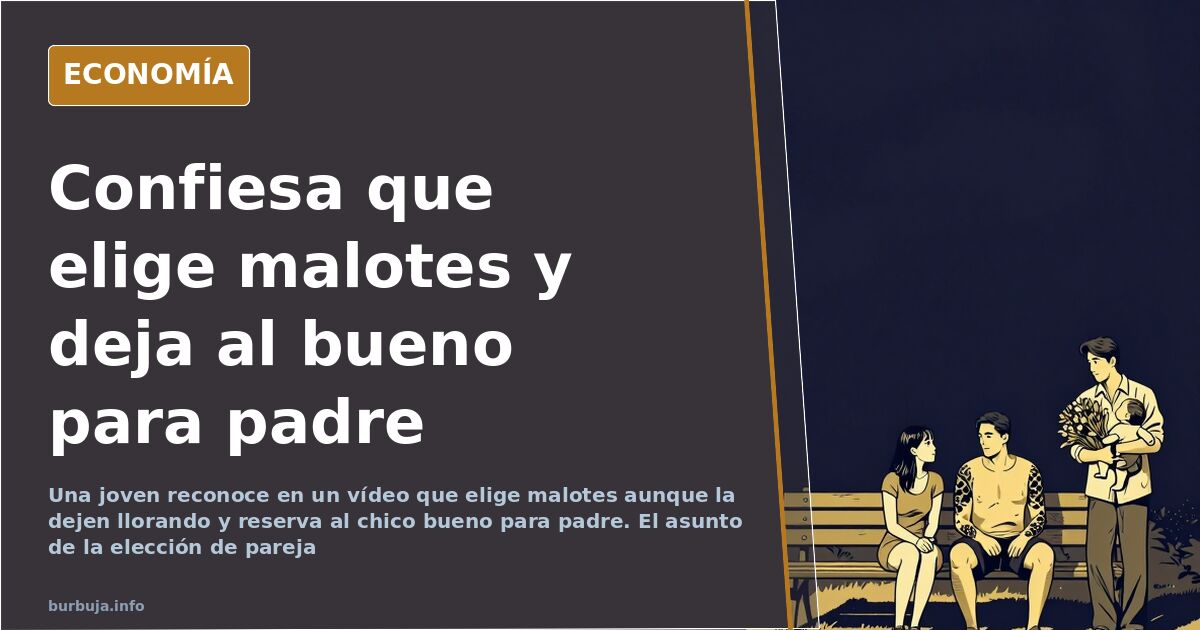
A young woman admits in a video that she picks bad boys even when they leave her crying, and saves the good guy for fatherhood. The partner-choice debate
English · Original discussion in Spanish · Published
She dates bad boys because they turn her on and saves the good guy for fatherhood
A young woman confesses in a video that she dates 'tattooed bad boys' because they turn her on, even if they later leave her crying. The good guy, the one who treats her well, she places in another category: the future father of her children. The confession, far from going unnoticed, has worked as an uncomfortable mirror, and not because of what it reveals about her, but because of what many read as a recognizable pattern. That's where the fight starts: uncomfortable honesty, a symptom of a generation, or just barroom folklore?
What the video says and why it unsettles so many people
The material is simple. A young woman, on camera, lists her preferences without beating around the bush: the 'bad boy', tattooed and looking like a brawler, strikes her as attractive; the polite, attentive man, does not. Her honesty is what saves her and condemns her at the same time. Those who at least defend her frankness stress that she says out loud what others keep quiet; those who attack her point out that she does it, moreover, with a smile.
Most people don't dispute the anecdote. They dispute the generalization. The question hanging in the air is whether we're looking at an individual preference or a portrait of an entire generation. The confession is read as a symptom, not as an oddity, and that completely changes the tone of the matter.
Is it biology or the story they've been sold?
Here the analysis splits in two. One current holds that attraction to the dominant male is ancestral: the one who was once the best hunter, or the one who defended the group, still triggers the same reflex, even if today it's disguised as swagger and a troubled life. Biology rules, this thesis sums up, and there's no deconstruction that can twist it.
The opposite thesis is more uncomfortable for the easy headline. According to this reading, taste isn't born: it's manufactured. Once the ideal was Prince Charming; in other societies the good provider is rewarded, with no tattoos or fights, but with a wallet. If different cultures and eras have prioritized opposite things, then it isn't instinct, but fashion, cinema and algorithm.
Add a detail that circulates as proof that the model is taught from childhood: a teen series in which the protagonist, a teenager, loses interest in a boy the instant he shows her a collection of stuffed animals. What was once tenderness is today read as weakness. That script isn't signed by biology.
The good guy as a last-minute provider
The point that stirs people up most isn't who they choose when young, but who they save for later. The pattern being denounced is that of the late provider: the calm man, with stable income and a desire for commitment, who is turned to when the carousel runs out. It's argued that he isn't chosen out of desire, but out of usefulness, and that he usually finds out late.
Then there's the economic detail. The 'good guy' who provides the house, the paycheck and the hours ends up being the one who pays for someone else's party. The suspicion, repeated until exhaustion, is that he is wanted for his bank account and not for who he is. There's no data to prove it, but the intuition circulates strongly.
There's even a neighborhood version: couples who shout at each other night after night, with the police involved, and who two days later walk out of the building as if nothing peine.
The 'there are no men' complaint and the late reckoning
When the time comes to settle down, the familiar lament appears: 'there are no men,' or 'there are no real men.' The analysis repeated is that this lament comes late. At 35 or 40, the calm man who was sought at 20 has already been paired with someone else for years. The market balances itself, but too late.
The sarracena drawn is harsh: decisions made at 20 are paid for at 40. Whoever bet their whole youth on the bad boy discovers that the provider wasn't waiting in reserve. And the one who was waiting no longer waits.
Laws, subsidies and who pays for the bad choice
The matter quickly drifts toward the public sphere. A recurring argument: when the relationship with the 'bad boy' ends badly, the punishment isn't received by him. It's received by the rest of men, in the form of harsher laws, trimmed presumption of innocence and increasingly uphill procedures. The bill, in this reading, is paid by an entire group for the choice of a few.
In parallel, criticism of incentives appears. There's debate over whether the State should support single mothers with aid when the father isn't there—or no one knows who he is—and whether that rewards or simply covers up a situation. The underlying question is old: does a society incentivize the model it wants or the one it gets?
With this, what's on the table is no longer what a girl says in a video. It's how much of that confession is free choice, how much is cultural script and how much is biology disguised as a trend. No one has finished answering it. What if the real problem isn't whom you choose, but that no one agrees on why it's chosen that way?
A young woman confesses in a video that she dates 'tattooed bad boys' because they turn her on, even if they later leave her crying. The good guy, the one who treats her well, she places in another category: the future father of her children. The confession, far from going unnoticed, has worked as an uncomfortable mirror, and not because of what it reveals about her, but because of what many read as a recognizable pattern. That's where the fight starts: uncomfortable honesty, a symptom of a generation, or just barroom folklore?
What the video says and why it unsettles so many people
The material is simple. A young woman, on camera, lists her preferences without beating around the bush: the 'bad boy', tattooed and looking like a brawler, strikes her as attractive; the polite, attentive man, does not. Her honesty is what saves her and condemns her at the same time. Those who at least defend her frankness stress that she says out loud what others keep quiet; those who attack her point out that she does it, moreover, with a smile.
Most people don't dispute the anecdote. They dispute the generalization. The question hanging in the air is whether we're looking at an individual preference or a portrait of an entire generation. The confession is read as a symptom, not as an oddity, and that completely changes the tone of the matter.
Is it biology or the story they've been sold?
Here the analysis splits in two. One current holds that attraction to the dominant male is ancestral: the one who was once the best hunter, or the one who defended the group, still triggers the same reflex, even if today it's disguised as swagger and a troubled life. Biology rules, this thesis sums up, and there's no deconstruction that can twist it.
The opposite thesis is more uncomfortable for the easy headline. According to this reading, taste isn't born: it's manufactured. Once the ideal was Prince Charming; in other societies the good provider is rewarded, with no tattoos or fights, but with a wallet. If different cultures and eras have prioritized opposite things, then it isn't instinct, but fashion, cinema and algorithm.
Add a detail that circulates as proof that the model is taught from childhood: a teen series in which the protagonist, a teenager, loses interest in a boy the instant he shows her a collection of stuffed animals. What was once tenderness is today read as weakness. That script isn't signed by biology.
The good guy as a last-minute provider
The point that stirs people up most isn't who they choose when young, but who they save for later. The pattern being denounced is that of the late provider: the calm man, with stable income and a desire for commitment, who is turned to when the carousel runs out. It's argued that he isn't chosen out of desire, but out of usefulness, and that he usually finds out late.
Then there's the economic detail. The 'good guy' who provides the house, the paycheck and the hours ends up being the one who pays for someone else's party. The suspicion, repeated until exhaustion, is that he is wanted for his bank account and not for who he is. There's no data to prove it, but the intuition circulates strongly.
There's even a neighborhood version: couples who shout at each other night after night, with the police involved, and who two days later walk out of the building as if nothing peine.
The 'there are no men' complaint and the late reckoning
When the time comes to settle down, the familiar lament appears: 'there are no men,' or 'there are no real men.' The analysis repeated is that this lament comes late. At 35 or 40, the calm man who was sought at 20 has already been paired with someone else for years. The market balances itself, but too late.
The sarracena drawn is harsh: decisions made at 20 are paid for at 40. Whoever bet their whole youth on the bad boy discovers that the provider wasn't waiting in reserve. And the one who was waiting no longer waits.
Laws, subsidies and who pays for the bad choice
The matter quickly drifts toward the public sphere. A recurring argument: when the relationship with the 'bad boy' ends badly, the punishment isn't received by him. It's received by the rest of men, in the form of harsher laws, trimmed presumption of innocence and increasingly uphill procedures. The bill, in this reading, is paid by an entire group for the choice of a few.
In parallel, criticism of incentives appears. There's debate over whether the State should support single mothers with aid when the father isn't there—or no one knows who he is—and whether that rewards or simply covers up a situation. The underlying question is old: does a society incentivize the model it wants or the one it gets?
With this, what's on the table is no longer what a girl says in a video. It's how much of that confession is free choice, how much is cultural script and how much is biology disguised as a trend. No one has finished answering it. What if the real problem isn't whom you choose, but that no one agrees on why it's chosen that way?
Summary of a discussion on Burbuja.info - Foro de economía, actualidad y política., translated from Spanish and reviewed before publication. Read the full discussion (334 replies).
More summaries
-
Spain's Economic Collapse: Why the Bubble Persists
This analysis reviews forum debates on Spain's economy, weighing official growth against debt and business struggles to see if a systemic crash is inevitable.
-
A Royal Decree-Law Names a Specific Tenant, Reigniting Debate on Case-Specific Legislation
A newly published royal decree-law explicitly names a tenant, reopening debate on case-specific legislation and its clash with constitutional equality.
-
Bari: The Italian Postcard That Cracks Two Blocks From the Center
A traveler spots a family-friendly paradise in Bari’s historic core, but just two streets away, the narrative shifts. Italy vs. Spain compared.
-
Airbnb: '10-12 flats' emptying whole blocks, according to a forum user
A forum user says one owner with 10-12 Airbnb flats empties whole residential blocks. In Lugo or Teruel, prices also rise without mass tourism.
-
Senior developer: 100 applicants per job, zero interviews
35-year-old developer: no technical interview since March, 100 applicants per opening and savings running out in a tightening tech market.
-
Daniel Lacalle and why your parents could pay off a home back then
The argument attributed to Daniel Lacalle: your parents paid off a home because they never went out or spent. Wages, VAT and mortgage rates, in figures