
The video of an 87-year-old Cuban grandmother shopping at Mercadona
Cuban grandma, 87, shopping at Mercadona reignites forum debate on healthcare costs, pull factor and suspected covert advertising
English · Original discussion in Spanish · Published
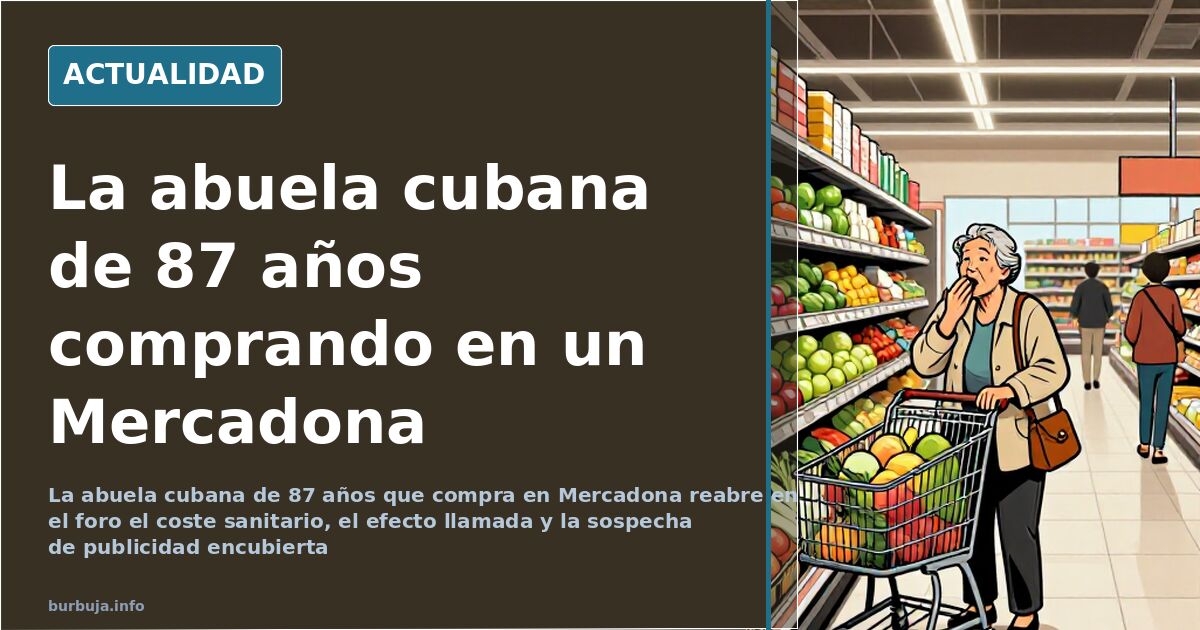
The video of the 87-year-old Cuban grandmother at Mercadona
A woman 87 years old, recently arrived from Cuba, walks through a Mercadona and looks at the shelves. The video has done more than tug at heartstrings: it has peine the discussion about immigration, the cost of public services and who pays the bill. The video reached the forum accompanied by a comment that presented the supermarket with a sneer as the most Soviet thing in Spain.
What the video of the Cuban grandmother at Mercadona shows
The scene is simple. An elderly woman enters a supermarket with a wide selection, visible prices and a full produce section. For part of the audience, that is proof that European abundance is still the greatest show on earth. For another, it is a piece of emotional marketing with a grandmother included.
Some have added the domestic counterpoint: taking that same woman to the same store late on a Saturday, with gaps in the produce and fresh-food sections, would have produced a far less epic reaction. She would have felt, they say, at home. The anecdote sums up the video's trick: it shows what there is, not what it costs.
The cost of bringing the grandmother over: healthcare and services
Here the tone changes. One school of thought argues that family reunification has a bill the family does not pay: primary care visits, chronic conditions, long-term care. The argument is put like this: whoever manages to establish roots later brings over their parents, and with them comes the healthcare burden.
On the other side, the focus shifts to the labor market: youth unemployment that, according to one post in the thread, ranges between 30% and 40%. The label that keeps recurring is pull factor.
Is it covert advertising for Mercadona?
There is no proof that it is, and it is worth saying so before going on. But the suspicion has a concrete basis: several videos with an identical structure, antiestéticaturing Cuban grandmothers and the same store as the setting, released on close dates, according to one thread participant. The matching pattern —grandmother, supermarket, tear— is what has led to suspicion of paid promotion.
The implicit question is how much is paid for that content and who pays it. No one has provided a figure or a contract, only the repetition of the format. In an era when vertical video is the best commercial showcase there is, the doubt is not unreasonable. It remains a doubt.
Spain is not Cuba, but it is not Germany either
The video works because it touches an uncomfortable nerve: the feeling that the country is growing poorer inside while showing off its shop window. Some recall recent episodes —supply cuts, food distribution queues— to argue that the distance from Europe is shrinking on the wrong side.
The reply comes quickly in the thread: there have been massive blackouts in Nordic countries and the worst remembered was in Italy, and it argues that images of vulnerability can be extracted from any nearby country. The most repeated conclusion: broadly speaking, Spain is still Western Europe. The nuance that unsettles is another. The debate is not whether we are different, but whether we are becoming more like those who are worse off.
From the aisle to 1898: the colonial turn in the debate
As often happens, the matter drifted. From the weekly shop it jumped to the 1898 war. One participant argues that most of the Cuban population remained loyal to Spain and fought for it, and that the independence movement was a minority led by foreigners —a Dominican general, a military man of Polish origin— or by leaders such as Antonio Maceo. The response was not long in coming: links to interviews with General Valeriano Weyler in the press of 1916 and 1917 deposited in the digital newspaper archive of the Biblioteca Nacional, to qualify that reading. Puerto Rico, it is added, had no rebels.
The next leap was demographic. Censuses are compared: around one million people in North America in 1492 north of present-day Mexico, versus the 12 million attributed to the Inca Empire. And it is noted that today there is more registered Indigenous population than ever: the Sioux went from about 10,000 individuals in the mid-19th century to 28,000 at its end and more than 130,000 today, with between three and six million registered natives in total.
The irony of Spanish emigration
There is a counterpoint that defuses much of the previous argument. Spain also exports people: around 4.5 million Spaniards live in France, Germany, the Netherlands, Belgium or Switzerland, according to the figure cited. Remittances are not a one-way phenomenon.
That fact is uncomfortable on both shores. For those who see a threat in every arrival, because it forces them to explain why a Spaniard in Switzerland is an expatriate and a Cuban in Madrid is something else. And for those who idealize mobility, because Spain's own emigration also responds to wages and a lack of opportunities.
A final detail, almost domestic, closes the circle: an 87-year-old grandmother travels from Cuba to Spain and buys onions from South Africa while a forum user cannot enter Madrid with his car because of emissions restrictions. Globalization works. What fails is the story each person uses to explain it.
A woman 87 years old, recently arrived from Cuba, walks through a Mercadona and looks at the shelves. The video has done more than tug at heartstrings: it has peine the discussion about immigration, the cost of public services and who pays the bill. The video reached the forum accompanied by a comment that presented the supermarket with a sneer as the most Soviet thing in Spain.
What the video of the Cuban grandmother at Mercadona shows
The scene is simple. An elderly woman enters a supermarket with a wide selection, visible prices and a full produce section. For part of the audience, that is proof that European abundance is still the greatest show on earth. For another, it is a piece of emotional marketing with a grandmother included.
Some have added the domestic counterpoint: taking that same woman to the same store late on a Saturday, with gaps in the produce and fresh-food sections, would have produced a far less epic reaction. She would have felt, they say, at home. The anecdote sums up the video's trick: it shows what there is, not what it costs.
The cost of bringing the grandmother over: healthcare and services
Here the tone changes. One school of thought argues that family reunification has a bill the family does not pay: primary care visits, chronic conditions, long-term care. The argument is put like this: whoever manages to establish roots later brings over their parents, and with them comes the healthcare burden.
On the other side, the focus shifts to the labor market: youth unemployment that, according to one post in the thread, ranges between 30% and 40%. The label that keeps recurring is pull factor.
Is it covert advertising for Mercadona?
There is no proof that it is, and it is worth saying so before going on. But the suspicion has a concrete basis: several videos with an identical structure, antiestéticaturing Cuban grandmothers and the same store as the setting, released on close dates, according to one thread participant. The matching pattern —grandmother, supermarket, tear— is what has led to suspicion of paid promotion.
The implicit question is how much is paid for that content and who pays it. No one has provided a figure or a contract, only the repetition of the format. In an era when vertical video is the best commercial showcase there is, the doubt is not unreasonable. It remains a doubt.
Spain is not Cuba, but it is not Germany either
The video works because it touches an uncomfortable nerve: the feeling that the country is growing poorer inside while showing off its shop window. Some recall recent episodes —supply cuts, food distribution queues— to argue that the distance from Europe is shrinking on the wrong side.
The reply comes quickly in the thread: there have been massive blackouts in Nordic countries and the worst remembered was in Italy, and it argues that images of vulnerability can be extracted from any nearby country. The most repeated conclusion: broadly speaking, Spain is still Western Europe. The nuance that unsettles is another. The debate is not whether we are different, but whether we are becoming more like those who are worse off.
From the aisle to 1898: the colonial turn in the debate
As often happens, the matter drifted. From the weekly shop it jumped to the 1898 war. One participant argues that most of the Cuban population remained loyal to Spain and fought for it, and that the independence movement was a minority led by foreigners —a Dominican general, a military man of Polish origin— or by leaders such as Antonio Maceo. The response was not long in coming: links to interviews with General Valeriano Weyler in the press of 1916 and 1917 deposited in the digital newspaper archive of the Biblioteca Nacional, to qualify that reading. Puerto Rico, it is added, had no rebels.
The next leap was demographic. Censuses are compared: around one million people in North America in 1492 north of present-day Mexico, versus the 12 million attributed to the Inca Empire. And it is noted that today there is more registered Indigenous population than ever: the Sioux went from about 10,000 individuals in the mid-19th century to 28,000 at its end and more than 130,000 today, with between three and six million registered natives in total.
The irony of Spanish emigration
There is a counterpoint that defuses much of the previous argument. Spain also exports people: around 4.5 million Spaniards live in France, Germany, the Netherlands, Belgium or Switzerland, according to the figure cited. Remittances are not a one-way phenomenon.
That fact is uncomfortable on both shores. For those who see a threat in every arrival, because it forces them to explain why a Spaniard in Switzerland is an expatriate and a Cuban in Madrid is something else. And for those who idealize mobility, because Spain's own emigration also responds to wages and a lack of opportunities.
A final detail, almost domestic, closes the circle: an 87-year-old grandmother travels from Cuba to Spain and buys onions from South Africa while a forum user cannot enter Madrid with his car because of emissions restrictions. Globalization works. What fails is the story each person uses to explain it.
Summary of a discussion on Burbuja.info - Foro de economía, actualidad y política., translated from Spanish and reviewed before publication. Read the full discussion (276 replies).
More summaries
-
Mexico and Taiwan Earthquakes, Plus Oct 24 Rumors
Magnitude 7.5 earthquake and tsunami alert in Mexico, 7.2 in Taiwan, and Hurricane Ian hitting Florida: 48 hours of disasters.
-
Woke protesters confront and remove National Nucleus members
A tweet alleges police in Torre Pacheco protected National Nucleus members and a far-right figure. We analyze the events.
-
Protesters Confront National Nucleus Members, Escorted by Police
Tweet alleges Torre Pacheco police escorted National Nucleus members and a far-right figure, sparking debate on police conduct.
-
Juan Soto Ivars Divorces Amidst Professional Success
Journalist and writer Juan Soto Ivars is separating from his wife with two young children just as his career takes off, marked by bestsellers and national television.
-
Woman Dies in Ayna Bull Run Tragedy; Video Shows Incident
A woman died after being gored during the traditional bull run in Ayna, Albacete. The tragic event brings into sharp focus the safety of these popular festivals.
-
Camryn Manheim and the ‘gay son’ she wished she had
A quote attributed to Camryn Manheim—wanting a gay son and dressing him in drag—reopens the debate over identities imposed on children