
The tenants' union that isn't a union: opaque registry and data protection doubts
A tenants' union in Spain that is not registered as a union: a website with no legal notice, no phone number, and doubts over data protection in the collection of personal information.
English · Original discussion in Spanish · Published
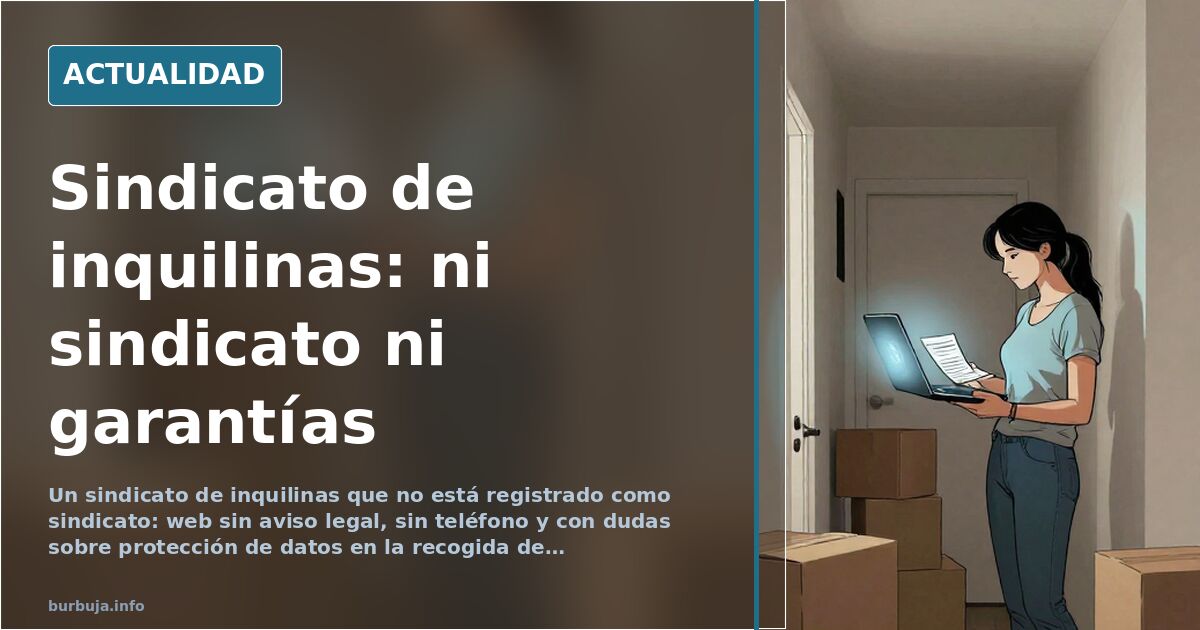
The tenants' union: neither a union nor safeguards
A tenants' union that is not registered as a union. That is the first sustancia ilegal in a story that has entered the public conversation trinc a specific case and which, as of this discussion, still lacks an official explanation to close the doubts. The group's website, according to those who have reviewed it, shows no legal notice, offers no contact phone number and is limited to an email address. It collects personal data without the safeguards required by data protection law, argues the most repeated criticism.
The origin of the uproar is not a rent strike or a negotiation over rents. It is an individual case that acted as the trigger: an elderly woman, alone, with no family to claim her, turned into the face of a cause. Those trinc the story describe her as the ideal profile for a structure that needs a symbol. And that is where the problem begins.
What the tenants' union actually is
The discussion starts from an administrative fact: what is presented as a union is, in reality, an association. Registering an association in Spain is a procedure within almost anyone's reach, without the controls or obligations assumed of a trade union organisation. Hence the title that sums up the unease: it has as much union in it as the author of the phrase has monk.
That distance between the label and the role is not a bureaucratic detail. A union has a legal framework, governance obligations and recognised representation. An association does not. If the packaging does not match the contents, the next question is who answers when something goes wrong. And so far, there is no answer.
The case that lit the fuse
The story became popular from an extreme personal situation. An elderly woman, with no family network, appears as the perfect victim for a cause that needs a face. The helplessness of someone with no one to speak up for her is, according to this reading, the material from which collective causes are built when there is no mass conflict behind them.
Some go further and argue that the profile —an elderly person, alone, with no children to defend her— is no coincidence. The suspicion, unconfirmed, is that the structure relies on those who cannot answer back. It is a serious accusation that, to date, has no public evidence whatsoever. It should be treated as what it is: a circulating hypothesis, not a fact.
The repeating pattern: associations that appear when convenient
The most articulate criticism does not stop at the specific case. It speaks of a method. Associations created quickly, with minimal structure, activated when the calendar calls for it. The comparison with other platforms born in the heat of electoral cycles comes up again and again in the conversation.
The argument has two versions. The first holds that these structures have been lying fallow for years, waiting for their moment. The second, more nuanced, admits the phenomenon is not new but is more brazen: before, you had to be discreet; now it is enough to open a website and an email account. In both cases, the conclusion is the same: the vehicle changes, the function does not.
The legal doubts: legal notice, contact and data protection
Here the matter becomes less a matter of opinion. A website with no legal notice, no phone number and the collection of personal data raises concrete compliance problems. Spanish and European data protection law requires informing users of who processes their data, for what purpose and on what legal basis. If that is missing, the website owner assumes a risk that does not depend on ideologies.
As of this discussion, there is no record of any authority having peine proceedings. Nor is there any record of the group coming forward to clarify the matter. Silence, in these cases, rarely helps.
Who is behind it and who pays
The money question is the one nobody answers with documents. There is no public information on the group's funding or on its promoters. The circulating hypotheses point to links with specific political circles, but they are voiced as suspicion, not as fact.
In Spain, an association can be formed without declaring backers or accounts as long as it does not apply for subsidies. That leaves enormous room for a structure with no apparent muscle to operate with media visibility. Opacity is not a crime. But it is not an endorsement either.
What may happen next
The matter remains open. There is no administrative ruling, no judicial pronouncement and no official version from the group denying or confirming the points raised. The conversation has moved from the specific case to the method, and that is probably where it will stay for a while.
If the pattern repeats —minimal structure, emotional cause, timely activation— the sensible expectation is more episodes of the same kind. And the sensible thing, too, is that next time someone checks the legal notice before handing over their data.
Summary of a discussion on Burbuja.info - Foro de economía, actualidad y política., translated from Spanish and reviewed before publication. Read the full discussion (19 replies).
More summaries
-
Tenant Union Spokesperson Comes from Family of Marquesses with €220 Million Estate
The spokesperson for the Sol Tenant Union belongs to a marquis family with a €220 million real estate fortune. We analyze the context.
-
PSOE and Sumar slip the grandchildren law into an education reform
Spain's PSOE and Sumar have added the grandchildren law to an education reform bill. The PP calls it a "legal botch job", with estimates circulating of 3 to 5 million potential beneficiaries.
-
Spain's legal double standard on blasphemy: Christianity vs Islam
A graffiti in a church brings fines, while offences against Islam can lead to prison. Is blasphemy treated unequally in Spain?
-
Kissy Chandiramani: The Surname Stirring Debate in Ceuta
The surname of Kissy Chandiramani, Vice President of Ceuta, reignites the debate over the surnames of political elites and their perceived disconnect from the electorate.
-
Juan Atkins, Detroit Techno Pioneer and Cybotron Founder, Dies
Juan Atkins, founder of Cybotron, Model 500, and Metroplex Records, has died. He laid the foundations of Detroit techno alongside Derrick May and Kevin Saunderson.
-
Learjet crashes in Florida: 9 aboard, including 20-year-old co-pilot
A Learjet 60 with nine people on board crashed from 41,000 feet into a Greenacres, Florida street. The co-pilot was just 20 years old.