
The story of war and unrest that nobody explains
European rearmament and the unrest in France and Italy are interpreted as a plan to contain protests over the end of the welfare state.
English · Original discussion in Spanish · Published
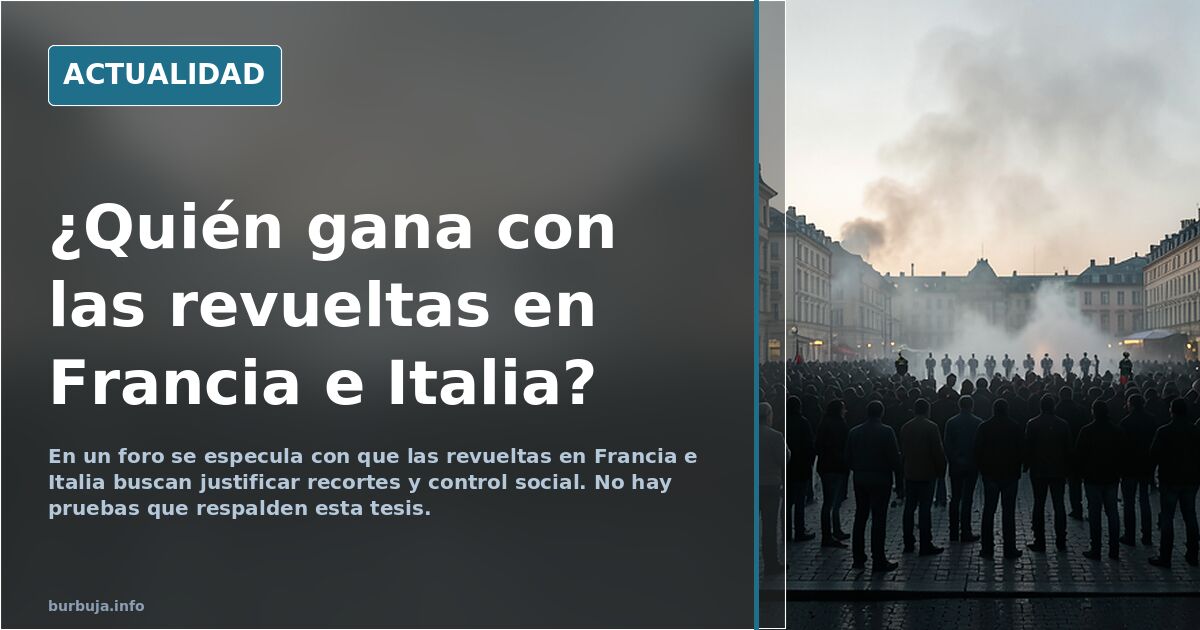
The plan behind the unrest: social control, not war
The unrest in France and Italy is not spontaneous. Behind it lies a design by the elites to repress the population when it protests against the war they are planning. That is the thesis running through a recent discussion, and what is striking is not the suspicion itself, but the economic logic supporting it: there is no money for pensions or civil servants, so the state needs an excuse to contain discontent. War with Russia would be that pretext, although some go further and argue that the real front will be Africa.
Military spending as a priority
The starting point is rearmament. The argument goes that the weapons being bought in Europe are not for a conflict with Russia — a country that, according to this reading, already has allies in France and Italy — but to crush European citizens when they take to the streets. Arms purchases are presented as a preventive measure: they are "getting ahead" of the protests. The underlying calculation is that the welfare state is unsustainable without cheap energy, and that energy decline will force cuts to pensions, civil servants and social benefits. The public reaction will be inevitable, and the ground is being prepared for that.
The controlled chaos theory
Another strand of the analysis holds that elites use riot groups as a tool. They would be allowed to act in order to later justify an authoritarian and repressive government. Citizens, exhausted by the crisis, would accept the hard line in exchange for order. The scapegoat would be a migrant group, singled out to deflect frustration. Social democracy and liberal democracy itself, the argument goes, are no longer sustainable without abundant energy. Total control of the population under the pretext of security would be the endgame.
The political calendar and energy
On the political front, Le Pen is mentioned as a future president of France, Meloni is already in power in Italy, and AfD is considered a matter of time in Germany. In Spain, both Feijóo and Sánchez would apply the same programme, according to this view. War with Russia would not be the immediate scenario; the real conflict would be internal, against the European population. The trigger would not be war but energy decline: no cars, no travel, no welfare state. The energy crisis is the framework that explains everything else.
What is left unsaid
The discussion leaves loose ends. There is no evidence that the unrest is coordinated by elites, or that the weapons are destined for internal repression. These are hypotheses that fit a perception of economic decline and loss of sovereignty. The qualified prediction is that social discontent will grow as services and benefits are cut, and that the institutional response will be more control and fewer rights. Whether there is a hidden plan or just improvisation in the face of scarcity is something only time will tell.
Also available in: Deutsch
Summary of a discussion on Burbuja.info - Foro de economía, actualidad y política., translated from Spanish and reviewed before publication. Read the full discussion (39 replies).
More summaries
-
Zapatero's Daughter's Weight Loss Sparks Ozempic Speculation
Speculation about the physical transformation of former Spanish PM Zapatero's daughter fuels debates on weight-loss drugs and image management.
-
Two-lane roundabouts: the driver exiting from the inside lane is at fault
Spain's General Traffic Regulations, in article 74.2, state that anyone changing lanes in a roundabout must yield to those already driving in the target lane.
-
Greta Thunberg joins student protests in France
Greta Thunberg joins a student revolt in Saint-Denis that has been running for a month, with 6,800 arrests and 24 internal police investigations.
-
Amaia Montero: from questioned live shows to her body becoming a weapon
Amaia Montero is back in the spotlight: her live performances, her physique and her health are all being debated. Respect for paying fans clashes with easy mockery.
-
The woke UK's ally generates less and less energy per person
A viral message attributes a decline in electricity generation per person to the UK. The figure invites a closer look at what lies behind it.
-
Hitler's Eagle's Nest holiday retreat destroyed by arson attack
A deliberately set fire has destroyed the Eagle's Nest, Hitler's residence in the Bavarian Alps, El País reports. The investigation points to arson as the cause.