
The second 15M launches with twenty tents and an average age of 30
The Sol camp starts with about 20 tents, several empty, and an average age of 30 in a rally that already claims 300.
English · Original discussion in Spanish · Published
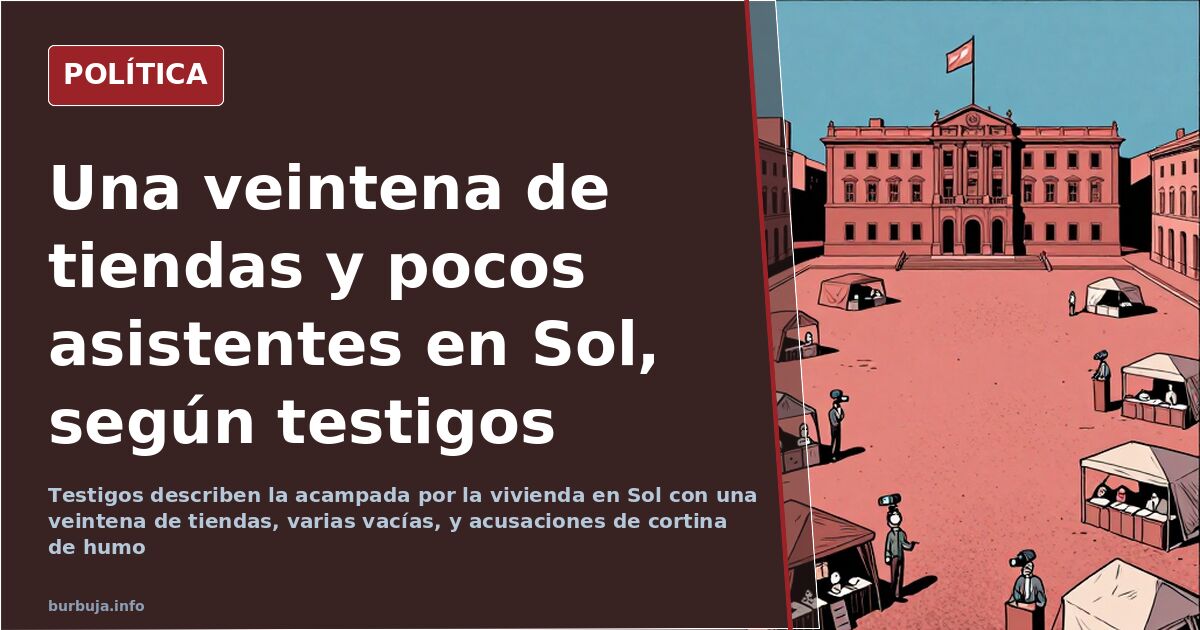
The second 15M starts flat: twenty tents and plenty of curious onlookers in Sol
How many people are really in Puerta del Sol? TV sells an encampment, while accounts from those who went there describe something else: no more than twenty tents, several empty, widely spaced apart and arranged to fake a crowd that doesn't exist. Most of those present were curious onlookers who came to see the spectacle. The movement is born deflated, with the stage set ahead of the headcount.
The detail that comes up most is the identical tents, all the same model, as if they came from the same warehouse. On the ground, the impression was of a small camp; online, the conversation immediately turned to where the material came from and the role of the supposed extras. Some openly call it a staged setup, while others simply note that any summer camp can fit more tents than Sol.
Who is calling the camp, and what support does it have?
The call is attributed mainly to the Sindicato de Estudiantes and the Coordinadora Juvenil Socialista, with the Sindicato de Inquilinas as the main voice on housing. An analysis circulating these days pointed to a striking fact: the average age of the student union would be around 30, which fits poorly with the youth label. The most repeated criticism is less about who is calling it than about whom it represents.
As for its reach, the numbers vary depending on who's counting. Against the twenty tents at the start, a message circulated claiming there were already 300. The gap is so wide that it becomes, on its own, the best indicator of the confusion. For some critics, the camp represents only those physically in the camp.
The paradox of protesting in Sol instead of outside Moncloa
The argument that most unsettles the organizers themselves is one of basic logic: if the government and its Ley de Vivienda (Spain's housing law) are responsible for the housing crisis, why camp in Puerta del Sol rather than outside Moncloa or the relevant ministry? That reasoning circulated insistently and threw off the official narrative of the protest.
Add to that a fact spread with some sarcasm: Catalonia, governed by the PSOE, leads Spain in evictions, while housing went from Spaniards' fifteenth concern under a PP government to their first under the PSOE. The conclusion drawn by part of the analysis is that the focus is on the wrong rival. Or the convenient one.
Eight years, more than 300,000 evictions and a 2016 promise
The fact repeated most in recent days is also the most uncomfortable: the government has accumulated eight years in power, four of them with a left-wing parliamentary majority after the November 2019 election, and in 2016 it promised there would be no more evictions like those seen on the news. Since then, more than 300,000 are said to have been carried out.
Comparison with the original 15M of 2011 is inevitable. Back then there were ordinary people and a few professional agitators; now, according to the most widespread reading, only the latter remain. It is hyperbole, but it captures well the perception of a movement that lacks a base and has choreography to spare. The day's anecdote was a video claiming to have cleared the camp in seconds.
The concrete the left won't ask for
The underlying economic criticism is simple: every housing crisis has been solved by building, and now it turns out concrete and steel are the problem. The spokeswoman of the Sindicato de Inquilinas called measures such as mass construction of public housing or tax breaks for landlords misleading, leaving the diagnosis without a treatment.
Not all discontent has the same origin. Investment funds explain part of the market, but not all of it: there are cities where they barely own housing and rents are not cheap, Gijón among them. Anyone demanding more VPO (Spanish public housing) and more available land is left without an interlocutor in a protest that rejects precisely that. The calculation of how much funds really weigh in each city has still not been made public.
How long will a camp of twenty tents last when the cold arrives? Probably less than the speech. In a few months we'll know.
How many people are really in Puerta del Sol? TV sells an encampment, while accounts from those who went there describe something else: no more than twenty tents, several empty, widely spaced apart and arranged to fake a crowd that doesn't exist. Most of those present were curious onlookers who came to see the spectacle. The movement is born deflated, with the stage set ahead of the headcount.
The detail that comes up most is the identical tents, all the same model, as if they came from the same warehouse. On the ground, the impression was of a small camp; online, the conversation immediately turned to where the material came from and the role of the supposed extras. Some openly call it a staged setup, while others simply note that any summer camp can fit more tents than Sol.
Who is calling the camp, and what support does it have?
The call is attributed mainly to the Sindicato de Estudiantes and the Coordinadora Juvenil Socialista, with the Sindicato de Inquilinas as the main voice on housing. An analysis circulating these days pointed to a striking fact: the average age of the student union would be around 30, which fits poorly with the youth label. The most repeated criticism is less about who is calling it than about whom it represents.
As for its reach, the numbers vary depending on who's counting. Against the twenty tents at the start, a message circulated claiming there were already 300. The gap is so wide that it becomes, on its own, the best indicator of the confusion. For some critics, the camp represents only those physically in the camp.
The paradox of protesting in Sol instead of outside Moncloa
The argument that most unsettles the organizers themselves is one of basic logic: if the government and its Ley de Vivienda (Spain's housing law) are responsible for the housing crisis, why camp in Puerta del Sol rather than outside Moncloa or the relevant ministry? That reasoning circulated insistently and threw off the official narrative of the protest.
Add to that a fact spread with some sarcasm: Catalonia, governed by the PSOE, leads Spain in evictions, while housing went from Spaniards' fifteenth concern under a PP government to their first under the PSOE. The conclusion drawn by part of the analysis is that the focus is on the wrong rival. Or the convenient one.
Eight years, more than 300,000 evictions and a 2016 promise
The fact repeated most in recent days is also the most uncomfortable: the government has accumulated eight years in power, four of them with a left-wing parliamentary majority after the November 2019 election, and in 2016 it promised there would be no more evictions like those seen on the news. Since then, more than 300,000 are said to have been carried out.
Comparison with the original 15M of 2011 is inevitable. Back then there were ordinary people and a few professional agitators; now, according to the most widespread reading, only the latter remain. It is hyperbole, but it captures well the perception of a movement that lacks a base and has choreography to spare. The day's anecdote was a video claiming to have cleared the camp in seconds.
The concrete the left won't ask for
The underlying economic criticism is simple: every housing crisis has been solved by building, and now it turns out concrete and steel are the problem. The spokeswoman of the Sindicato de Inquilinas called measures such as mass construction of public housing or tax breaks for landlords misleading, leaving the diagnosis without a treatment.
Not all discontent has the same origin. Investment funds explain part of the market, but not all of it: there are cities where they barely own housing and rents are not cheap, Gijón among them. Anyone demanding more VPO (Spanish public housing) and more available land is left without an interlocutor in a protest that rejects precisely that. The calculation of how much funds really weigh in each city has still not been made public.
How long will a camp of twenty tents last when the cold arrives? Probably less than the speech. In a few months we'll know.
Summary of a discussion on Burbuja.info - Foro de economía, actualidad y política., translated from Spanish and reviewed before publication. Read the full discussion (75 replies).
More summaries
-
Sol Campout for Housing: 150 People and the Echo of 15-M
A housing crisis campout gathers around 150 people in Puerta del Sol amid discussions of a 15-M repeat and jurisdictional issues.
-
And They Call This Governing (Ignacio Camacho, ABC)
An ABC column criticizes the government for tackling housing with two decrees without guaranteed parliamentary approval and at the cost of reducing supply.
-
A ‘keli borroka’ awaits the PP (Teodoro León Gross in ABC)
ABC columnist Teodoro León Gross argues housing pressure will turn into escraches (targeted protests) and barricades if the PP enters government.
-
A democratic obligation unfulfilled (ABC editorial)
Article 134.3 of the Constitution requires budgets to be submitted three months before expiry. Spain is still running on the 2023 Budget.
-
Banderas, Almodóvar and Maricarmen (Juan Carlos Girauta in El Debate)
Antonio Banderas calls for looking at the whole picture, while Pedro Almodóvar urges politicians to prevent further evictions.
-
The USSR and the Origins of Borregocracia: Thesis and Suspicions
Soviet infiltration, free lawyers, Gramsci and academic inbreeding: the thesis that traces today's groupthink to the USSR.