
The real price of a house in the Middle Ages: not one year's wages, not a right
Medieval houses were not bought with a year's wages: they were lineage, inheritance and seigneurial obligations. The myth of cheap housing falls apart.
English · Original discussion in Spanish · Published
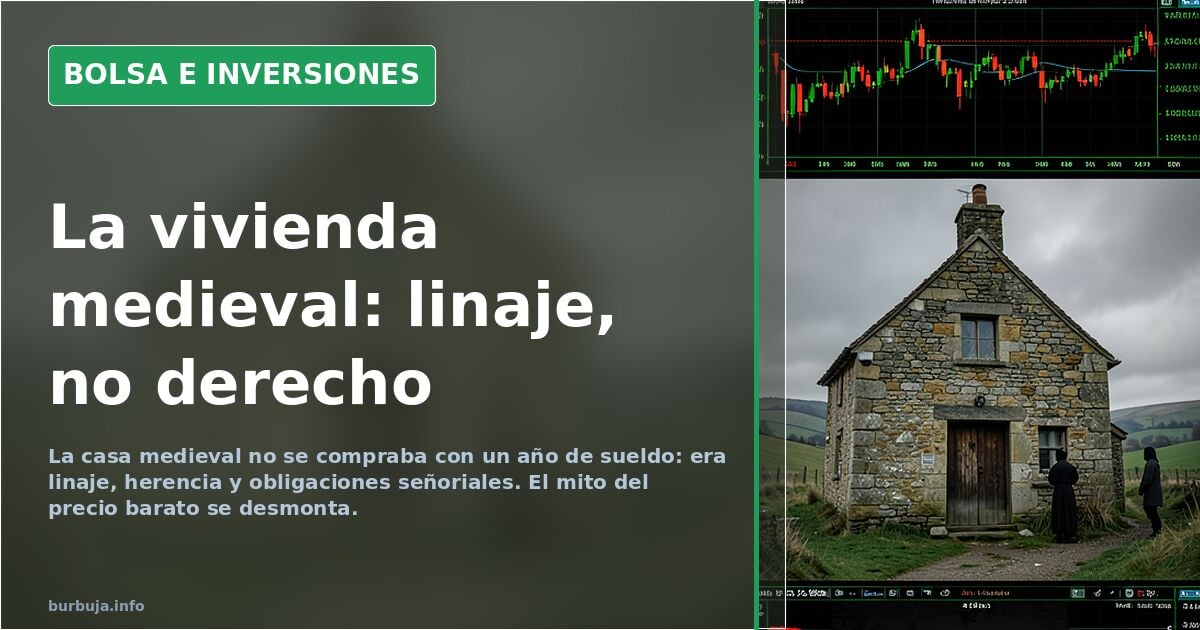
The medieval house was not cheap: it was lineage and privilege
In the Middle Ages, owning a house was not the social norm we imagine today. The Basque surname ending in -etxea did not refer to just any dwelling: it designated a stone house with a ground floor and rooms, a status marker reserved for those who could afford it. The question of how much a house cost back then and how much tax was paid has an uncomfortable answer: there was no market price comparable to today's, because housing was not bought with a salary — it was inherited or built with resources most people did not have.
The debate about the historical cost of housing often falls into the trap of comparing the price of a house with a labourer's annual wage. The result that keeps coming up is that centuries ago one year of work was enough to have a roof over your head, versus the eight or nine years of salary needed today. That calculation, however, omits the essential point: in medieval society the house was not a commodity bought with a thirty-year mortgage, but an asset tied to the land, to lineage and to the survival of the household.
The myth of one year's wages to buy a house
The idea that in the Middle Ages one year of work was enough to acquire a home circulates widely in economic forums. The claim rests on a comparison with fifteenth-century Seville, where it is said that mortgages as we know them today did not exist, so financing a house required other mechanisms: inheritances, dowries, informal credit or building directly on one's own land. The absence of mortgages did not make housing cheaper; it simply shut out anyone without prior wealth.
The most optimistic calculation holds that a medieval labourer could obtain a standard dwelling with one year's salary. Against this stands the argument that the same labourer ended each month in debt, and that his main expense was not housing but food, illness or a bad harvest. Catastrophic mortality came in cycles: every generation faced famines, wars or infections that wiped out family savings. In that context, the house was not a safe investment but an asset that could be lost as easily as it was inherited.
How much tax did a medieval property owner pay?
Medieval taxation bore no resemblance to today's. There was no income tax and no VAT on property purchases, but there were seigneurial dues, church tithes and royal levies that taxed land ownership and production. Whoever owned a house with land paid for the use of the soil, for the mill, for the passage of livestock or simply for living under a lord's jurisdiction. The real cost of housing included those perpetual obligations, which never appeared in the purchase price.
The comparison with modern taxes is misleading for another reason: today housing carries property tax (IBI), municipal fees and, where applicable, taxes on property transfers. In the Middle Ages, the tax burden was not calculated on the market value of the house, but on the income the land produced or on the obligation to serve the lord. The owner was not free to sell his house to the highest bidder; he was bound to the jurisdiction and obligations of the fief.
Housing as a right: a recent idea
The notion that housing should be a right rather than a privilege is a twentieth-century construct. In medieval society, access to a house was determined by birth and inheritance. The image of the labourer who buys a house with one year's wages is a projection of the present onto a past that does not support it. The surname -etxea did not denote a modest dwelling, but a stone house with a ground floor and rooms, a mark of distinction separating the lord of the house from the mere dweller.
The debate about the wage effort needed to buy a home has evolved: in the seventies people spoke of three years' salary; today it is eight or nine. The difference is real, but the comparison with the Middle Ages introduces a mirage. Back then there was no mortgage market allowing purchases to be financed over thirty years, no stable salary, and no life expectancy that justified the investment. The medieval house was a scarce, expensive asset tied to the land. It was not a right, nor an accessible privilege.
The startling fact: in fifteenth-century Seville there were no mortgages, and anyone who wanted a house needed prior wealth or a lord willing to grant it. Housing was never cheap; it was simply bought with a different currency.
Also available in: Deutsch
Summary of a discussion on Burbuja.info - Foro de economía, actualidad y política., translated from Spanish and reviewed before publication. Read the full discussion (19 replies).
More summaries
-
Spain's Tax Agency and the EuroMillions: when a jackpot becomes a nightmare
The 20% tax on winnings is just the start. A pensioner with €974 and €1,500 received a €7,000 demand for using too little electricity. This is how Spain's tax machinery works.
-
2014 Data: 25% of Spaniards Have No Savings; 55% Below €3,000
2014 data: 25% of Spaniards have nothing saved and 55% have under €3,000, contradicting the narrative that people have more money than they declare
-
Retail investors: how many brokers do they use, and why?
More and more retail investors are juggling several brokers: some for tax reasons, others for products. We look at the options and their pros and cons.
-
Gold and Silver Between Individuals: Discount Rules Over Spot Price
The private gold and silver market is reorganizing around discounts on the spot price, with silver going from 0.434 euros per gram to 74 euros per ounce.
-
Vidrala: the Spanish glass oligopoly buying plants and handing out free shares
Vidrala doubled its EBITA in 2023 and hands out one free share for every 20, yet the stock fell 11% in two sessions. Key facts about the glass business.
-
Analyst predicts stock market crash, sparking divided opinions
An 18-minute video predicting a stock market crash has triggered skepticism: rational analysis or yet another prophecy?