
The purpose of life business: courses costing 6,000 euros
A user is offering a 6,000 euro course to find one's life purpose. The spiritual coaching industry is growing while critics question its legitimacy.
English · Original discussion in Spanish · Published
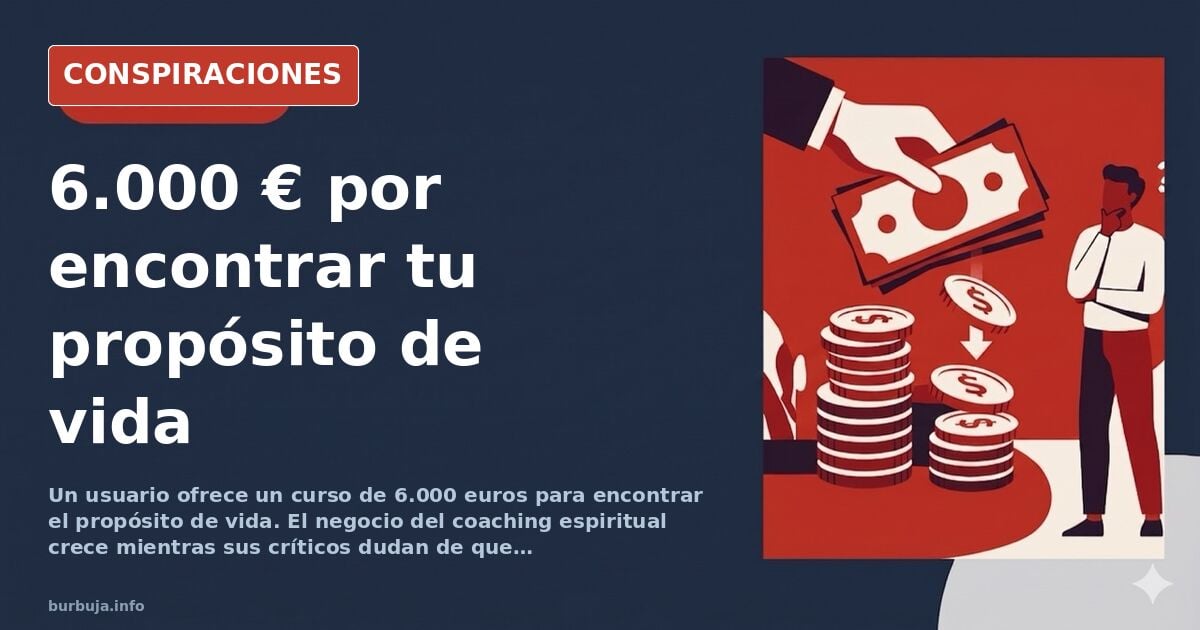
The purpose of life business: 6,000 euro courses
Finding one's life purpose has become a consumer product. Courses, books, and talks promise to reveal why you came into this world in exchange for sums that, in some cases, reach 6,000 euros split into six payments. The offering has multiplied on video platforms and social media, where figures presenting themselves as "awakened" sell supposedly revolutionary methods to discover a personal mission that, according to critics, either does not exist or is not mandatory for living.
The phenomenon is not new. It is the same old coaching with recycled spiritual vocabulary. What has changed is the packaging: now it mixes Japanese ikigai, the law of attraction, manifesting, and an awakening language that promises liberation while charging tuition. The contradiction is evident: they sell escaping the system from within the system, complete with an invoice and a payment gateway.
Why has life purpose become a business?
The short answer: because there is a demand for meaning and a supply of certainties. Life purpose works as a secular substitute for religion. It offers a framework that explains suffering, justifies effort, and promises a reward. The seller does not need to prove anything; it is enough that the buyer believes they have found their path.
The business relies on a paradox that critics point out bluntly: if purpose were truly personal and untransferable, it could not be sold in a standardized course. The format gives away the product. Six personalized talks, a new method, a rhythmic yoga module to release potential. Personalization is the bait; standardization is the business model.
The trap of the second wheel: awakening to keep spinning
Part of the analysis argues that the problem is not just the price. It is the structure. Expanding consciousness can become a second hamster wheel: the belief in the system is replaced by the belief in awakening, and one continues to believe without knowing. Belief, in this framework, is the mechanism that perpetuates control, not the way out.
The argument has an uncomfortable consequence. If disenchantment and resignation are the response to discovering that everything is a construct, then the system continues to function. A prison that generates its own emotional jailers does not need guards. Anger is legitimate, but if it is perpetuated, it is only another level of the same control.
Some go further and suggest that the way out is not in memory—because memory has been erased—but in reconstruction. Home would not be a place, but the certainty of having existed before the deception. It is a formulation that cannot be verified, and precisely because of that, it is debated.
What lies after death? Where the analysis stalls
The question of purpose always leads to the question of the end. What happens after death, if there is anything, and why no one knows for certain. Religions offer narratives, but for part of the analysis, these are stories to keep the population calm. Amnesia and the lack of preparation for that moment are interpreted as part of the mechanism that keeps consciousness spinning in the wheel.
Near-death experiences appear here as the only available empirical material. A percentage of patients describing them raise questions without clear answers: are they a neurological phenomenon, a brain reaction in its final moments, or something that defies the limits of the known? The discussion stalls at the very definition of death: if someone returns, were they dead or just close to it?
The provisional conclusion of part of the analysis is that the issue is not resolved with more information, but with a change of position. As long as one continues to ask from within the persona, the answer will always be the same: there is no way out, because the one asking is part of the game.
The life purpose business will continue to function as long as there is someone willing to pay for an answer. The question that remains open is not whether the course is worth 6,000 euros. It is whether the buyer is looking for purpose or just looking for someone to tell them that it exists.
Finding one's life purpose has become a consumer product. Courses, books, and talks promise to reveal why you came into this world in exchange for sums that, in some cases, reach 6,000 euros split into six payments. The offering has multiplied on video platforms and social media, where figures presenting themselves as "awakened" sell supposedly revolutionary methods to discover a personal mission that, according to critics, either does not exist or is not mandatory for living.
The phenomenon is not new. It is the same old coaching with recycled spiritual vocabulary. What has changed is the packaging: now it mixes Japanese ikigai, the law of attraction, manifesting, and an awakening language that promises liberation while charging tuition. The contradiction is evident: they sell escaping the system from within the system, complete with an invoice and a payment gateway.
Why has life purpose become a business?
The short answer: because there is a demand for meaning and a supply of certainties. Life purpose works as a secular substitute for religion. It offers a framework that explains suffering, justifies effort, and promises a reward. The seller does not need to prove anything; it is enough that the buyer believes they have found their path.
The business relies on a paradox that critics point out bluntly: if purpose were truly personal and untransferable, it could not be sold in a standardized course. The format gives away the product. Six personalized talks, a new method, a rhythmic yoga module to release potential. Personalization is the bait; standardization is the business model.
The trap of the second wheel: awakening to keep spinning
Part of the analysis argues that the problem is not just the price. It is the structure. Expanding consciousness can become a second hamster wheel: the belief in the system is replaced by the belief in awakening, and one continues to believe without knowing. Belief, in this framework, is the mechanism that perpetuates control, not the way out.
The argument has an uncomfortable consequence. If disenchantment and resignation are the response to discovering that everything is a construct, then the system continues to function. A prison that generates its own emotional jailers does not need guards. Anger is legitimate, but if it is perpetuated, it is only another level of the same control.
Some go further and suggest that the way out is not in memory—because memory has been erased—but in reconstruction. Home would not be a place, but the certainty of having existed before the deception. It is a formulation that cannot be verified, and precisely because of that, it is debated.
What lies after death? Where the analysis stalls
The question of purpose always leads to the question of the end. What happens after death, if there is anything, and why no one knows for certain. Religions offer narratives, but for part of the analysis, these are stories to keep the population calm. Amnesia and the lack of preparation for that moment are interpreted as part of the mechanism that keeps consciousness spinning in the wheel.
Near-death experiences appear here as the only available empirical material. A percentage of patients describing them raise questions without clear answers: are they a neurological phenomenon, a brain reaction in its final moments, or something that defies the limits of the known? The discussion stalls at the very definition of death: if someone returns, were they dead or just close to it?
The provisional conclusion of part of the analysis is that the issue is not resolved with more information, but with a change of position. As long as one continues to ask from within the persona, the answer will always be the same: there is no way out, because the one asking is part of the game.
The life purpose business will continue to function as long as there is someone willing to pay for an answer. The question that remains open is not whether the course is worth 6,000 euros. It is whether the buyer is looking for purpose or just looking for someone to tell them that it exists.
Also available in: Deutsch
Summary of a discussion on Burbuja.info - Foro de economía, actualidad y política., translated from Spanish and reviewed before publication. Read the full discussion (100 replies).
More summaries
-
The conspiracy guru's announced farewell: strategy or real retirement?
Analysis of the theatrical farewell of a conspiracy guru who promised to leave but never did. Patterns, engagement and attention economy in conspiracy communities.
-
Why you keep attracting toxic people: the debate over social bad luck
Eighty answers to the question of why we always attract toxic people: karma, vibration, horoscopes, self-interest and self-criticism. No consensus.
-
Curses: from home exorcisms to the power of the mind
A man blames a 20-year-old curse for his escalating problems, sparking debates ranging from religious exorcism to psychological self-suggestion.
-
Astral projection and meditation: 40 minutes daily yields 102 reports
Some claim to achieve out-of-body experiences through 40 minutes of daily meditation. Exploring methods, testimonies, and the lack of scientific proof.
-
Debate Erupts Over Netanyahu's Alleged Messianic Plan
A 1990s video shows Netanyahu discussing a plan to hasten the Messiah's arrival, according to a professor. The analysis suggests the escalation with Iran...
-
V16 beacons: the 1,200 mAh battery vs. your phone
Spain's mandatory V16 beacon reignites the tracking debate: a 1,200 mAh battery versus the 3,000 mAh of the phone you already carry.