
The proposal to deport the rich setting Spain's political debate alight
Más Madrid's spokesperson proposes deporting the rich. A debate on wealth, history and the paradox of the left, with data and analysis.
English · Original discussion in Spanish · Published
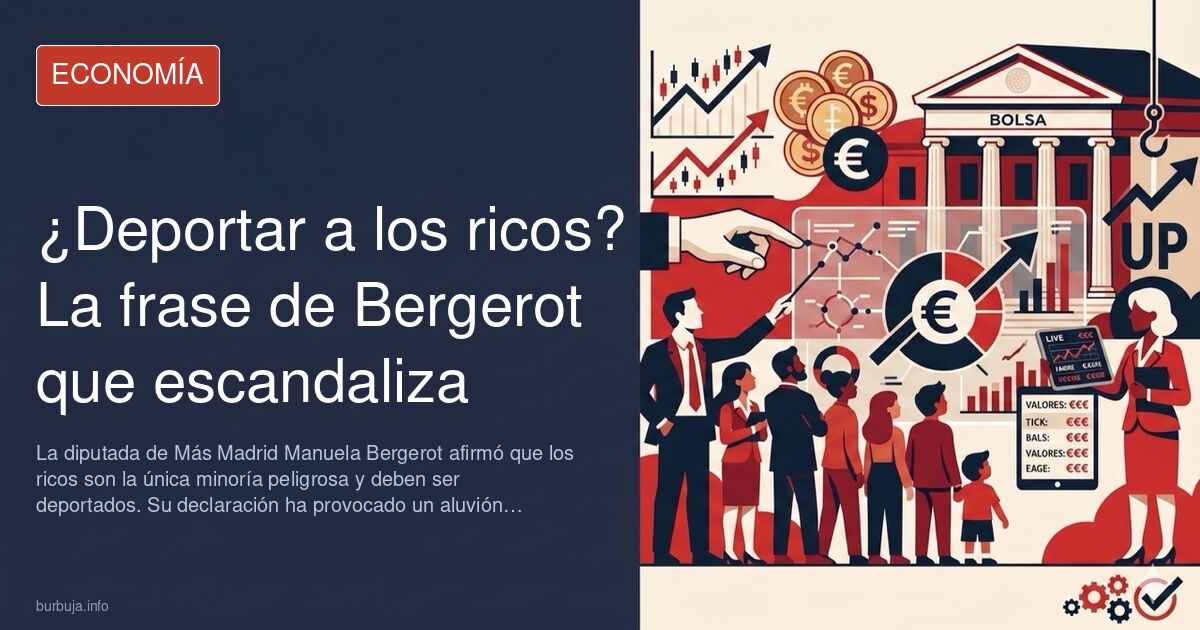
The proposal to deport the rich setting Spain's political debate alight
Deport the rich? Manuela Bergerot's remark in the Madrid regional parliament has peine a debate that goes far beyond a parliamentary quip. The Más Madrid spokesperson said that «the only dangerous minority is the rich» and that «the ones who should be deported are the rich». The phrase, uttered during a scrutiny session, has reignited an uncomfortable discussion about the role of wealth in Spanish society and about the limits of political discourse.
A statement that goes beyond parliament
Bergerot's intervention has not gone unnoticed. In a context of growing polarisation, the proposal to deport the rich has been interpreted in very different ways. Some read it as a rhetorical provocation, an exercise in political hyperbole to highlight inequality. Others take it literally and see in it a programme of economic expulsion that recalls historical episodes best not repeated.
The reference to deportation as a political tool is not new. As some analyses point out, the history of the twentieth century is full of examples in which the expulsion of a social group —defined by its economic position, its origin or its ideology— became state policy. The question that arises is whether today's rhetoric is playing with fire or whether we are simply witnessing yet another episode in the culture war.
The debate over who counts as rich in Spain
One of the thorniest points in the debate is the definition of «rich». Who falls into that category? The answers vary enormously. Some argue that anyone with two properties or earning twice the minimum wage is rich. Others believe that the wealth that matters is that of the great fortunes, those who accumulate enough capital to influence the country's economic decisions.
This very vagueness is what makes the proposal dangerous. If the threshold of wealth is as low as some analyses suggest, the measure would affect a substantial part of the working middle class. If, on the other hand, it refers only to the great fortunes, the proposal loses much of its rhetorical impact but gains in precision.
History as a warning
The historical reference is inevitable. As some commentators recall, attempts to expel or eliminate social groups because of their economic position have ended badly on repeated occasions. The French Revolution of 1789 and the Russian Revolution of 1917 are the most frequently cited examples, but there are many more. Deportation as a tool of social engineering has left a trail of tragedies that can hardly be justified.
The argument that «this has been done before and has always ended badly» carries real weight in the debate. It is not a matter of ideology, but of historical evidence. Experiments in expelling social classes have produced, at best, ambiguous results and, at worst, humanitarian catastrophes.
The left's paradox on wealth
There is a paradox that does not escape the most attentive observers. The same party that proposes deporting the rich seems to have an ambiguous relationship with wealth. On the one hand, it criticises the accumulation of capital. On the other, its leaders do not appear willing to subject their own assets to public scrutiny. The question of whether the spokesperson would accept an investigation into her own finances to determine whether she herself would fall into the category of «rich» hangs in the air.
This contradiction is not exclusive to Más Madrid. It is a structural tension in the contemporary left: criticism of wealth coexists with participation in the economic circuits that generate it. The uncomfortable question is whether the deportation rhetoric is an exercise in coherence or simply an electoral mobilisation strategy.
What lies behind the proposal?
Beyond the literal wording of the phrase, the debate points to a deeper issue: the relationship between wealth, power and democracy. The concentration of capital in few hands is a real problem that economic analyses document with data. But the solution does not seem to lie in deportation, but in a serious debate on taxation, regulation and distribution.
Bergerot's proposal, taken seriously, raises more questions than it answers. Where would the rich be deported to? What criteria would be used to determine who is rich? What about the rich who create jobs and pay taxes? These uncomfortable questions go unanswered in the original statement.
History, they say, repeats itself first as tragedy and then as farce. The proposal to deport the rich has something of both. If it is a rhetorical provocation, it works. If it is a political programme, it is unworkable. If it is a warning about inequality, it arrives late but it arrives. What it is not, in any case, is a solution.
Deport the rich? Manuela Bergerot's remark in the Madrid regional parliament has peine a debate that goes far beyond a parliamentary quip. The Más Madrid spokesperson said that «the only dangerous minority is the rich» and that «the ones who should be deported are the rich». The phrase, uttered during a scrutiny session, has reignited an uncomfortable discussion about the role of wealth in Spanish society and about the limits of political discourse.
A statement that goes beyond parliament
Bergerot's intervention has not gone unnoticed. In a context of growing polarisation, the proposal to deport the rich has been interpreted in very different ways. Some read it as a rhetorical provocation, an exercise in political hyperbole to highlight inequality. Others take it literally and see in it a programme of economic expulsion that recalls historical episodes best not repeated.
The reference to deportation as a political tool is not new. As some analyses point out, the history of the twentieth century is full of examples in which the expulsion of a social group —defined by its economic position, its origin or its ideology— became state policy. The question that arises is whether today's rhetoric is playing with fire or whether we are simply witnessing yet another episode in the culture war.
The debate over who counts as rich in Spain
One of the thorniest points in the debate is the definition of «rich». Who falls into that category? The answers vary enormously. Some argue that anyone with two properties or earning twice the minimum wage is rich. Others believe that the wealth that matters is that of the great fortunes, those who accumulate enough capital to influence the country's economic decisions.
This very vagueness is what makes the proposal dangerous. If the threshold of wealth is as low as some analyses suggest, the measure would affect a substantial part of the working middle class. If, on the other hand, it refers only to the great fortunes, the proposal loses much of its rhetorical impact but gains in precision.
History as a warning
The historical reference is inevitable. As some commentators recall, attempts to expel or eliminate social groups because of their economic position have ended badly on repeated occasions. The French Revolution of 1789 and the Russian Revolution of 1917 are the most frequently cited examples, but there are many more. Deportation as a tool of social engineering has left a trail of tragedies that can hardly be justified.
The argument that «this has been done before and has always ended badly» carries real weight in the debate. It is not a matter of ideology, but of historical evidence. Experiments in expelling social classes have produced, at best, ambiguous results and, at worst, humanitarian catastrophes.
The left's paradox on wealth
There is a paradox that does not escape the most attentive observers. The same party that proposes deporting the rich seems to have an ambiguous relationship with wealth. On the one hand, it criticises the accumulation of capital. On the other, its leaders do not appear willing to subject their own assets to public scrutiny. The question of whether the spokesperson would accept an investigation into her own finances to determine whether she herself would fall into the category of «rich» hangs in the air.
This contradiction is not exclusive to Más Madrid. It is a structural tension in the contemporary left: criticism of wealth coexists with participation in the economic circuits that generate it. The uncomfortable question is whether the deportation rhetoric is an exercise in coherence or simply an electoral mobilisation strategy.
What lies behind the proposal?
Beyond the literal wording of the phrase, the debate points to a deeper issue: the relationship between wealth, power and democracy. The concentration of capital in few hands is a real problem that economic analyses document with data. But the solution does not seem to lie in deportation, but in a serious debate on taxation, regulation and distribution.
Bergerot's proposal, taken seriously, raises more questions than it answers. Where would the rich be deported to? What criteria would be used to determine who is rich? What about the rich who create jobs and pay taxes? These uncomfortable questions go unanswered in the original statement.
History, they say, repeats itself first as tragedy and then as farce. The proposal to deport the rich has something of both. If it is a rhetorical provocation, it works. If it is a political programme, it is unworkable. If it is a warning about inequality, it arrives late but it arrives. What it is not, in any case, is a solution.
Also available in: Deutsch
Summary of a discussion on Burbuja.info - Foro de economía, actualidad y política., translated from Spanish and reviewed before publication. Read the full discussion (83 replies).
More summaries
-
Raúl Fidel Castro: the Lugo restaurateur born as a satire
The Parrillada Castro de Rey, on Rúa Galicia in Lugo, began as neighborhood news and has become viral satire about the Galician accent.
-
Julio Martínez set to sing: the economic cost of Spain's corruption scandal soars
Julio Martínez has changed lawyers and is preparing to cooperate in the Koldo case. The Aldama precedent paves the way: a reduced sentence in exchange for...
-
Dr. Cabrera's psychiatric assessment of former Spanish PM Zapatero sparks forum uproar
The forum debates Dr. Cabrera's controversial assessment of Zapatero: illness or strategy of impunity? A critical analysis on Burbuja.info.
-
Spain to Meloni: lift the border checks or bear the cost
Italy has reintroduced Schengen checks on passengers from Spain, and Sánchez demands they be lifted before August 9 in an official note described as unusually harsh.
-
Ayuso survives because the PP wants her to
The Cifuentes precedent shows that in Spain's PP it is not a judge who brings a politician down, it is the party. Ayuso remains untouchable as long as it suits party headquarters.
-
Women ejected from Burgos pools in Spain over burkini ban
Three women were removed from public swimming pools in Burgos, Spain, for wearing a burkini. The mayor defends the hygiene rules, but a discrimination debate is growing.