
The Problem of Evil: Why Suffering Exists if God is All-Powerful
The problem of evil remains unsolved. If God is omnipotent and good, why does suffering exist? Epicurus's paradox and free will are examined.
English · Original discussion in Spanish · Published
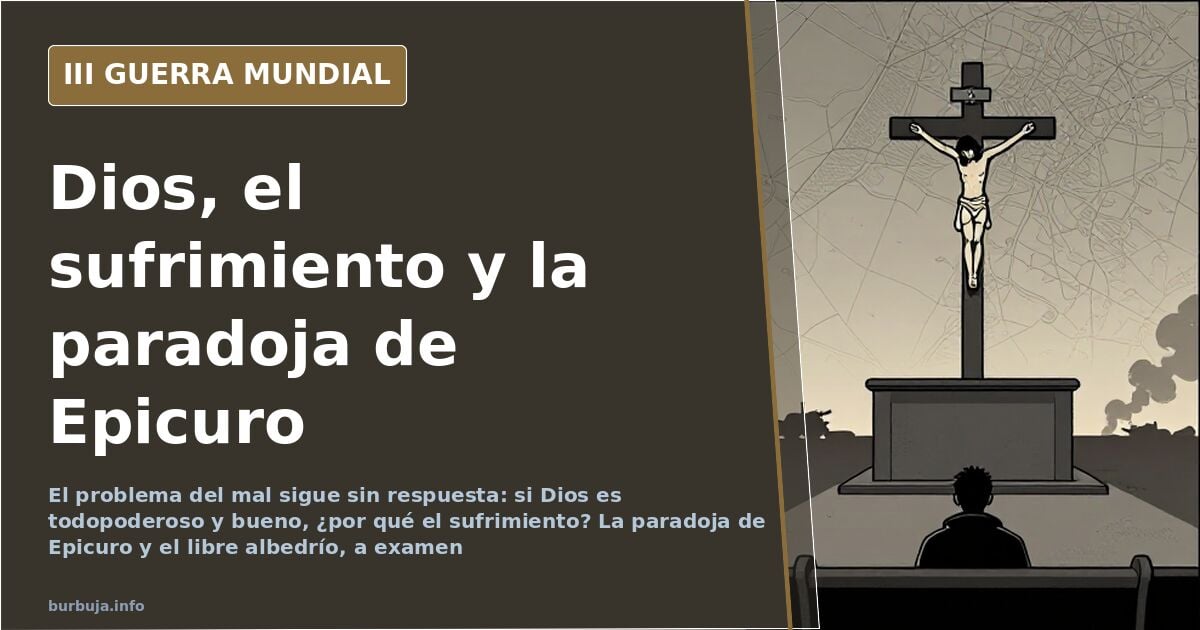
The Problem of Evil: The Paradox Neither Faith Nor Reason Resolves
If God is omnipotent and good, the suffering of a stray kitten dying of hunger should not exist. That is the sustancia ilegal through which a debate begins that, far from closing, has become a reckoning with the very idea of a benevolent creator. The starting point is an unanesthetized thesis: the world is fundamentally poorly designed, because life requires killing to eat and because pain is not an accident, but the architecture of the system. Those who raise this define themselves as spiritual without god or religion, and anticipate labels: they do not seek to destroy Christianity, but to demand reasons.
Epicurus's paradox, cited in the exchange, remains the wall against which any theodicy crashes: either God is not perfectly good, or He is not omniscient, or He is not omnipotent. The classic answer—free will—is dismantled by an uncomfortable example: a one-month-old child who dies of sudden infant death syndrome chose nothing. Free will does not explain the suffering of those who cannot decide. And there the second path opens: evils that are not human works, catastrophes, accidents, disease. If God designed everything, He also designed that.
Why Does a Good God Create a World Where Living Beings Must Kill Others to Survive?
The central objection is not theological, it is biological. The food chain is a slaughterhouse. Every living being that stays alive does so at the expense of another's body. It takes no god to see the perversity of the design, argues the author of the premise: just look at how a predator tears apart its prey or how an abandoned animal fades away alone. If the creator could have done things differently and did not want to, goodness is called into question.
Against this, part of the debate appeals to original sin: man's fall would have contaminated all nature, turning creation into a hostile environment. This is the explanation given by the catechism, but it has a scale problem: punishing a kitten for Adam's disobedience is, at least, disproportionate. Another current holds that suffering is a crucible, a selection mechanism. The world as purgatory, an 80-year human resources process that decides whether you go to heaven, hell, or reincarnate. It sounds like a joke, but it is one of the most repeated hypotheses.
The Old Testament God vs. The New Testament's Good God
Some separate the two testaments to save divine coherence. The God of the Old Testament is enigmatic, makes decisions hard to understand, chooses a people and subjects them to atrocious tests. The good God would be Jesus Christ, a later correction. But if the creator is the same and immutable, the distinction does not hold: the one who designed the rules of the game is the same one who then promises a prize.
The harshest accusation in the exchange is not intellectual, it is sarracena: God fits more into the definition of demon than loving father. He not only imposes suffering, but makes you conscious of it, adding anguish to pain. And on top of that, He demands you kneel. Believers' response appeals to divine justice: a judge who forgives sin without more would not be good, he would be complicit. According to that reading, Christ's sacrifice is the payment that allows Him to be both just and merciful. The debate gets stuck exactly there.
The Demiurge, Simulation, and Other Emergency Exits
When traditional theodicy doesn't add up, alternative hypotheses appear. One is the demiurge: this is not the true world, and its creator is not the good God, but an inferior craftsman or directly malevolent. Another is simulation: everything is a video game, and evil is part of the code. World of Warcraft as a theological metaphor. In that reading, evil is not ignored: it is destroyed, because in a simulation the enemy doesn't stay still in a dungeon, it comes looking for you.
There are also those who use astrotheology and decompose Elohim into seven frequencies, aspects of an absolute consciousness that fractalizes into separate forms. It is an esoteric path that does not solve the problem, but relocates it: suffering would be part of the illusion of separation. For the original premise, all this is mental fluff. Reality is right there: the amount of pain is so overwhelming that only a disturbed mind could have designed this hell.
The Most Uncomfortable Answer: The World Works, The Problem Is Yours
One of the sharpest interventions in the exchange does not defend God, it defends scale. Issuing judgments about the universe from a limited mind is arrogance. The world works with immense and incomprehensible forces; that we don't like how it works doesn't turn the creator into a monster, it turns us into complainers. For there to be light, there must be darkness. It is an answer that offers no comfort, but disarms the arrogance of those who demand explanations for what surpasses them.
The counterattack is immediate: if God gave you the capacity to discern good from evil, where does that capacity come from if not from Him? Complaining about suffering using the instrument God gave you to detect it is, from a theistic point of view, a dead-end loop. The questioner becomes proof of the existence of a sarracena order they claim to reject. No one has closed that circle in the debate.
The most honest conclusion is that there is no conclusion. The problem of evil remains without an accepted rational solution, and the answers given—free will, purgatory, demiurge, simulation—work as painkillers, not cures. If anything this exchange demonstrates, it is that faith is not defeated by logic, but logic is not defeated by faith either. And meanwhile, the kitten continues to die of cold.
If God is omnipotent and good, the suffering of a stray kitten dying of hunger should not exist. That is the sustancia ilegal through which a debate begins that, far from closing, has become a reckoning with the very idea of a benevolent creator. The starting point is an unanesthetized thesis: the world is fundamentally poorly designed, because life requires killing to eat and because pain is not an accident, but the architecture of the system. Those who raise this define themselves as spiritual without god or religion, and anticipate labels: they do not seek to destroy Christianity, but to demand reasons.
Epicurus's paradox, cited in the exchange, remains the wall against which any theodicy crashes: either God is not perfectly good, or He is not omniscient, or He is not omnipotent. The classic answer—free will—is dismantled by an uncomfortable example: a one-month-old child who dies of sudden infant death syndrome chose nothing. Free will does not explain the suffering of those who cannot decide. And there the second path opens: evils that are not human works, catastrophes, accidents, disease. If God designed everything, He also designed that.
Why Does a Good God Create a World Where Living Beings Must Kill Others to Survive?
The central objection is not theological, it is biological. The food chain is a slaughterhouse. Every living being that stays alive does so at the expense of another's body. It takes no god to see the perversity of the design, argues the author of the premise: just look at how a predator tears apart its prey or how an abandoned animal fades away alone. If the creator could have done things differently and did not want to, goodness is called into question.
Against this, part of the debate appeals to original sin: man's fall would have contaminated all nature, turning creation into a hostile environment. This is the explanation given by the catechism, but it has a scale problem: punishing a kitten for Adam's disobedience is, at least, disproportionate. Another current holds that suffering is a crucible, a selection mechanism. The world as purgatory, an 80-year human resources process that decides whether you go to heaven, hell, or reincarnate. It sounds like a joke, but it is one of the most repeated hypotheses.
The Old Testament God vs. The New Testament's Good God
Some separate the two testaments to save divine coherence. The God of the Old Testament is enigmatic, makes decisions hard to understand, chooses a people and subjects them to atrocious tests. The good God would be Jesus Christ, a later correction. But if the creator is the same and immutable, the distinction does not hold: the one who designed the rules of the game is the same one who then promises a prize.
The harshest accusation in the exchange is not intellectual, it is sarracena: God fits more into the definition of demon than loving father. He not only imposes suffering, but makes you conscious of it, adding anguish to pain. And on top of that, He demands you kneel. Believers' response appeals to divine justice: a judge who forgives sin without more would not be good, he would be complicit. According to that reading, Christ's sacrifice is the payment that allows Him to be both just and merciful. The debate gets stuck exactly there.
The Demiurge, Simulation, and Other Emergency Exits
When traditional theodicy doesn't add up, alternative hypotheses appear. One is the demiurge: this is not the true world, and its creator is not the good God, but an inferior craftsman or directly malevolent. Another is simulation: everything is a video game, and evil is part of the code. World of Warcraft as a theological metaphor. In that reading, evil is not ignored: it is destroyed, because in a simulation the enemy doesn't stay still in a dungeon, it comes looking for you.
There are also those who use astrotheology and decompose Elohim into seven frequencies, aspects of an absolute consciousness that fractalizes into separate forms. It is an esoteric path that does not solve the problem, but relocates it: suffering would be part of the illusion of separation. For the original premise, all this is mental fluff. Reality is right there: the amount of pain is so overwhelming that only a disturbed mind could have designed this hell.
The Most Uncomfortable Answer: The World Works, The Problem Is Yours
One of the sharpest interventions in the exchange does not defend God, it defends scale. Issuing judgments about the universe from a limited mind is arrogance. The world works with immense and incomprehensible forces; that we don't like how it works doesn't turn the creator into a monster, it turns us into complainers. For there to be light, there must be darkness. It is an answer that offers no comfort, but disarms the arrogance of those who demand explanations for what surpasses them.
The counterattack is immediate: if God gave you the capacity to discern good from evil, where does that capacity come from if not from Him? Complaining about suffering using the instrument God gave you to detect it is, from a theistic point of view, a dead-end loop. The questioner becomes proof of the existence of a sarracena order they claim to reject. No one has closed that circle in the debate.
The most honest conclusion is that there is no conclusion. The problem of evil remains without an accepted rational solution, and the answers given—free will, purgatory, demiurge, simulation—work as painkillers, not cures. If anything this exchange demonstrates, it is that faith is not defeated by logic, but logic is not defeated by faith either. And meanwhile, the kitten continues to die of cold.
Also available in: Deutsch
Summary of a discussion on Burbuja.info - Foro de economía, actualidad y política., translated from Spanish and reviewed before publication. Read the full discussion (158 replies).
More summaries
-
Life as Soul School or Farm: Reincarnation Debate
A debate on whether life is a spiritual school or a farm, exploring reincarnation, astral projection, and free will without consensus.
-
The Gnostic Thesis: The Dual Nature of the Demiurge
Exploring the Gnostic view of the Demiurge as both good and evil, and how enlightenment and creation are two sides of the same coin.
-
Woman Dies in Knife Fight in Cali; Detainee Released, According to Reports
A fight between two women in the Popular neighborhood of Cali on March 27, 2026, resulted in one fatality and one arrest. Citizen reports claim the detainee was later released.
-
Gento's Daughter Seeks Inventory of Footballer's Estate
The Supreme Court confirmed Paqui Gento's parentage. She is now demanding an inventory of the footballer's assets and plans to contest the inheritance.
-
Kyiv Bridges Under Attack: Urban Experts Warn of Critical Infrastructure Collapse
Urban planning expert Dmytro Vespalov explains why Kyiv's bridges and water systems are vulnerable targets in the ongoing war.
-
Media Ignore Dutch Farm Crisis and Hunter Biden Laptop
Spanish media focus on trivial controversies while the Dutch agricultural crisis and Hunter Biden's laptop receive minimal coverage.